

SMB IT security ROI measurement is the process of quantifying the financial value of security investments by calculating losses avoided and risks reduced relative to their costs. The formal industry term for this is Return on Security Investment, or ROSI. Most small and medium business owners never calculate it. They spend on firewalls, endpoint protection, and employee training, then struggle to explain why at budget time. That gap costs real money. 68% of SMB decision-makers are confident in their attack prevention, yet 50% report experiencing a data breach in the past year. Confidence without measurement is not a strategy.
What is the ROSI formula and how does it apply to SMBs?
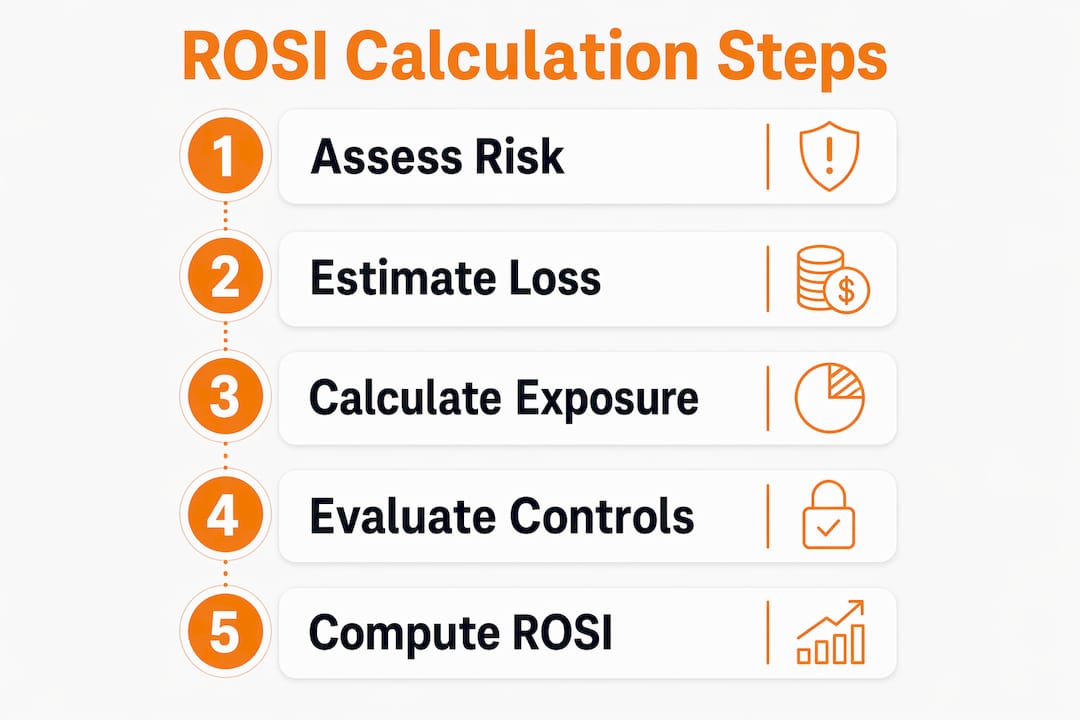
Cybersecurity ROI measures avoided cost and risk reduction rather than revenue generated. That framing matters. You are not selling a product that earns money. You are preventing a loss that would cost money. The ROSI formula captures exactly that.
The formula works like this:
ROSI = (Risk Exposure × Risk Mitigation % − Cost of Security Control) ÷ Cost of Security Control
Three supporting concepts make this formula work:
- Single Loss Expectancy (SLE): The estimated dollar loss from one incident. For a small business, a ransomware attack might cost $50,000 in recovery, legal fees, and downtime.
- Annual Rate of Occurrence (ARO): How often that incident is likely to happen per year. If ransomware hits similar businesses once every two years, your ARO is 0.5.
- Annualized Loss Expectancy (ALE): SLE multiplied by ARO. In this example, ALE = $50,000 × 0.5 = $25,000 per year in expected losses.
Now apply ROSI. Say your endpoint detection and response tool costs $5,000 per year and reduces your ransomware risk by 70%. Your risk reduction value is $25,000 × 0.70 = $17,500. Subtract the $5,000 control cost: $12,500. Divide by $5,000. Your ROSI is 150%. Well-structured security investments can deliver annual returns near 61% by reducing annual loss exposure, which already outperforms the S&P 500 average of 13.6%. A 150% return on a single control is not unusual when the underlying risk is real.
Keep in mind that incident costs include forensic, operational, reputational, legal, and remediation expenses. IBM breach cost data averages around $8 million at enterprise scale. Adjust that figure down for SMB size, and the exposure is still significant enough to justify serious controls.

Pro Tip: Build your ROSI calculation in a simple spreadsheet with columns for SLE, ARO, ALE, control cost, and mitigation percentage. Update it quarterly as your threat environment changes.
What complementary metrics help demonstrate ongoing IT security ROI for SMBs?
ROSI gives you a snapshot. Ongoing metrics tell the full story over time. Five key metrics track security ROI continuously and give leadership something concrete to watch.
- Incident Reduction Rate: The percentage drop in confirmed security incidents quarter over quarter. A 40% reduction in phishing-related incidents after security awareness training is a direct, measurable return on that training investment.
- Mean Time to Detect (MTTD) and Mean Time to Respond (MTTR): How fast your team spots a threat and contains it. Shorter times mean less damage per incident. These numbers translate directly into lower remediation costs.
- Phishing Simulation Click Rate: Run monthly phishing simulations and track how many employees click. A drop from 22% to 6% over two quarters shows your security awareness training is working. That is a measurable behavior change with real financial implications.
- Patch Compliance Rate: The percentage of systems updated within your defined patch window. Unpatched systems are the entry point for most breaches. A rate above 95% signals strong system hygiene and reduces your ALE directly.
- Cyber Insurance Premium Trends: Your insurer prices risk. If your premiums drop or you qualify for better coverage after implementing controls, that is a direct, dollar-denominated return on your security investment.
These metrics work together. No single number tells the whole story. Tracking all five gives you a risk posture narrative that leadership can follow month to month.
What tools and data do you need for accurate IT security ROI analysis?
Accurate measurement starts with the right inputs. Without clean data, your ROSI calculation is a guess. Here is what you need and where to get it.
| Data Input | Source | Why It Matters |
|---|---|---|
| Asset values | IT asset inventory or accounting records | Sets the financial baseline for SLE calculations |
| Exposure factor | Risk assessment or vulnerability analysis | Estimates what percentage of an asset is at risk per incident |
| Incident frequency | Historical logs, SIEM data, or industry benchmarks | Drives your ARO figure |
| Control costs | Vendor invoices, IT labor hours | The denominator in your ROSI formula |
| Compliance scores | Audit reports, CMMC assessments | Validates control effectiveness and supports regulatory justification |
For most SMBs, a spreadsheet is enough to start. You do not need enterprise software. A basic model with five columns and quarterly updates gives you trend data within six months. Free cybersecurity ROI calculators exist online and can accelerate the setup process.
Organizational cybersecurity maturity and data collection sophistication critically impact how trustworthy your ROI numbers are. If you have never run a formal risk assessment, your ALE estimates will be rough. That is fine as a starting point. The goal is to build measurement discipline over time, not to produce a perfect number on day one. A Cybersecurity Maturity Model Certification process can formalize your data collection and give your ROI inputs real credibility.
How do you communicate SMB cybersecurity investment value to decision-makers?
Getting the math right is only half the job. The other half is translating it into language that a CFO or board member will act on. Shifting budget justification from product features to expected loss reduction improves acceptance of cybersecurity budgets. Nobody approves spending based on technical specs. They approve it based on financial exposure.
Here is how to frame the conversation:
- Lead with cost avoidance, not features. “This control reduces our ransomware exposure by $17,500 per year” lands better than “this tool provides endpoint detection and response.”
- Use a traffic light system for risk. Red, yellow, and green indicators for each risk category give non-technical leaders an instant read on your security posture without requiring them to understand the underlying data.
- Reference industry benchmarks. Peer comparisons carry weight. If similar businesses in your sector are experiencing a certain breach rate, your leadership needs to know where you stand relative to that baseline.
- Layer your communication. Boards respond to economic analysis and risk trajectory. Operations teams respond to compliance posture and incident metrics. Use the same data, but frame it differently for each audience.
Security budget requests with stated outcome metrics gain more credibility with CFOs and boards. Come to the meeting with a one-page summary showing current risk exposure, projected exposure after investment, and the ROSI percentage. That format respects their time and answers their core question: is this worth it?
Pro Tip: Present risk trajectory trends over multiple quarters rather than a single ROI figure. Boards respond better to “our incident rate dropped 40% over six months” than to a standalone percentage.
What are the most common mistakes in measuring security ROI for SMBs?
Most SMBs make the same errors. Knowing them in advance saves you months of frustration.
- Measuring the wrong thing. The core difficulty in cybersecurity ROI is that it measures negative events — incidents that did not happen. If you try to show ROI the same way a sales team shows revenue, you will always come up short. Frame every metric as cost avoidance from the start.
- Overcomplicating the formula. Most cybersecurity practitioners do not use the formal ROSI formula in practice because the complexity creates paralysis. A simplified layered approach combining one or two financial metrics with qualitative performance indicators works better for most SMBs.
- Starting without a baseline. If you do not know your incident frequency before a control is deployed, you cannot measure improvement after. Run a vulnerability assessment before any major security investment to establish your starting point.
- Ignoring the Pareto Principle. The 80/20 rule applies directly to security controls. A small number of controls deliver the majority of your risk reduction. Focus your ROI measurement on those high-impact controls first, not on every tool in your stack.
- Collecting data once and stopping. ROI measurement is not a one-time project. It is a quarterly practice. SMB leaders prefer simple ROI communication that connects spending directly to loss reduction over time. That connection only appears when you track consistently.
Key Takeaways
Accurate SMB IT security ROI measurement requires a baseline risk assessment, the ROSI formula applied to your actual asset values, and at least five ongoing performance metrics tracked quarterly to show leadership a clear risk reduction trend.
| Point | Details |
|---|---|
| Use the ROSI formula | Calculate (Risk Exposure × Mitigation % − Control Cost) ÷ Control Cost for each major control. |
| Track five core metrics | Monitor incident rate, MTTD/MTTR, phishing click rate, patch compliance, and insurance premiums. |
| Establish a baseline first | Run a vulnerability assessment before deploying controls so you can measure improvement. |
| Communicate in financial terms | Frame every security metric as cost avoidance, not technical capability, when presenting to leadership. |
| Apply the 80/20 rule | Focus measurement on the controls delivering the most risk reduction, not every tool in your stack. |
Why most SMBs are measuring security ROI the wrong way
I have worked with dozens of SMB owners who could tell me exactly what they spent on cybersecurity but had no idea what it was worth. That is the wrong starting point. The question is never “what did we spend?” It is “what did we avoid losing?”
The shift that changes everything is treating security like an insurance actuary would. You are not buying a product. You are buying a probability reduction. Once you frame it that way, the ROSI formula stops feeling abstract and starts feeling like a basic business calculation. I have seen a single well-framed risk reduction conversation change a CFO’s entire posture toward the security budget.
The other thing I have learned is that trend data beats point-in-time numbers every time. A board that sees your phishing click rate drop from 22% to 6% over two quarters understands the value of training without needing to understand the underlying technology. That is the narrative you want to build. Not a single ROI figure, but a story of improving risk posture with real numbers attached.
Start simple. Build the spreadsheet. Run the quarterly numbers. The credibility compounds over time.
— Alden
How Totalcyber helps SMBs get real returns from security spending
Knowing the formula is one thing. Having the data, the tools, and the expertise to run it accurately is another. Totalcyber works with small and medium businesses to build the measurement infrastructure that makes IT security ROI real and defensible. From managed cybersecurity services that generate the incident data you need for ROSI calculations, to vulnerability assessments that establish your risk baseline, Totalcyber provides the operational foundation that turns security spending into a documented business case. If you are ready to stop guessing at your security value and start measuring it, Totalcyber is the team to call.
FAQ
What does ROSI stand for in cybersecurity?
ROSI stands for Return on Security Investment. It measures the financial return of a security control by comparing the risk reduction value it delivers against its cost.
How do SMBs calculate annualized loss expectancy?
Annualized Loss Expectancy equals Single Loss Expectancy multiplied by Annual Rate of Occurrence. For example, a $50,000 incident with a 0.5 annual probability produces an ALE of $25,000.
What is a good ROSI percentage for an SMB?
Any positive ROSI indicates a net financial benefit from a security control. Well-structured investments can deliver returns near 61% annually, which outperforms most traditional financial benchmarks.
Why is measuring cybersecurity ROI difficult for small businesses?
The core challenge is that cybersecurity ROI measures incidents that did not happen, making it an avoidance-based calculation rather than a revenue-based one. Without a pre-investment baseline, there is nothing to compare against.
How often should SMBs review their security ROI metrics?
Quarterly reviews give you enough data to identify trends without creating measurement fatigue. Tracking five core metrics, including incident rate and patch compliance, on a quarterly cadence builds a credible risk posture narrative over time.
Recommended
- 2022 ISC2 Cybersecurity Workforce Report | Total Cyber Solutions
- Why It’s Time for Businesses to Adopt Managed IT Services | Total Cyber Solutions
- tcs-links | Total Cyber Solutions
- Dangers of Shadow IT | Total Cyber Solutions