

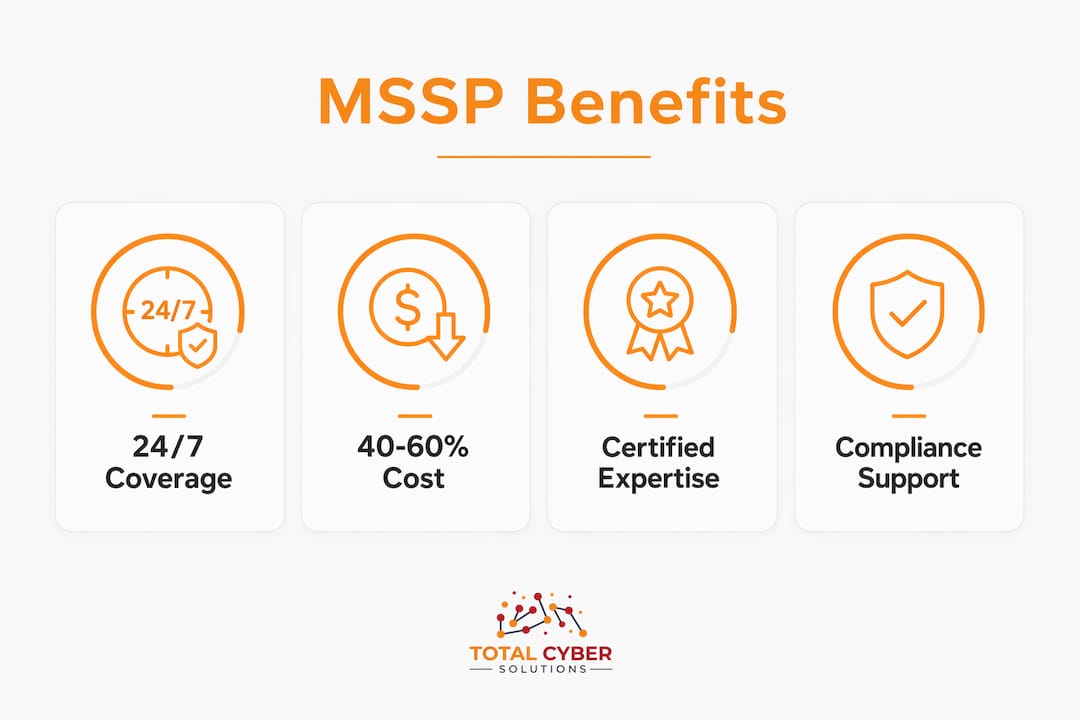
Most SMBs should outsource cybersecurity to a managed security service provider (MSSP). Full stop. The immediate wins are real: your business gets 24/7 threat monitoring from day one, access to a team of certified analysts you couldn’t afford to hire, and a predictable monthly cost instead of a surprise six-figure breach bill. For most companies under 200 employees, outsourcing security is the fastest path to meaningful protection.
The three benefits you feel immediately are:
- 24/7 monitoring and response — threats don’t wait for business hours, and neither does your MSSP’s SOC
- Instant access to expertise — CISSP-certified analysts, threat hunters, and incident responders on call without the recruiting process
- Predictable costs — a fixed monthly fee replaces unpredictable incident costs and capital-heavy tooling investments
Pro Tip: Start the conversation with an MSSP before a security incident forces your hand. The best time to onboard is during a calm period — not after a breach. One caveat: most MSSPs cover monitoring and response, but physical security, employee background checks, and application-layer code review typically fall outside standard scope. Clarify those boundaries upfront.
Table of Contents
- What is a managed security service provider and what do they actually do?
- The real managed security services SMB benefits, backed by numbers
- How to evaluate an MSSP: what to look for and what to avoid
- How MSSP pricing works for US SMBs and what ROI looks like
- How Total Cyber Solutions works with SMBs
- What onboarding actually looks like when you integrate an MSSP with your existing IT
- Key Takeaways
- Why the “just hire someone” instinct keeps SMBs exposed
- Totalcyber’s managed cybersecurity services for SMBs
- Useful sources and further reading
What is a managed security service provider and what do they actually do?
An MSSP is a third-party company that monitors, manages, and responds to cybersecurity threats on your behalf, around the clock. Think of them as your outsourced security operations team. They differ from a virtual CISO (vCISO), who provides strategic leadership and policy guidance, and from an in-house team, which you hire, train, and retain yourself. An MSSP handles the operational work: watching your systems, catching threats, and responding fast.
SMB demand for MSSPs has grown sharply, driven by more sophisticated attacks, a persistent cybersecurity talent shortage, and the simple reality that most small IT teams can’t staff a 24/7 security operation alone.
The core services SMBs actually use:
- MDR (Managed Detection and Response) — continuous monitoring plus human-reviewed alert triage and active threat containment
- SOC as a Service — access to a shared security operations center without building your own
- EDR (Endpoint Detection and Response) — agent-based monitoring on laptops, servers, and workstations that catches threats traditional antivirus misses
- Vulnerability management — regular scanning and prioritized remediation guidance, often tied to ISMS vulnerability frameworks
- Managed firewall — configuration, monitoring, and rule updates handled by the provider
- Email security — filtering for phishing, malicious attachments, and business email compromise
- Incident response — documented playbooks and guaranteed response times when something goes wrong
- Compliance reporting — log retention, evidence collection, and audit-ready documentation for PCI DSS, HIPAA, CMMC, and SOC 2
For most SMBs, the right starting point is MDR plus email security. Those two services address the highest-probability attack vectors first.
The real managed security services SMB benefits, backed by numbers
Cost is usually the first question. MSSP partnerships generally cost significantly less than building equivalent in-house security for businesses with fewer than 200 employees. The reason is straightforward: the provider spreads SOC infrastructure, tooling, and staffing costs across hundreds of clients. Premium threat intelligence feeds alone can run $100,000–$300,000 annually for a single organization. Your MSSP absorbs that cost and passes the capability to you at a fraction of the price.
A small-business data breach commonly costs $200,000–$500,000 when you add up downtime, customer notification, legal fees, and remediation. That figure puts even a $3,000/month MSSP engagement in a very different light.
Beyond cost, the business case for outsourcing security rests on five concrete advantages:
- Faster detection and response — MDR services catch early-stage attack behavior before it escalates. Shorter mean time to detect (MTTD) and mean time to respond (MTTR) directly reduce the blast radius of any incident.
- Access to specialized expertise — most SMBs can’t hire a CISSP, a threat hunter, and a compliance analyst simultaneously. An MSSP gives you all three.
- Compliance and insurance readiness — MSSPs generate the log retention, audit trails, and documentation that compliance frameworks like HIPAA, PCI DSS, and CMMC require. Cyber insurers increasingly ask for evidence of 24/7 monitoring and EDR deployment before issuing or renewing policies.
- Scalability — adding endpoints, onboarding a new office, or expanding cloud coverage takes days with an MSSP versus months of hiring.
- Operational maturity — your internal IT team stops getting pulled into security investigations and can focus on the work that moves the business forward.
Pro Tip: For SMBs that also need strategic security leadership, pair a vCISO with your MSSP. The combined vCISO and MSSP model covers both governance and 24/7 operations at a fraction of what a fully staffed in-house team costs.
How to evaluate an MSSP: what to look for and what to avoid

Not every MSSP delivers the same level of coverage. A quality provider shows evidence of operational maturity before you sign anything.
Must-have capabilities:
- 24/7 SOC with human analysts reviewing alerts (not just automated rules)
- EDR deployed on endpoints, not just legacy antivirus
- Centralized SIEM or log aggregation with documented retention periods
- Incident response playbooks and runbooks you can review
- Vulnerability scanning on a defined cadence with prioritized remediation reports
- SLA commitments on MTTD, MTTR, and escalation windows
Questions to ask during evaluation:
- What is your guaranteed response time for a confirmed ransomware event?
- Can I see a sample monthly report and a redacted incident report?
- Which certifications does your SOC staff hold (CISSP, SANS GIAC, CompTIA Security+)?
- Do you have clients in my industry with similar compliance requirements?
- What does your onboarding process look like, and how long until monitoring is live?
Red flags that signal weak coverage:
- No documented SLAs or vague “best effort” language on response times
- Alerts are automated only, with no human review tier
- No EDR deployment, relying solely on firewall logs
- Inability to provide client references or case studies
- Long contract lock-in with no performance exit clause
A provider that can’t answer the SLA question specifically is telling you something important.
How MSSP pricing works for US SMBs and what ROI looks like
MSSP pricing in the US follows a few common models. Per-endpoint or per-user pricing works well for businesses with predictable headcounts. Tiered monthly packages bundle services at fixed price points. Some providers use a flat monthly retainer for a defined scope, with hourly rates for incident response that falls outside normal coverage.
| Tier | Typical Monthly Cost | What’s Usually Included |
|---|---|---|
| Basic endpoint monitoring | $50–$150/endpoint/month | EDR deployment, automated alerting, patch status reporting |
| MDR with SOC | $1,000–$3,000/month | 24/7 human-reviewed monitoring, threat hunting, incident triage |
| Full managed security | $2,500–$8,000/month | MDR, managed firewall, email security, compliance reporting, vCISO hours |
Pricing ranges vary by scope, industry, and provider.
ROI comes from three places: avoided breach costs, reduced cyber insurance premiums, and the operational hours your internal team gets back. Most SMBs reach core monitoring coverage within a few weeks to a couple of months of onboarding, versus many months to hire and tool up an in-house team. That speed-to-value gap is significant when threats are active now.
How Total Cyber Solutions works with SMBs
Totalcyber is a veteran-owned cybersecurity and IT services company built specifically for businesses that need real security without enterprise-level overhead. The engagement model is designed for SMBs: practical, transparent, and integrated with whatever IT infrastructure you already have.
The onboarding process follows a clear sequence. First, a discovery session maps your current environment, existing tools, and the compliance requirements that apply to your business. From there, Totalcyber establishes a risk baseline using a vulnerability assessment and produces a prioritized roadmap. EDR agents and SIEM integration are deployed next, followed by a tuning period to reduce false positives before full monitoring goes live. Reporting cadence, escalation contacts, and SLA terms are confirmed before the engagement moves into steady-state operations.
Typical SMB engagements with Totalcyber include MDR, managed firewall, email security filtering, and compliance documentation support. Cyber awareness training is available as an add-on, which matters because phishing remains the most common entry point for attacks. The team integrates directly with existing MSPs and internal IT staff, handling security operations while your team stays focused on infrastructure and business systems.
Trust signals Totalcyber provides include certified staff (CISSP and SANS-trained analysts), documented SLAs with defined response windows, sample reports available during the sales process, and a SOC cadence that clients can review in monthly briefings.
| Engagement Component | Included | Optional Add-On |
|---|---|---|
| 24/7 MDR with human analysts | Yes | |
| EDR deployment and management | Yes | |
| Managed firewall | Yes | |
| Email security filtering | Yes | |
| Compliance reporting (HIPAA, PCI, CMMC) | Yes | |
| vCISO strategic advisory hours | Yes | |
| Cyber awareness training | Yes | |
| Penetration testing | Yes |
What onboarding actually looks like when you integrate an MSSP with your existing IT
The first two weeks of an MSSP engagement are the most intensive. Your provider needs visibility into your environment before monitoring can be meaningful. That means deploying EDR agents on endpoints, connecting your firewall and email gateway to the SIEM, and establishing log forwarding from cloud services like Microsoft 365 or Google Workspace.

Week one typically covers discovery and access provisioning. Week two focuses on agent deployment and initial log ingestion. By week three, the SOC is reviewing live alerts and tuning detection rules to your environment. False positives drop significantly after the first 30 days as the system learns your normal traffic patterns.
Integration with an existing MSP is straightforward when roles are clearly defined. The MSP handles infrastructure, helpdesk, and device management. The MSSP handles security monitoring, threat detection, and incident response. Those two functions rarely overlap, and a good MSSP will document the handoff points explicitly so there’s no confusion during an actual incident.
For businesses running cloud services, the MSSP extends coverage to cloud workloads, SaaS applications, and identity management. That’s increasingly where attacks start, and it’s coverage most internal IT teams don’t have the tooling to provide on their own.
Key Takeaways
MSSPs give SMBs 24/7 security coverage, certified expertise, and compliance documentation at 40–60% of the cost of building an equivalent in-house team.
| Point | Details |
|---|---|
| Cost advantage is significant | MSSP partnerships cost 40–60% less than in-house equivalents for businesses under 200 employees. |
| Breach costs justify the spend | A small-business breach commonly runs $200,000–$500,000; a monthly MSSP fee is a fraction of that exposure. |
| Speed to coverage matters | Core monitoring goes live in 30–60 days with an MSSP, versus months to hire and tool up internally. |
| Evaluate on SLAs and certifications | Demand documented MTTD/MTTR SLAs, human analyst review, EDR deployment, and CISSP-level staff credentials. |
| Totalcyber fits the SMB model | Totalcyber’s veteran-owned team delivers MDR, managed firewall, compliance support, and managed cybersecurity services sized for small businesses. |
Why the “just hire someone” instinct keeps SMBs exposed
The most common mistake SMB owners make is treating cybersecurity as a staffing problem. Hire one IT person, give them a security title, and assume the gap is closed. It isn’t. A single analyst working business hours can’t monitor 24/7, can’t maintain threat intelligence across hundreds of attack patterns, and can’t staff an incident response at 2 AM on a Saturday. The math doesn’t work, and the risk doesn’t sleep.
What actually works is treating your MSSP as an extension of your team, not a vendor you check in with quarterly. The businesses that get the most value from managed security are the ones that stay engaged: reviewing monthly reports, asking questions, and using the compliance documentation their provider generates. Totalcyber’s veteran-owned background means the team understands operational discipline and clear communication, which matters when you’re integrating with an existing IT setup and need the handoff points to be clean. The model works best when both sides treat it as a partnership.
Totalcyber’s managed cybersecurity services for SMBs
Protecting your business doesn’t require building a security team from scratch. Totalcyber delivers managed cybersecurity services built for SMBs: 24/7 MDR, EDR deployment, managed firewall, email security, and compliance documentation, all under one predictable monthly engagement.
A discovery call with Totalcyber runs 30–60 minutes. You’ll walk away with a clear picture of your current exposure, a scope recommendation, and a pricing estimate tied to your actual environment. No pressure, no vague proposals. Just a practical conversation about what your business needs and what it costs.
Start that conversation here and get your assessment scheduled.
Useful sources and further reading
- AICPA SOC for Service Organizations — the authoritative framework for SOC 2 compliance; relevant when evaluating MSSP audit readiness and trust signals
- Harvard Business Review: AI and Phishing Scams — explains why AI is raising the quality and volume of phishing attacks, a key driver of SMB MSSP adoption
- MSSPProviders.io: MSSP vs. In-House Security — detailed comparison of cost, coverage, and scalability across MSSP and in-house models
- Vanta: MSSP Explained — clear breakdown of MSSP service types, engagement models, and compliance support
- BizTech Magazine: Why MSSPs Are Essential for Small Businesses — covers market drivers and the operational case for SMB outsourcing
- E-Tech: MDR Benefits for SMBs — practical breakdown of MDR value for small and medium businesses
- ISO 27001 for Small Businesses: The Complete 2026 Guide — partner resource explaining ISO 27001 basics and how MSSPs support readiness (partner content)
- Totalcyber: Why Compliance Reduces Cyber Risk for SMBs — explains how documentation and compliance frameworks reduce measurable risk for small businesses
Recommended
- Cloud Security Benefits for Small Businesses: 2026 Guide | Total Cyber Solutions
- The Role of Automated Security Tools for SMBs | Total Cyber Solutions
- IT Security Best Practices for Virginia SMBs: 2026 Guide | Total Cyber Solutions
- SMB IT Security ROI Measurement: A Practical Guide | Total Cyber Solutions