

“DPS engineer” is one of those job titles that means three different things depending on who posted it. Most listings fall into one of two buckets: engineers employed by a firm named DPS (primarily Arcadis DPS Group or DPS Telecom), or Data Protection Services engineers working in IT and cybersecurity. A third meaning, state-level Department of Public Safety agencies, shows up less often but catches candidates off guard.
Before you apply, check these three things:
- Is “DPS” the company name or a role acronym? Arcadis DPS Group and DPS Telecom are employers. “DPS engineer” in an IT job posting usually means Data Protection Services.
- What industry does the posting mention? Life sciences or semiconductors points to Arcadis DPS Group. Telecom alarm systems points to DPS Telecom. Backup, recovery, or cloud resilience points to a cybersecurity context.
- Watch for false matches. Dictionary.com lists DPS as “damage per second” in gaming, and the Cambridge Business English Dictionary defines it as “dividend per share” in finance. Neither is an engineering role.
Table of Contents
- Which DPS employers will you actually find when you search?
- What does a DPS engineer actually do day to day?
- What skills and qualifications do DPS employers actually screen for?
- What salary can you expect as a DPS engineer in the U.S.?
- How do you find DPS jobs and actually get an interview?
- What benefits and culture should you expect?
- If you mean Data Protection Services: how that role works and where Totalcyber fits
- Key Takeaways
- What most candidates get wrong about DPS roles
- Totalcyber covers the DPS-grade capabilities your organization needs
- Useful sources and next places to look
Which DPS employers will you actually find when you search?
The table below covers the four main employer classes. Salary ranges reflect U.S. market estimates based on industry benchmarks; verify current figures with the Bureau of Labor Statistics or LinkedIn Salary.
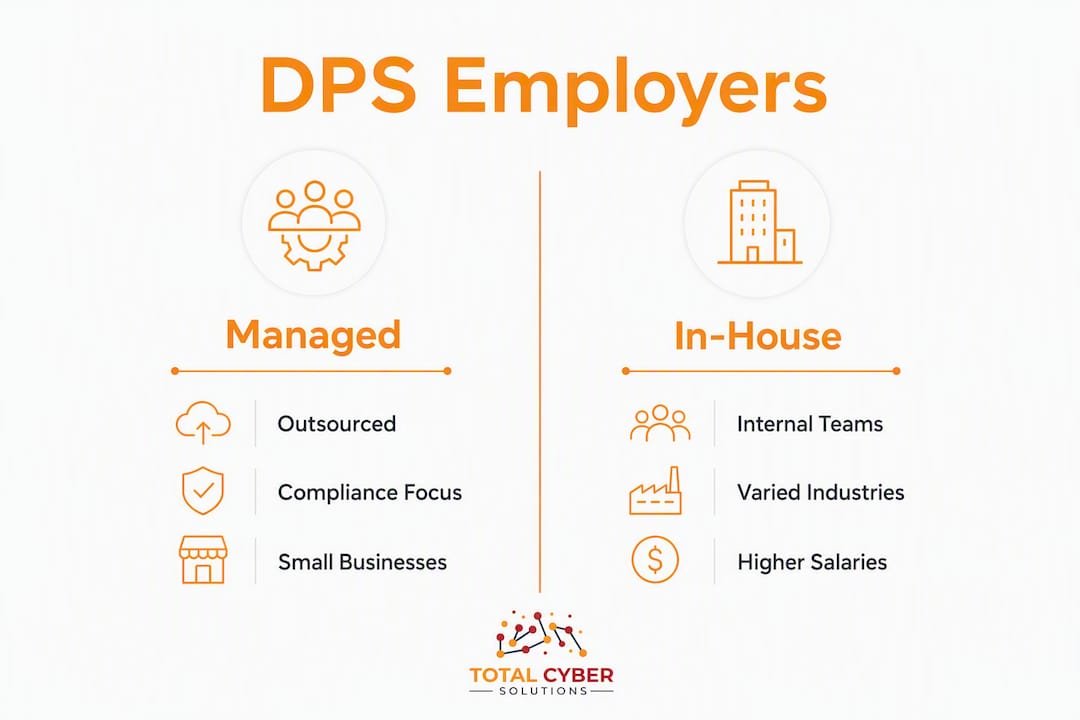
| Employer | Company type | Typical roles & seniority | U.S. presence | Typical salary range | Benefits & culture | How to apply |
|---|---|---|---|---|---|---|
| Arcadis DPS Group | Global consulting/engineering firm | Process Engineer, Project Engineer, Senior Engineer, Principal | Nationwide; client-site embedded | Salary ranges typical for consulting engineering roles | Client-first, travel-heavy, strong training | dpsgroupglobal.com/careers |
| DPS Telecom | Telecom equipment vendor | Product Engineer, Protocol Engineer, Systems Engineer | Fresno, CA; remote roles | Salary ranges typical for telecom engineering roles | Product-focused, R&D culture | dpstele.com |
| Dept. of Public Safety (state agencies) | Government | Systems Engineer, Comms Engineer, IT Engineer | — | Salary ranges typical in government positions | Strong benefits, pension, slower promotion | State government job portals |
| DPS as Data Protection Services | IT/cybersecurity teams or MSPs | Backup Engineer, DR Engineer, DPS Engineer | Remote-friendly, nationwide | Salary ranges typical for IT/cybersecurity roles | Varies by employer; compliance-driven | LinkedIn, Indeed, company careers pages |
One-line verdicts:
- Arcadis DPS Group is the dominant employer for process and project engineers in life sciences and advanced technology. Expect client-embedded work and GMP familiarity requirements.
- DPS Telecom suits engineers who want product ownership and protocol-level work on telecom alarm systems, with a smaller team feel.
- State Departments of Public Safety offer stability and public-service benefits but move on government hiring timelines.
- Data Protection Services roles are the fastest-growing segment, driven by rising demand for enterprise backup and cyber recovery expertise.
Where does Totalcyber fit? As a managed cybersecurity provider, Totalcyber hires and partners with engineers focused on managed cybersecurity services, backup architecture, and compliance. If you are searching for DPS roles in the IT/cyber space, managed service providers are a legitimate and often overlooked career path.
What does a DPS engineer actually do day to day?
The answer depends entirely on which “DPS” hired you.
Arcadis DPS Group (consulting/process engineering)
Engineers here work embedded at client manufacturing sites, adapting to client CMMS systems, safety protocols, and site-specific standards while representing the consultancy. Day-to-day tasks include:
- Generating P&IDs and process flow diagrams (PFDs) for pharmaceutical or semiconductor facilities
- Writing commissioning and start-up protocols; executing CQV (commissioning, qualification, and validation) activities
- Coordinating vendor bid packages and reviewing equipment submittals
- Conducting P&ID walkdowns and process calculations on live client sites
- Managing project schedules and communicating progress to client stakeholders
DPS Telecom (vendor/product engineering)
- Designing and testing alarm monitoring hardware and software
- Handling legacy protocol integration (SNMP, T/Mon, DNP3)
- Supporting field deployments and customer technical escalations
- Contributing to product roadmap development
Data Protection Services (IT/cybersecurity)
- Architecting enterprise backup solutions using tools like Veeam, Commvault, or Rubrik
- Defining RPO (recovery point objective) and RTO (recovery time objective) targets with business stakeholders
- Building and testing disaster recovery playbooks
- Monitoring backup job health and responding to failures
Seniority matrix
| Level | Experience | Core focus |
|---|---|---|
| Entry (Engineer I) | Early career | Execution, documentation, supervised commissioning |
| Mid (Engineer II/III) | Mid career | Independent design, vendor coordination, client interface |
| Senior/Lead | Senior level | Project ownership, mentoring, regulatory sign-off |
What skills and qualifications do DPS employers actually screen for?
The single most common hiring filter is domain-specific experience. For Arcadis DPS Group, that means GMP or CQV familiarity. For semiconductor clients, cleanroom standards matter. For Data Protection Services roles, hands-on experience with enterprise backup platforms is the gating requirement.
Technical skills checklist
- P&ID and PFD creation (Arcadis/consulting roles)
- AutoCAD or Revit for facility design drawings
- Process calculations and equipment sizing
- Commissioning and validation documentation (IQ/OQ/PQ protocols)
- Enterprise backup tools: Veeam, Commvault, Rubrik, or Cohesity (DPS/IT roles)
- Disaster recovery orchestration and failover testing
- Cloud backup and cloud-native resilience patterns
Soft skills that move candidates forward
- Clear written and verbal communication with non-technical stakeholders
- Vendor management and bid evaluation
- Adaptability to client site cultures and CMMS systems
Certifications employers commonly request
- PE (Professional Engineer) license for senior consulting roles
- PMP or CAPM for project engineering tracks
- CompTIA Security+ or associate-level security certs for DPS/IT roles
- Vendor-specific backup certifications (Veeam VMCE, Commvault Certified Professional)
- cGMP training certificates for life sciences work
Statistic callout: Arcadis DPS Group project engineer postings explicitly require 5+ years of life sciences capital project experience, which signals that mid-level candidates without regulated-industry exposure are typically screened out early.
Pro Tip: Read the job description’s “preferred qualifications” section as carefully as the “required” section. Hiring managers at consulting firms often write preferred items that are actually dealbreakers in regulated industries like pharma or biotech.
What salary can you expect as a DPS engineer in the U.S.?
Pay varies more by employer type than by job title. A “DPS engineer” at a state agency and a “DPS engineer” at Arcadis DPS Group can differ by $30,000 or more at the same seniority level.

These ranges are U.S. market estimates. Verify current figures with the Bureau of Labor Statistics and LinkedIn Salary for your specific metro area.
What drives pay up or down:
- Location: San Francisco, Boston, and New York add 20–35% over national medians. Remote roles often pay closer to national averages.
- Industry specialization: GMP/CQV expertise or DR orchestration skills command premiums over generalist engineering.
- Billable-rate model vs. salary: Consulting firms like Arcadis DPS Group bill clients at higher rates, which can translate to bonuses and faster raises for high performers.
- Certifications: A PE license or a vendor backup certification can shift a mid-level offer by $10,000–$15,000.
Government roles trade top-line salary for pension plans, defined benefits, and job security that private-sector roles rarely match.
How do you find DPS jobs and actually get an interview?
Searching “DPS engineer” on Indeed or LinkedIn returns a mix of all three employer types. Here is a step-by-step approach that cuts through the noise.
- Identify the employer type first. Open the posting and scan for the company name. If you see “Arcadis,” “DPS Group,” or “dpsgroupglobal.com,” that is the consulting track. “DPS Telecom” or “dpstele.com” is the vendor track. A state agency name is the government track. Backup, Veeam, or DR language signals the IT/cyber track.
- Use targeted search strings. Try “DPS Group engineer,” “Arcadis process engineer,” “DPS Telecom systems engineer,” or “data protection engineer backup” rather than the bare phrase “DPS engineer.”
- Go directly to careers pages. Arcadis DPS Group’s careers page lists open roles by region and specialty. State DPS agencies post on their official state government portals.
- Mirror the job description’s language in your resume. If the posting says “P&ID walkdowns” and “cGMP,” use those exact phrases in your bullet points. ATS systems score on keyword match.
- Activate referrals early. LinkedIn’s “Alumni” filter lets you find people who worked at Arcadis DPS Group or DPS Telecom. A warm introduction shortens the screening cycle significantly.
Common DPS interview questions and how to handle them:
- “Describe a commissioning project you led from start to finish.” Walk through scope, your specific deliverables, and how you handled a deviation or delay.
- “How do you adapt to a client’s existing CMMS or site standards?” Show that you ask questions first and document your understanding before proposing changes.
- “What backup or DR tools have you worked with?” Name specific platforms and describe a real recovery scenario you tested or executed.
- “How do you communicate technical findings to non-engineers?” Give a concrete example of translating a P&ID issue or a backup failure into plain language for a client or executive.
For a broader view of where DPS engineer fits in the cybersecurity career ladder, the cybersecurity job titles guide from Pluck Jobs is a useful reference.
What benefits and culture should you expect?
Culture varies sharply across the three employer types. Knowing what to expect before the offer stage saves you from a bad fit.
Consulting firms (Arcadis DPS Group)
- Client-first culture: your schedule follows the client’s project milestones, not a fixed 9-to-5
- Travel and site-embedded work are common, especially for commissioning phases
- Strong emphasis on professional development and certification support
- Billable-time incentives can boost total compensation for high performers
Telecom vendors (DPS Telecom)
- Product-focused culture with longer-term ownership of specific systems or protocols
- Engineering R&D involvement; you may contribute directly to product roadmaps
- Smaller team environment with more cross-functional visibility
- Less travel than consulting, but customer escalations can be intense
Government (state DPS agencies)
- Defined benefit pension plans and strong health coverage
- Slower promotion cadence tied to civil service classifications
- Predictable hours and workload compared to consulting
- Public-service mission that resonates with candidates who want community impact
Red flags to watch for in any DPS role:
- Vague travel expectations (“occasional travel” with no definition)
- High turnover in the engineering team (ask the hiring manager directly)
- Unclear role scope or a job description that mixes three different specialties
- No mention of training, certification support, or professional development budget
If you mean Data Protection Services: how that role works and where Totalcyber fits
In IT job listings, DPS engineer often stands for Data Protection Services engineer, a role focused on enterprise data backup, cyber recovery, and data integrity. This is a distinct track from process engineering at Arcadis DPS Group. The skills overlap is minimal.
A Data Protection Services engineer typically owns:
- Backup architecture design across on-premises, hybrid, and cloud environments
- RPO and RTO definition in partnership with business continuity teams
- Disaster recovery playbook creation, testing, and documentation
- Enterprise backup platform administration (Veeam, Commvault, Rubrik, Cohesity)
- Monitoring backup job health and managing failure escalations
- Supporting policy compliance requirements under frameworks like HIPAA, NIST, or CMMC
When a managed provider is the right path. Not every organization can hire a full-time DPS engineer. Smaller businesses and mid-market companies often partner with a managed cybersecurity provider to get the same capabilities without the overhead of a dedicated headcount. Totalcyber’s managed cybersecurity services cover backup architecture, cyber recovery, and compliance-focused engagements, which maps directly to what a Data Protection Services engineer delivers in-house.
For engineers considering the managed-services career path, Totalcyber’s work spans HIPAA, NIST, CJIS, and CMMC compliance, cloud security, and incident response. That breadth gives DPS-focused engineers exposure to a wider range of client environments than most single-employer roles.

Key Takeaways
“DPS engineer” covers at least three distinct career tracks, and identifying which one you are looking at before you apply is the single most important step in your job search.
| Point | Details |
|---|---|
| Verify the employer type first | Check whether DPS is a company name (Arcadis, DPS Telecom) or a role acronym (Data Protection Services) before tailoring your resume. |
| Mirror domain-specific language | Use GMP/CQV terms for life sciences roles; use backup platform names and DR terminology for IT/cyber postings. |
| Salary varies by employer class | Data Protection Services roles and consulting firms typically pay more than government or vendor tracks at equivalent seniority. |
| Referrals shorten the hiring cycle | Use LinkedIn’s Alumni filter to find contacts at Arcadis DPS Group or DPS Telecom before applying cold. |
| Totalcyber as a managed-services path | Totalcyber provides DPS-grade backup, recovery, and compliance services for organizations that need these capabilities without a full-time hire. |
What most candidates get wrong about DPS roles
The biggest mistake is treating “DPS engineer” as a single job title. It is not. Candidates who apply to Arcadis DPS Group with a resume built around backup and DR tools will get screened out in the first pass. The reverse is equally true: a process engineer with P&ID and CQV experience who applies to a Data Protection Services role at a cybersecurity firm will look like a mismatch before the phone screen.
The second mistake is underestimating the regulatory dimension. Recruiters at Arcadis DPS Group consistently flag candidates who cannot connect their experience to the target industry’s compliance environment. If you have worked in pharma, say GMP. If you have worked in semiconductors, say cleanroom standards. Generic engineering language does not pass the first filter in regulated industries.
For engineers considering the IT/cyber DPS track, the career path is genuinely strong right now. Cyber threats continue to rise, which keeps demand for backup and recovery expertise high. But the role requires you to think like a business continuity planner, not just a systems administrator. The candidates who advance are the ones who can explain RPO and RTO trade-offs to a CFO, not just configure a backup job.
Totalcyber covers the DPS-grade capabilities your organization needs
If you are an employer reading this because you need Data Protection Services capabilities and you are not sure whether to hire or outsource, Totalcyber offers a direct answer. As a veteran-owned managed cybersecurity provider, Totalcyber delivers backup architecture, cyber recovery, incident response, and compliance consulting under one contract, without the recruiting timeline or the overhead of a full-time hire.
The team works with small and mid-sized businesses across the U.S. on HIPAA, NIST, CJIS, and CMMC requirements, and the managed services model means you get DPS-grade protection that scales with your organization. Ready to talk through what your environment needs? Start the conversation here.
Useful sources and next places to look
- Arcadis DPS Group careers page: The primary source for open roles in consulting and process engineering. Filter by region and specialty.
- Arcadis DPS Group process engineer posting: A live example of the P&ID, PFD, and cGMP requirements you will see on most consulting postings.
- Arcadis DPS Group project engineer posting: Shows the 5+ years life sciences capital project requirement and electrical/commissioning expectations.
- Bureau of Labor Statistics: Use the Occupational Employment and Wage Statistics tool to check current salary data for mechanical, electrical, and computer systems engineers by metro area.
- Cybersecurity job titles guide (Pluck Jobs): Helps you place the Data Protection Services engineer title within the broader cybersecurity career taxonomy.