

The NIST Cybersecurity Framework (CSF) is a voluntary, outcome-driven set of guidelines that helps organizations of any size manage and communicate cybersecurity risk. It is not a compliance checklist. It is a common language, a structured way to describe where your security program stands today and where it needs to go.
Who benefits from it?
- Executives and board members who need to understand cyber risk without reading technical reports
- CISOs and IT managers building or maturing a security program
- Small and mid-size businesses (SMBs) that need a starting point
- Government agencies and critical infrastructure operators managing complex risk environments
The official home for all CSF resources is NIST’s CSF overview and resource guide.
Table of Contents
- Why does the NIST framework exist, and who should use it?
- What does the NIST framework actually contain?
- What changed in CSF 2.0, and why does governance matter now?
- How do you actually implement the NIST framework?
- How does the CSF map to other standards?
- What does CSF adoption look like in the real world?
- What does CSF adoption realistically cost and how long does it take?
- How Total Cyber helps you put the NIST framework into practice
- Key Takeaways
- The part most organizations get wrong about the NIST framework
- Ready to build a CSF-aligned security program?
- Useful sources and further reading
Why does the NIST framework exist, and who should use it?
Cybersecurity risk does not live only in the IT department. A breach affects operations, finances, reputation, and customer trust. The CSF exists to give organizations a shared structure for managing that risk across every level, from the server room to the boardroom.
The framework’s technology-agnostic, outcome-focused design means it does not tell you which firewall to buy. It describes the outcomes you need to achieve and then points you to prescriptive resources, like NIST Special Publications or CIS Controls, when you need specific controls. That flexibility is the point.
Three quick examples of what a successful CSF outcome looks like in practice:
- Small business: A small accounting firm uses the CSF to identify its highest-risk assets (client financial data), put basic access controls in place, and create a simple incident response plan. The FTC’s small-business guidance on the NIST framework is a practical starting point for exactly this scenario.
- Mid-market company: A mid-sized manufacturer maps its cloud environment to CSF outcomes, closes gaps in its detection capabilities, and produces a one-page risk summary for the CFO every quarter.
- Government agency: A regional public agency integrates CSF with its enterprise risk management (ERM) program, giving leadership a unified view of cyber risk alongside financial and operational risks.
What does the NIST framework actually contain?
The CSF has three main components: the Framework Core, Profiles, and Implementation Tiers.
The Framework Core is the heart of the framework. It is a taxonomy of cybersecurity outcomes organized into six Functions, each of which breaks into Categories and Subcategories. Informative references then map each Subcategory to specific controls in documents like NIST SP 800-53, ISO/IEC 27001, and CIS Controls.
| Function | Purpose | Example Category |
|---|---|---|
| Govern | Set and communicate cybersecurity strategy, roles, and policies | Organizational context and risk strategy |
| Identify | Understand your assets, risks, and business environment | Asset management and risk assessment |
| Protect | Put safeguards in place to limit or contain a cyber event | Access control and data security |
| Detect | Find cybersecurity events quickly | Continuous monitoring and anomaly detection |
| Respond | Take action when an incident occurs | Incident response planning and communications |
| Recover | Restore capabilities after an incident | Recovery planning and improvements |
Profiles let you describe your organization’s current security posture (Current Profile) and where you want it to be (Target Profile). The gap between the two becomes your roadmap.
Implementation Tiers (Tier 1 through Tier 4) describe how mature and integrated your cybersecurity risk management practices are, from ad hoc and reactive at Tier 1 to adaptive and continuously improving at Tier 4. Tiers are not a score to chase for its own sake. They help you have an honest conversation about where you are and what moving up actually requires.
What changed in CSF 2.0, and why does governance matter now?
NIST released CSF 2.0 in February 2024, and the changes are more than cosmetic. Here is what is new:
- Stronger ERM integration. The Enterprise Risk Management Quick-Start Guide that accompanies CSF 2.0 gives organizations a direct path to fold cyber risk into their broader enterprise risk programs.
- Improved reference tools — NIST expanded its searchable catalog so teams can map CSF outcomes to controls in SP 800-53, ISO/IEC 27001, and CIS Controls without building the crosswalk from scratch.
The Govern function is the biggest shift in philosophy. Previous versions assumed organizations would manage cyber risk technically. CSF 2.0 assumes the board and C-suite are accountable for it.
Pro Tip: Before your next board meeting, pull together a one-page Current Profile summary showing which CSF Functions are well-covered and which have gaps. Frame it in business terms, not technical ones. That single document can open a productive conversation about cyber risk investment without requiring anyone to understand firewall rules.
How do you actually implement the NIST framework?
Adoption does not have to be a massive project. A phased approach works well, especially for SMBs with limited staff and budget. Here is a practical sequence:
- Build your Current Profile. Walk through the six Functions and honestly assess which outcomes you currently meet. Use the CSF reference tool to speed this up.
- Select and implement controls. Use informative references (SP 800-53, CIS Controls, ISO/IEC 27001) to find specific controls that close each gap. Tools like cybersecurity risk scoring can help you prioritize.
Timeline reality check: An initial assessment and Current Profile typically takes a few weeks for an SMB. Closing priority gaps and reaching a repeatable program often takes several months. Reaching Tier 3 or 4 maturity is a multi-year effort.
Pro Tip: Start with the Identify and Govern Functions. You cannot protect what you have not inventoried, and you cannot sustain a program without leadership buy-in. A 90-day pilot focused on asset inventory, risk assessment, and a basic governance policy gives you quick wins and a foundation to build on.
How does the CSF map to other standards?
The CSF does not replace SP 800-53, ISO/IEC 27001, or CIS Controls. It sits above them as an organizing layer. Here is when to reach for each:
- NIST SP 800-53: — Use it when you need detailed, prescriptive controls, especially for federal systems or FISMA compliance. It maps directly to CSF Subcategories.
NIST’s searchable reference catalog lets you enter a CSF Subcategory and see the corresponding controls across all of these frameworks simultaneously. That crosswalk saves significant time when you are building a compliance program that needs to satisfy multiple standards at once. Compliance programs built on CSF outcomes tend to satisfy multiple regulatory requirements more efficiently than programs built around a single standard.
What does CSF adoption look like in the real world?
Three scenarios that show how different organizations use the same framework differently:
Small business protecting customer data. A regional healthcare practice uses the CSF to map its patient data handling against the Protect and Identify Functions. The gap analysis reveals that staff have no formal training on phishing and that remote access lacks multi-factor authentication. Both gaps close within 60 days at low cost. The practice now has a defensible security posture and a cleaner path to HIPAA alignment.
Mid-market firm aligning cloud security. A financial services company migrating to Microsoft 365 uses CSF Profiles to define what “secure cloud” means for their environment before migration begins. The Target Profile drives their configuration standards and their vendor security review checklist.

Enterprise cross-unit collaboration. Large organizations that reach higher CSF maturity, like those documented in NIST’s published success stories, consistently share one trait: explicit leadership sponsorship and cross-unit collaboration. Cybersecurity stops being an IT problem and becomes a business program.
Common benefits organizations report after adopting the CSF:
- Clearer visibility into which assets and processes carry the most risk
- Executive and board reporting that is meaningful, not just technical
- More defensible investment decisions when requesting security budget
- Faster, more organized incident response when something goes wrong
- Stronger supply chain and third-party risk conversations, since CSF gives you a common language to use with vendors
What does CSF adoption realistically cost and how long does it take?
There is no single answer, but here are the honest variables:
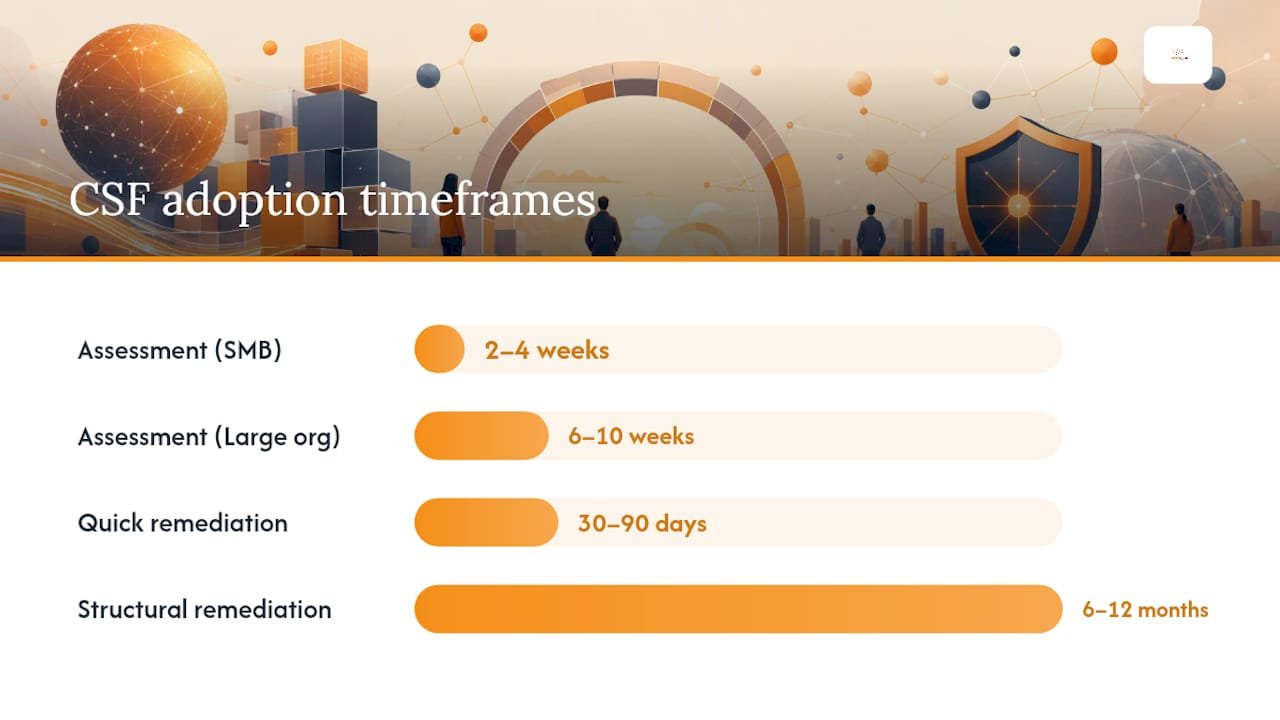
- Initial assessment: Two to four weeks for an SMB; six to ten weeks for a larger organization with complex environments.
- Gap remediation: Highly variable. Quick wins (MFA, patching, basic policies) can close in 30–90 days. Structural gaps in detection or incident response may take six to twelve months.
- Ongoing program: Plan for a recurring annual review and continuous monitoring as a steady-state cost.
Major cost drivers to plan for:
- Internal staff time for assessment and remediation
- Tooling for monitoring, vulnerability scanning, and logging
- External consulting or managed services if internal capacity is limited
- Training for staff, which supports the Protect and Govern Functions directly
- Remediation backlog, often the largest and most unpredictable cost
A pilot project scoped to one business unit or one critical system is the fastest way to validate the investment and build internal confidence before scaling. Understanding cybersecurity maturity models alongside the CSF Tiers helps you set realistic expectations for what each phase of maturity actually requires.
How Total Cyber helps you put the NIST framework into practice
Knowing the framework is one thing. Operationalizing it with limited staff and a real budget is another. Total Cyber is a veteran-owned cybersecurity and managed IT services company that helps SMBs and mid-market organizations move from “we know we need this” to a running CSF-aligned program.
Services directly relevant to CSF adoption include:
- Managed cybersecurity services that keep your program running without requiring a full internal security team
- Cyber awareness training to close human-factor gaps in the Protect Function
Total Cyber works with organizations that do not have a security team yet and with those that have one but need strategic direction. The goal is always the same: a program that actually works, not just a document that checks a box.
Request a discovery conversation to talk through where your organization stands and what a CSF-aligned program would look like for your environment.
Key Takeaways
The NIST Cybersecurity Framework gives organizations a structured, voluntary path to manage cyber risk, communicate it clearly, and improve over time.
| Point | Details |
|---|---|
| CSF is voluntary and flexible | Any organization, any size, any sector can adopt it without a mandate. |
| Six Functions organize the Core | Govern, Identify, Protect, Detect, Respond, and Recover cover the full security lifecycle. |
| CSF 2.0 adds governance | The new Govern function makes leadership accountability a formal part of the framework. |
| Profiles drive your roadmap | Comparing your Current and Target Profiles produces a prioritized, actionable gap list. |
| Total Cyber accelerates adoption | Assessments, vCISO services, and managed security help SMBs operationalize CSF quickly. |
The part most organizations get wrong about the NIST framework
Most organizations that struggle with CSF adoption do not fail because the framework is too complex. They fail because they treat it as an IT project instead of a business program.
The Govern function in CSF 2.0 is not a bureaucratic addition. It is a recognition of something practitioners have known for years: security programs without executive ownership stall. Budget does not get approved. Policies do not get enforced. Incidents do not get escalated properly. The technical work is actually the easier part.
My recommendation for any organization starting out is to resist the urge to build a perfect Current Profile before getting leadership in the room. Start with a 90-day pilot, pick one critical system or business unit, and use the gap analysis to produce a one-page risk summary for the executive team. That conversation, more than any control you implement, is what builds a sustainable program.
Ready to build a CSF-aligned security program?
Total Cyber takes the guesswork out of NIST framework adoption. You get a veteran-owned team that has done this for SMBs and mid-market organizations across the U.S., with services that cover every phase: initial assessment, gap remediation, ongoing managed security, and compliance consulting.

No long onboarding. No internal security team required to get started. Whether you need a one-time risk assessment or a fully managed program, Total Cyber builds it around your environment and your budget.
Talk to the team at Total Cyber and get a clear picture of where your security program stands today.
Useful sources and further reading
- The NIST Cybersecurity Framework (CSF) 2.0
- NIST Cybersecurity Framework (CSF) 2.0: Resource & overview guide | NIST
- Understanding the NIST cybersecurity framework | FTC
- SAP success story | NIST Cybersecurity Framework