

Outsourcing IT security gets your business faster threat detection, predictable monthly costs, and access to specialists most companies could never hire full-time. For a typical small or mid-sized business, that trade generally beats the alternative of building an in-house team from scratch.
The clearest wins show up in four places:
- Round-the-clock monitoring from analysts who aren’t juggling help desk tickets between alerts
- Predictable pricing instead of the wild cost swings of hiring, tooling, and retraining an internal team
- Faster response times, because managed providers build their entire business around mean time to detect and mean time to respond
- Built-in compliance support for frameworks like HIPAA, CMMC, and NIST CSF 2.0, without hiring a dedicated compliance hire
If you’re a business with fewer than 500 employees and no dedicated security operations center, outsourcing some or all of your security function is very likely the more defensible move, both financially and operationally.
Key Takeaways
Outsourcing IT security improves detection speed, response time, and cost predictability for most SMBs by shifting specialized talent and 24/7 coverage onto a provider built for exactly that job.
| Point | Details |
|---|---|
| Cost comparison is stark | In-house 24/7 SOCs often run $1.2M to $1.8M annually, versus $300K to $800K for MDR engagements. |
| Hybrid models fit mid-market well | Keep internal staff for business context; outsource 24/7 monitoring and first-line triage. |
| NIST CSF 2.0 guides the mapping | Outsourced services can cover all six framework functions: Govern, Identify, Protect, Detect, Respond, Recover. |
| Track KPIs, not promises | Demand real MTTD, MTTR, and false-positive numbers from any provider before signing. |
| Total Cyber tailors engagements to gaps | Total Cyber builds managed security, compliance, and vCSO engagements around the specific coverage gaps a business already has. |
Table of Contents
- What Are the Benefits of Outsourced IT Security Compared to In-House Teams?
- The Specific Benefits of Outsourced IT Security, and How to Measure Each
- How Outsourced Security Maps to the NIST Cybersecurity Framework
- How Do You Choose an Outsourced IT Security Provider?
- What Does a 90-Day Outsourced Security Onboarding Look Like?
- When Does Total Cyber Recommend Outsourcing Security?
- Ready to Explore Managed Security With Total Cyber?
- Frequently Asked Questions
- Sources
What Are the Benefits of Outsourced IT Security Compared to In-House Teams?
Every business eventually faces the same decision: build a security team internally, hand the whole function to an outside provider, or split the difference. Each path has real tradeoffs, and the right answer depends less on company size and more on how much specialized talent you can attract and retain.
In-house security gives you full control. Your team knows your systems, your business context, and your quirks. They can investigate an anomaly with institutional memory nobody outside the company has. The problem is staffing it properly. A fully-loaded, six-analyst security operations center running 24/7 in North America commonly costs $1.2 million to $1.8 million a year once you factor in salaries, tooling, training, and the overhead of keeping people from burning out on graveyard shifts.
Fully outsourced security (often delivered through Managed Detection and Response, or MDR, and Managed Security Service Providers, or MSSPs) trades some of that control for scale. Providers spread detection engineering and threat intelligence across many client environments, which means they typically catch patterns a single company’s SOC would miss. The same cost analysis found MDR engagements running $300,000 to $800,000 annually depending on scope, roughly a third to half the price of the in-house equivalent.
Hybrid, co-managed models split the difference: a small internal team owns business context, policy decisions, and vendor management, while an outside provider handles 24/7 monitoring and first-line triage. This is often the sweet spot for mid-market companies that need coverage they can’t staff alone but still want a voice in the room during a real incident.
One nuance gets lost in most outsourcing pitches: MDR is a detection and response service. It is not automatically a full security program. Vendor analyses on this point are consistent that MDR doesn’t replace strategic program ownership like vulnerability management prioritization or long-term architecture decisions. If a provider implies otherwise, that’s worth a second look.
Pro Tip: If you keep even one internal security-minded staffer, give them explicit ownership of the provider relationship, not just a “point of contact” title. That person becomes your institutional memory when analysts on the vendor side rotate, which they will.
The risk to watch in a hybrid model is coverage gaps at the seams, where your internal team assumes the vendor is handling something and the vendor assumes you are. Write down who owns what before day one, not after an incident exposes the gap.
The Specific Benefits of Outsourced IT Security, and How to Measure Each
1. Access to specialized expertise and modern detection tools
Most SMBs cannot afford a dedicated detection engineer, a threat hunter, and someone fluent in Endpoint Detection and Response (EDR) tooling. Outsourced providers spread those specialists across dozens of clients, which is how they justify the headcount you can’t. Measure this with coverage percentage, meaning what share of your endpoints, cloud workloads, and network segments are actually feeding telemetry into the provider’s detection stack. A provider that only sees your laptops but not your cloud environment isn’t giving you the expertise you’re paying for.
2. 24/7 monitoring and faster mean time to respond
Attackers don’t work business hours, and neither do the providers built for this. The core KPI here is mean time to detect (MTTD) paired with mean time to respond (MTTR). Ask any prospective provider for their historical average on both, not just their target SLA.

3. Cost-effectiveness and predictable pricing
Trading a six-figure salary lineup for a monthly subscription converts a volatile cost center into a fixed line item finance can actually forecast. Track total cost per protected endpoint per year against the fully-loaded in-house SOC benchmark of $1.2 million to $1.8 million to see where you land.
4. Scalability as your business changes
Adding 50 employees, opening a new office, or migrating to a new cloud provider shouldn’t mean a hiring scramble. A managed provider absorbs that growth inside your existing contract terms, usually with a scoped adjustment rather than a rebuild. Watch onboarding time for new assets, meaning how many days it takes a new device or cloud account to appear in active monitoring.
5. Proactive threat hunting instead of reactive alerts
Basic monitoring waits for an alarm. Mature MDR programs actively hunt for attacker behavior that hasn’t triggered a signature yet. Measure this by asking how many confirmed incidents originated from proactive hunting versus automated alerts. If the answer is always “automated alerts,” you’re paying for monitoring, not hunting.
6. Compliance and audit readiness
Frameworks like HIPAA, CMMC, and SOC 2 require documented evidence, not just good intentions. A provider that generates audit-ready logs and reports on a recurring cadence saves your team weeks during audit season. Track evidence turnaround time, how quickly the provider can produce documentation when an auditor asks.
7. Risk reduction and liability management
Every unpatched system and unmonitored account is liability sitting on your balance sheet. Outsourced providers reduce that exposure by keeping patching, access reviews, and detection consistent even when your internal attention is elsewhere. Measure false positive rate, because a provider drowning your team in noise is quietly increasing risk by training everyone to ignore alerts.
8. Integration and automation benefits
Modern providers connect their tooling directly into your identity provider, ticketing system, and cloud platforms, automating containment actions that used to require a phone call. Fewer manual handoffs mean fewer places for a threat to slip through during the gap between detection and action.
9. Workforce relief and lower turnover risk
Security analyst burnout is well documented, and the ISC2 2024 Cybersecurity Workforce Study points to a persistent talent shortage that makes hiring and retaining SOC staff genuinely hard for smaller companies. Outsourcing shifts that hiring and retention burden onto the vendor, which matters more in markets where analyst tenure runs short.
Pro Tip: If you’re running a hybrid engagement, put your internal team on detection engineering and business-context decisions, and let the vendor own the 3 a.m. alert triage. That split plays to each side’s actual strength.
How Outsourced Security Maps to the NIST Cybersecurity Framework
The NIST Cybersecurity Framework 2.0 organizes cybersecurity outcomes into six functions, and outsourcing typically covers the ones SMBs struggle to staff internally.
| NIST CSF 2.0 Function | Typical Outsourced Service |
|---|---|
| Govern | vCSO leadership, policy development, risk governance advisory |
| Identify | Asset inventory, vulnerability assessments, risk scoring |
| Protect | Endpoint protection, access management, security awareness training |
| Detect | 24/7 monitoring, EDR, MDR threat detection |
| Respond | Incident response, containment playbooks, escalation management |
| Recover | Backup validation, disaster recovery testing, post-incident review |
NIST’s own small business guidance explicitly recommends leaning on external partners for activities that require skills or resources a small business doesn’t have in-house, things like enabling multi-factor authentication broadly or building a tested recovery playbook. That’s not a workaround. It’s the framework’s intended use.
The cost math tracks the same pattern seen in the tradeoffs above: a fully-loaded in-house SOC running all six functions lands in that $1.2 million to $1.8 million range annually, while outsourced coverage of the Detect and Respond functions alone through MDR typically runs a fraction of that.
Three KPIs tie directly back to specific functions:
- Time-to-detect maps to the Detect function and tells you how fast anomalies surface.
- Mean time to respond maps to the Respond function and measures containment speed.
- Recovery time objective attainment maps to the Recover function and shows whether your backups actually restore on schedule, not just in theory.
CISA’s guidance materials reinforce the same point from a different angle: continuous monitoring and coordinated playbooks are central to resilience, and those are exactly the capabilities most managed providers are built to deliver at scale.
How Do You Choose an Outsourced IT Security Provider?
Not every managed provider delivers the same depth. Before signing a contract, run prospects through this checklist.
- Coverage scope. Confirm the provider monitors every data source you actually use, including cloud platforms, SaaS applications, and any custom internal applications, not just endpoints and the network perimeter.
- Detection engineering depth. Ask whether detections are tuned to your industry and environment or pulled from a generic rule set applied to every client.
- SLA specifics. Get contractual numbers for MTTD and MTTR, not marketing language like “rapid response.”
- Incident authority model. Clarify whether the provider can act autonomously to contain a threat or must wait for your sign-off, and make sure that matches your risk tolerance.
- Reporting cadence and format. Confirm you’ll get reports your executives and auditors can actually use, not raw alert dumps.
- Data handling and privacy terms. Understand exactly what data leaves your environment, where it’s stored, and for how long.
When vetting a vendor, put these questions directly to them:
- How long do you retain our logs, and where are they stored?
- Who authorizes containment actions during an active incident, your team or ours?
- What’s your on-call escalation path when an alert needs a human decision at 2 a.m.?
- How do you handle detection for custom or legacy applications you haven’t seen before?
Watch for a few red flags during procurement: vague SLA language with no historical MTTR data to back it up, limited visibility into which data sources are actually covered, and unusually high rates of alerts escalated to you that turn out to be false positives. A provider who can’t produce real numbers on any of these during a sales conversation likely can’t produce them during an incident either.
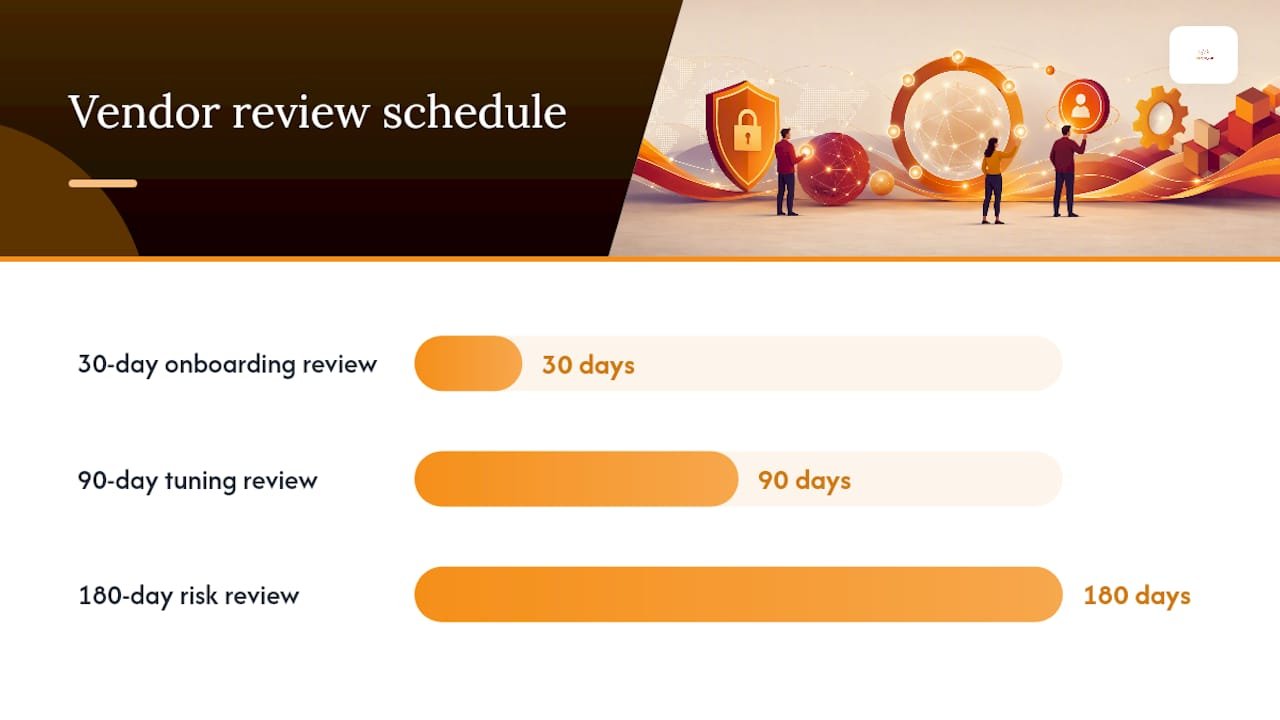
Plan to formally review vendor performance at 30, 90, and 180 days. The 30-day mark tells you whether onboarding went smoothly. The 90-day mark tells you whether detections are tuned to your environment. The 180-day mark tells you whether the relationship is actually reducing your risk or just generating reports.
What Does a 90-Day Outsourced Security Onboarding Look Like?
A clean transition preserves the institutional knowledge your current setup already has while getting the new provider productive fast.
- Days 0 to 30: Foundation. Onboard log sources, complete asset inventory, and assign internal ownership for the vendor relationship.
- Days 0 to 30: Access setup. Grant least-privilege access to systems the provider needs to monitor, nothing broader.
- Days 31 to 60: Playbook agreement. Finalize incident response runbooks and get sign-off on the escalation matrix, meaning who gets called and in what order.
- Days 31 to 60: Detection tuning. Work with the provider to reduce false positives specific to your environment’s normal behavior.
- Days 61 to 90: Reporting cadence. Establish a recurring executive reporting rhythm, whether monthly or quarterly, tied to the KPIs you actually care about.
- Days 61 to 90: Compliance evidence check. Confirm the provider’s reporting format satisfies whatever framework you’re being audited against.
Assign a single internal owner for onboarding, not a committee. That person should track:
- Which systems and accounts have been fully onboarded into monitoring
- Whether data residency requirements are being met for regulated data
- Whether access granted to the provider follows least-privilege principles rather than broad admin rights
The role of clear cybersecurity policy becomes especially visible during onboarding, because a provider can only enforce what you’ve actually defined. If your access policy is informal, day 30 is when that becomes obvious.
When Does Total Cyber Recommend Outsourcing Security?
The businesses that benefit most from outsourced security tend to share a few traits: no 24/7 coverage today, a security hire who left within the last year and hasn’t been replaced, or a tooling budget that can’t stretch to cover detection, response, and compliance all at once. In those situations, outsourcing usually isn’t a downgrade from in-house security. It’s the only realistic way to get coverage that actually exists around the clock.
Two patterns show up repeatedly in engagements like these. A company with a single overworked IT generalist brings on managed detection and response, and within the first quarter, mean time to respond drops because someone is actually watching alerts at 2 a.m. instead of finding them at 9. A company facing a compliance deadline for HIPAA or CMMC brings on managed compliance support, and audit prep that used to take weeks of scrambling becomes a documented, repeatable process.
Neither outcome requires abandoning the internal knowledge your team has built. It requires putting the right specialists on the parts of security that genuinely need round-the-clock attention.
If any of that sounds like your situation, start a conversation with Total Cyber about what a managed security engagement would actually look like for your environment.
Ready to Explore Managed Security With Total Cyber?
Total Cyber Solutions builds managed security engagements around the exact benefits covered here: 24/7 monitoring backed by real MTTD and MTTR tracking, predictable monthly pricing instead of a six-figure hiring gamble, and compliance support mapped directly to frameworks like HIPAA, NIST, CJIS, and CMMC.
As a veteran-owned provider, Total Cyber pairs managed cybersecurity services with:
- Virtual Chief Security Officer (vCSO) leadership for governance and risk decisions
- Compliance consulting across HIPAA, NIST, CJIS, and CMMC
- Cyber awareness training to reduce human-error risk
- Cloud security and Microsoft 365 migration and management
- Vulnerability assessments and penetration testing
If you want a clear picture of where your current setup has gaps before committing to anything, fill out the managed services form and Total Cyber will walk through what a tailored engagement covers for your specific environment.
Frequently Asked Questions
What are the main benefits of outsourced IT security for a small business?
The core benefits are access to specialized expertise, 24/7 monitoring with faster response times, predictable monthly costs instead of volatile hiring expenses, and built-in support for compliance frameworks like HIPAA and CMMC.
Is outsourced IT security cheaper than hiring an in-house team?
Usually, yes. A fully-loaded 24/7 in-house SOC commonly costs $1.2 million to $1.8 million a year, while MDR engagements typically run $300,000 to $800,000 depending on scope.
What’s the difference between MDR and MSSP?
MDR (Managed Detection and Response) focuses specifically on detecting threats and responding to them quickly. MSSP (Managed Security Service Provider) is a broader term that can include MDR alongside firewall management, compliance support, and other ongoing security services.
Can outsourced security help with compliance requirements like HIPAA or CMMC?
Yes. Most managed providers generate the audit-ready documentation, monitoring evidence, and policy support that compliance frameworks require, which significantly reduces the internal workload during audit season.
Does a hybrid model make sense if I already have an internal IT person?
Often, yes. A common hybrid approach keeps your internal person focused on business context and vendor management while the outsourced provider handles round-the-clock monitoring and initial alert triage.
Sources
- NIST Cybersecurity Framework — Small Business resources
- SP 1300, NIST Cybersecurity Framework 2.0: Small Business Quick-Start Guide | CSRC
- ISC2 2024 Cybersecurity Workforce Study
- CISA summit materials — Cyber for physical security (2022)