

Yes, data privacy laws almost certainly affect your business, and 2026 is the year that stopped being optional. If you collect emails, process payments, run web analytics, operate a loyalty program, or use ad pixels from Meta or Google, you’re likely already in scope of at least one state law. Compliance can raise your data storage costs by more than 20%, according to University of Colorado research, and more than 20 states now have active privacy statutes. Total Cyber Solutions works with SMBs facing exactly this squeeze.
Quick flags that mean you’re probably covered:
- You collect Social Security numbers, health data, or precise geolocation
- Customers live in multiple states, including California, Colorado, or Connecticut
- You run targeted ads or use third-party tracking pixels
- You’ve crossed 25,000 to 100,000 consumer records annually, depending on the state
Key Takeaways
Data privacy laws now apply to most SMBs that collect customer data, and delaying compliance costs more than acting on it does.
| Point | Details |
|---|---|
| Assume you’re covered | Falling thresholds and multi-state customers mean most data-collecting SMBs already fall under some state privacy law. |
| Map data flows first | Inventory every touchpoint before rewriting your privacy policy so it reflects reality, not a template. |
| Prioritize deletion requests | Systems like California’s DROP portal can impose daily fines, so triage deletion requests above access requests. |
| Budget for disproportionate costs | Compliance can raise storage costs over 20% for small firms, according to University of Colorado research. |
| Phase your spending | Start with legal review for immediate risk, then add managed support for ongoing enforcement and monitoring. |
Table of Contents
- Why Data Privacy Laws Affect SMBs More Than Ever in 2026
- Which Privacy Laws Apply to Your Business?
- How Compliance Reshapes Costs, Staffing, and Marketing
- A 6-Step Compliance Checklist You Can Start This Month
- Handling Deletion, Access, and Correction Requests Without Missing Deadlines
- When to Bring in a Lawyer or a Managed Compliance Partner
- How Total Cyber Solutions Helps SMBs Meet Privacy Obligations
- Common Misconceptions That Lead SMBs Into Costly Mistakes
- What Enforcement Actually Looks Like for a Small Business
- Budget-Friendly Tools That Actually Move the Needle
- Frequently Asked Questions
- Sources
Why Data Privacy Laws Affect SMBs More Than Ever in 2026
Privacy law used to be a Big Tech problem. Not anymore. The shift started with California’s CCPA and its 2023 upgrade, CPRA, then accelerated hard through 2025 and into mid-2026, when Connecticut, Arkansas, and Utah all tightened their statutes and California layered on new rules through its Delete Act. Congress has floated federal fixes too, including the SECURE Data Act and the GUARD Financial Data Act, though neither has become law yet. States aren’t waiting.
More than 20 states now have comprehensive privacy laws on the books, and thresholds keep falling. A business that processed 100,000 consumer records and felt safe two years ago might now trip a trigger at 25,000. That’s not a hypothetical: mid-2026 state updates lowered coverage floors and added new categories of sensitive data, including biometric and precise location information.
Regulators no longer treat “we didn’t know” as a defense. They expect a documented privacy policy, a process for handling consumer requests, and evidence you took basic security seriously before something went wrong.
Consumers have caught up too. People increasingly ask what happens to their data before they hand it over, and a vague answer costs you trust before it costs you a fine.
Which Privacy Laws Apply to Your Business?
Figuring out which laws apply comes down to three triggers: where your customers live, what kind of data you handle, and how much of it you process.
- Customer residency. If you have customers in California, Colorado, Connecticut, Virginia, Utah, or a growing list of other states, their state’s law can apply to you regardless of where your business is headquartered.
- Data sensitivity. Health information, biometric data, precise geolocation, and children’s data trigger obligations at much lower volume thresholds than ordinary contact information.
- Volume. Many state laws set numeric thresholds, but those thresholds dropped in 2026, and some now count vendors’ processing on your behalf toward your total.
Selling into the EU adds GDPR to the mix, and California’s Delete Act creates fresh deletion obligations even for smaller data brokers.
Run these checks in under 30 minutes:
- List your top five data touchpoints: website forms, point-of-sale, CRM, analytics, ad pixels
- Pull the states listed in your customer database and cross-reference against active state laws
- Estimate your annual consumer record count, including anything a vendor processes for you
If two or more boxes get checked, you’re covered. Confusing patchwork, but a knowable one, as industry coverage of the trend has documented repeatedly.
How Compliance Reshapes Costs, Staffing, and Marketing
The financial hit is real and it lands harder on small firms than large ones. University of Colorado researchers found that compliance-driven data storage requirements can raise costs by more than 20% for small businesses, largely because they lack the dedicated legal and security teams that absorb the same rules more cheaply at scale.
Small businesses face compliance costs that don’t scale down proportionally. A 20-person company can’t just hire a fraction of a privacy officer.
Marketing feels the pinch just as directly. Opt-out requests reduce your retargeting pools, cookie consent banners cut analytics visibility, and deletion requests under systems like California’s DROP portal shrink the customer data you can legally use for lookalike audiences. That typically pushes customer acquisition costs up and squeezes ad return on investment.
Day-to-day operations absorb the rest. Someone has to answer consumer requests, someone has to review vendor contracts for data-sharing clauses, and someone has to enforce retention schedules so old records don’t linger past their legal shelf life. None of that work is glamorous, but skipping it is how a $500 fine becomes a $50,000 one. Building compliance into your existing security posture tends to cost less than treating it as a separate project.
A 6-Step Compliance Checklist You Can Start This Month
Start with what you actually have, not what a template assumes you have.
- Inventory your data flows. List every place customer data enters your business: web forms, POS systems, CRM, email tools, analytics.
- Map your vendors. Check every contract for AI-training or “model improvement” clauses that let a vendor reuse your customer data.
- Rewrite your privacy policy to match reality. Include AI/LLM disclosures if any vendor trains models on your data.
- Build a lightweight DSAR intake process. Even a shared inbox and a spreadsheet beats no process at all.
- Apply baseline security controls. Multi-factor authentication, encrypted backups, and basic endpoint protection cover most regulatory expectations.
- Document an incident response plan and vendor data processing agreement template. You need this before a breach, not during one.
A 30/90/180-day version of this looks like:
- 30 days: Complete the data inventory and vendor list; owner-level task, no budget required
- 90 days: Rewrite the privacy policy and stand up the DSAR intake process; low-cost tools handle this
- 180 days: Implement MFA and encrypted backups across all systems; document your incident response plan
Pro Tip: Never start by copying a competitor’s privacy policy. Map your actual data flows first, then write the policy to describe what you really do. A policy that promises protections you don’t deliver is worse than no policy at all.
Cloud vendors matter here too. Reviewing how your cloud storage handles encryption and access controls is part of the vendor-mapping step, not a separate project.
Handling Deletion, Access, and Correction Requests Without Missing Deadlines
Consumer rights requests follow a predictable shape: someone asks to see, correct, or delete their data, and you have a limited window to respond.
The process that works for a small team: verify the requester’s identity, log the request with a timestamp, locate every system holding that person’s data (including vendor-held copies), fulfill the request or document a lawful reason you can’t, and confirm completion in writing.
The biggest exposure isn’t a well-handled request. It’s the request nobody logged, because there’s no record to show you responded on time.
The most common mistakes are handling requests ad hoc with no log, forgetting that vendors hold copies too, and skipping identity verification, which opens the door to someone deleting a different customer’s data by mistake. States enforce deadlines strictly, and systems like California’s DROP portal can impose daily fines for unfulfilled deletion requests, so prioritize deletion requests above access or correction requests if you’re triaging a backlog.
When to Bring in a Lawyer or a Managed Compliance Partner
Call a lawyer when you’re handling health or financial data, operating across several states, facing a litigation threat, or drowning in DSAR volume you can’t process internally. Bring in a managed partner when you need continuous monitoring, automated request handling, or someone to maintain your technical controls alongside your policies.
Before signing with either, ask:
- Can you show me a sample data processing agreement template?
- Do you carry SOC 2 or ISO 27001 certification, or work with clients who require it?
- Have you handled state-specific privacy laws for businesses my size?
- Can I talk to a current SMB client?
Budget-wise, a one-off legal review typically costs less upfront than an ongoing managed service, but it also leaves the technical enforcement to you. Most SMBs do best phasing spending: legal review first for immediate risk, then a managed partner for ongoing enforcement once the basics are documented.
How Total Cyber Solutions Helps SMBs Meet Privacy Obligations
Handling privacy compliance alone stretches a small team thin fast. Total Cyber Solutions bundles the pieces that usually fall through the cracks:
- Managed monitoring that flags unusual data access before it becomes a breach
- DSAR workflow support so consumer requests get logged, tracked, and closed on time
- Vendor risk assessments that catch data-sharing clauses before they become liabilities
- Privacy policy drafting and staff training to keep documentation aligned with reality
- Incident response planning and documentation support for when something does go wrong
Managed support also automates deletion and retention workflows, which matters directly under systems like California’s Delete Act, where missed deletion deadlines can trigger daily fines rather than a single penalty. That kind of automation often costs less than the staff hours it would take to do the same work manually, and surveyed consumers consistently say they trust businesses more when privacy practices are visible and documented.
If you’re not sure where your business stands, start with a compliance intake through Total Cyber’s MSP form. A short conversation and a baseline vulnerability scan usually reveal more risk than owners expect, and it costs nothing to find out.
Common Misconceptions That Lead SMBs Into Costly Mistakes
“We’re too small to matter” is the most expensive myth in this space. Falling thresholds mean a business processing as few as 25,000 records can be covered under some state laws, and enforcement agencies have gone after small operators, not just household names.
“A generic template privacy policy protects us” is the second trap. A policy that describes data practices you don’t actually follow creates liability rather than removing it. If your policy says you don’t sell data to third parties but your ad pixel setup shares behavioral data with Meta, that’s a gap regulators can act on.
“GDPR doesn’t apply to us because we’re a U.S. business” ignores that GDPR follows the customer, not the company. Selling to a single customer in Germany can trigger obligations regardless of where your servers sit.
“We’ll deal with it if we get a complaint” underestimates how enforcement actually starts. Many state attorneys general run active monitoring programs, and some laws allow consumers themselves to sue over specific violations. Waiting for a complaint means you’re already behind.
“Cyber insurance covers this” is a costly assumption too. Most policies exclude regulatory fines, and even when they don’t, insurers increasingly require documented compliance controls before honoring a claim at all.
What Enforcement Actually Looks Like for a Small Business
Penalties vary by state, but the pattern is consistent: escalating fines per violation, with some states allowing daily penalties for unresolved deletion or access requests. California’s framework permits enforcement actions that scale with the number of affected consumers, which means a breach touching a few thousand customer records can produce a fine far larger than most SMBs have budgeted for.
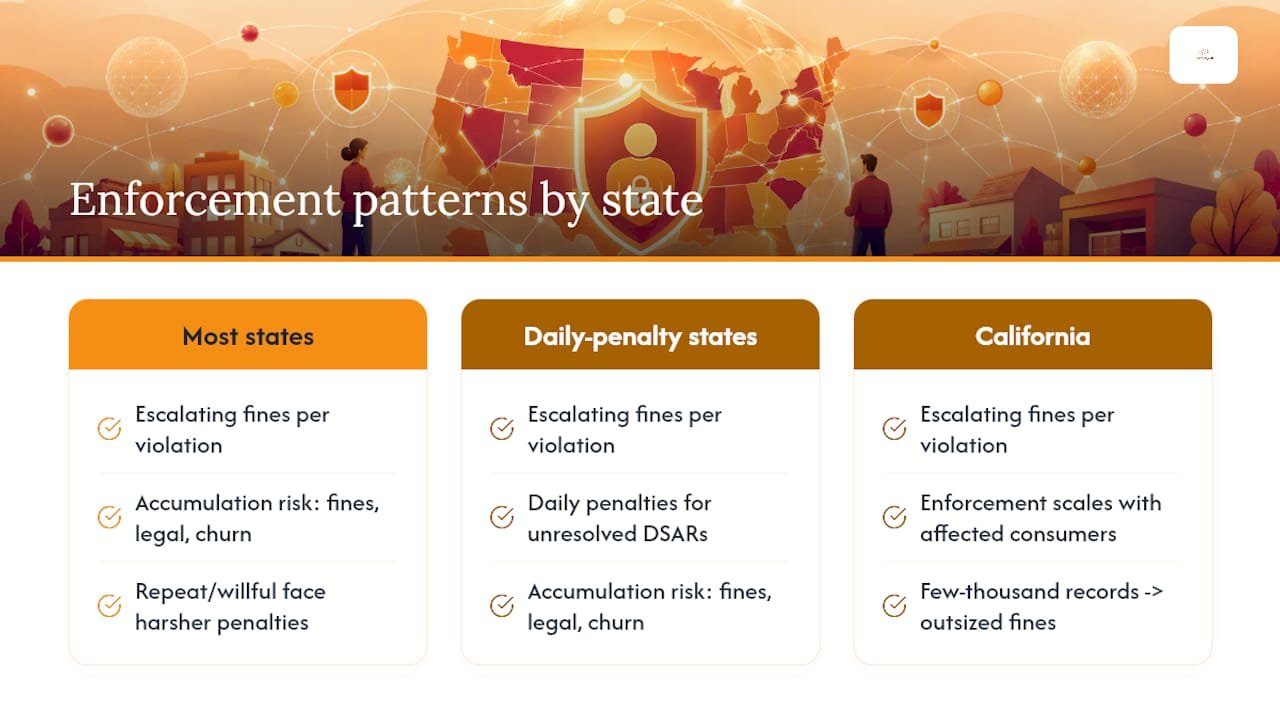
The bigger risk for most small businesses isn’t a single catastrophic fine. It’s the accumulation of smaller enforcement actions layered with legal fees, breach notification costs, and the customer churn that follows public disclosure of a violation. A University of Colorado analysis found that compliance costs already hit small firms disproportionately hard before you factor in what happens after an actual violation.
Regulators have also started treating repeat or willful violations differently from good-faith mistakes. A business that can show a documented privacy policy, a working DSAR process, and basic security controls tends to face lighter scrutiny than one with no paper trail at all, even when both experience a similar incident. That gap is exactly why the compliance checklist earlier in this piece matters more than it might seem on first read.
Non-compliance risk isn’t only regulatory, either. Business customers and partners increasingly ask about your privacy practices during vendor onboarding, and failing that review can cost you a contract before any regulator gets involved.
Budget-Friendly Tools That Actually Move the Needle
You don’t need enterprise software to handle most of this. A shared inbox with a tagging system can run your DSAR intake process for the first year or two, and a simple spreadsheet tracking data touchpoints often beats an expensive data-mapping platform that nobody on your team fully understands.
Password managers and MFA apps cost little to nothing per seat and close one of the most common breach vectors outright. Cloud providers with built-in encryption and access logging frequently include the technical controls regulators expect, which means switching platforms sometimes solves half your compliance gap without a separate tool purchase.

For vendor contract review, a checklist template covering data-sharing clauses and AI-training language costs nothing and takes an afternoon to build. Where budget allows, a managed compliance partner replaces a half-dozen point tools with one relationship, and for many SMBs that ends up costing less than licensing five separate platforms that each solve one piece of the puzzle. Industry benchmarking resources like BizMiner can help you gauge whether your compliance spending is in line with typical costs for your sector before you commit to a bigger investment.
The honest tradeoff: cheap tools require more of your own time, and managed services trade money for time back. Most SMBs land somewhere in between, at least for the first year.
Why SMB Owners Should Act Now, Not Later
The businesses that get hurt most aren’t the ones missing a perfect compliance program. They’re the ones that never started, because the patchwork felt too complicated to tackle. Small, sequenced steps beat paralysis every time, and the security work you do for privacy compliance strengthens your broader cyber defenses at the same time. Managed help exists precisely because most SMBs shouldn’t have to build this alone.
Frequently Asked Questions
Do data privacy laws really apply to small businesses, or just large corporations?
Most state privacy laws apply based on customer residency, data type, and volume thresholds, not company size. A business with customers in California or Colorado can be covered even with a small headcount.
What happens if my SMB ignores a consumer deletion request?
Depending on the state, unfulfilled deletion requests can trigger escalating or daily fines, particularly under newer systems like California’s Delete Act deletion portal.
How much does privacy compliance typically cost a small business?
Costs vary widely, but University of Colorado research found compliance can raise data storage costs by more than 20% for small businesses specifically.
Is a copied privacy policy template good enough for compliance?
No. A policy that doesn’t match your actual data practices creates liability rather than protection. Map your data flows first, then write the policy around what you actually do.
When should I hire a lawyer versus a managed compliance partner?
Hire a lawyer for high-risk data, cross-state exposure, or litigation threats. Bring in a managed partner for ongoing monitoring, DSAR automation, and technical security controls.
This article is general information, not a substitute for advice from a qualified lawyer. Consult a qualified legal professional about your own circumstances before acting on anything here.
Sources
- How privacy rules meant to protect consumers may hurt small businesses — University of Colorado (Colorado Today)
- The mid-2026 state privacy law wave: what small businesses need to know | Beancount
- Why small businesses can no longer ignore data privacy laws | Stacker
For a compliance intake tailored to your business, contact Total Cyber Solutions.
Recommended
- The CMMC Rule May Be Gone—But Your Cybersecurity Responsibilities Are Not | Total Cyber Solutions
- The Role of Cybersecurity Policies for SMB Owners | Total Cyber Solutions
- Why Compliance Reduces Cyber Risk for SMBs | Total Cyber Solutions
- Cloud Security Benefits for Small Businesses: 2026 Guide | Total Cyber Solutions