

Least privilege access means every user, application, and service account gets only the permissions needed to do its job, nothing more. If you take one action today, run a full access inventory and flag every admin or internet-facing account for immediate review. Everything else in your access control program builds on that single audit.
TL;DR:
- Most organizations should prioritize reviewing and disabling internet-facing and highly privileged accounts first to prevent privilege creep and reduce breach impact.
- Implementing role-based or attribute-based access control requires careful design and ongoing management, especially for complex or dynamic environments.
- Continuous monitoring, automated entitlement reconciliation, and quarterly access reviews are crucial to maintain least privilege and prevent privilege escalation over time.
- Tools that support least privilege include identity governance platforms, privileged access management systems, secrets management, and architectural controls like network segmentation.
- External assessments and managed services can help SMBs establish an effective least privilege program, providing inventory, risk prioritization, and quick wins to stay compliant and secure.
Table of Contents
- What Is Least Privilege Access and How Does It Work?
- What Are the Benefits of Least Privilege Access?
- How Do You Implement Least Privilege Access Step by Step?
- Who Owns Least Privilege Policy and Governance?
- What Tools Support Least Privilege Enforcement?
- How Does Least Privilege Map to NIST and CISA Standards?
- How Do You Monitor Least Privilege Once It’s in Place?
- What Total Cyber Sees in Real Least Privilege Engagements
- Get a Managed Least Privilege Assessment
- Sources
- FAQ
What Is Least Privilege Access and How Does It Work?
The Principle of Least Privilege (PoLP) rests on three building blocks: privileges, roles, and entitlements. A privilege is a specific permission, like the ability to reset passwords or modify a firewall rule. A role bundles privileges around a job function. An entitlement is the actual grant tying a person or system to a role.
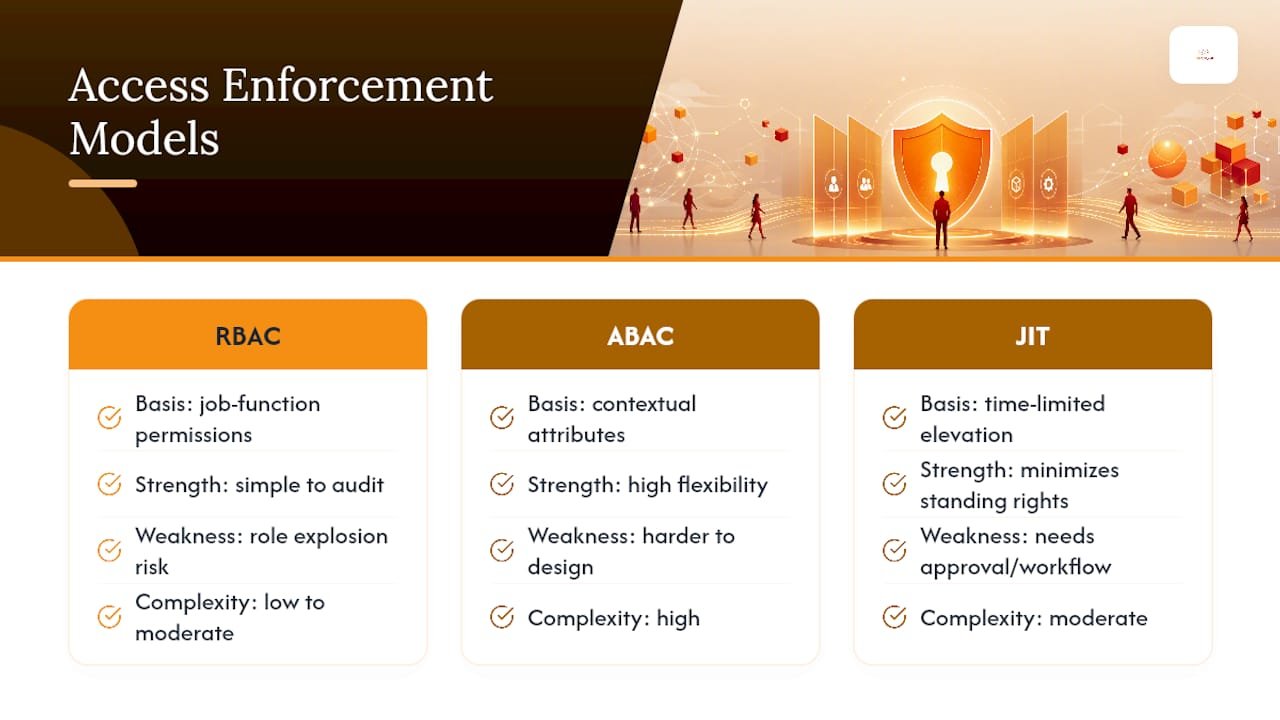
Two enforcement models dominate real-world deployments. Role-based access control (RBAC) assigns permissions by job function. It’s simple to audit but gets messy when roles multiply. Attribute-based access control (ABAC) grants access based on context: department, device health, location, time of day. It’s more flexible, but harder to design cleanly.
Just-in-time (JIT) elevation adds a time dimension to either model. Instead of standing admin rights, a user requests elevated access, gets it for a defined window, and loses it automatically when the task ends.
Not every identity carries the same risk. Privileged human users, service accounts, and non-human identities like API keys and automation scripts all need distinct handling, since a compromised service account often has broader reach than a compromised employee login.
What Are the Benefits of Least Privilege Access?
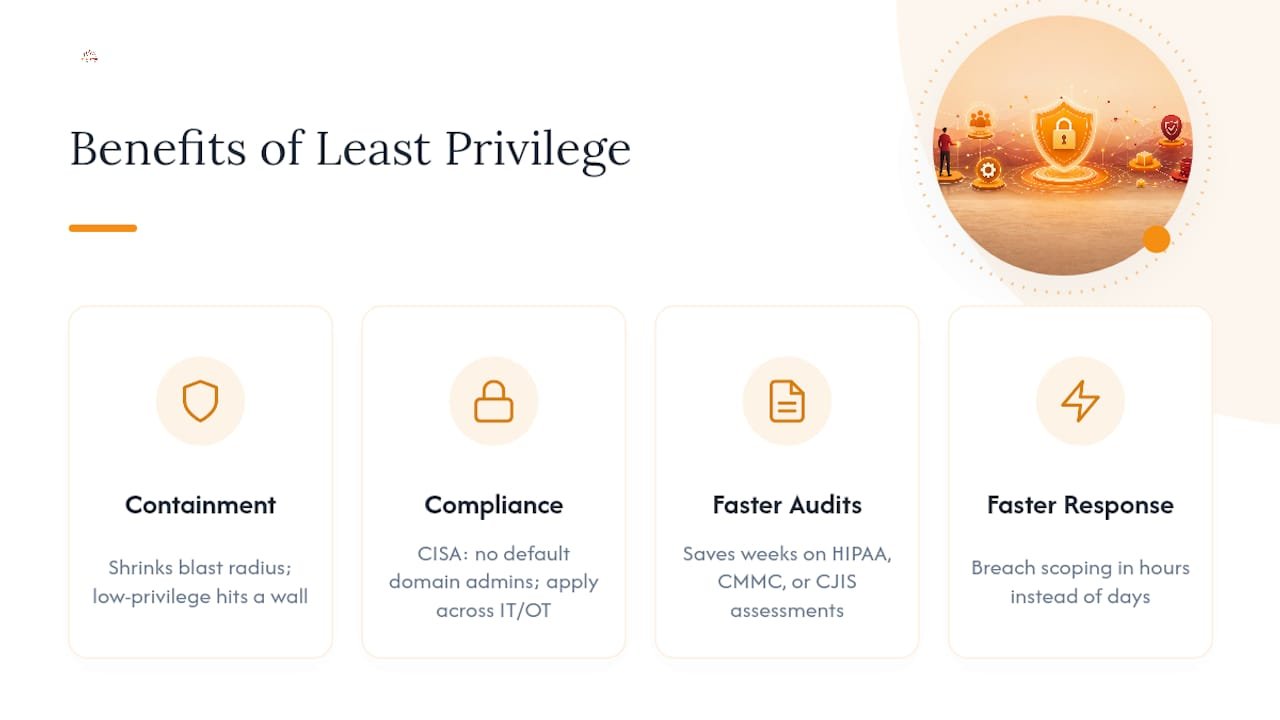
Least privilege shrinks the blast radius of every breach. When an attacker compromises a low-privilege account, they hit a wall instead of a wide-open network. That containment effect is the entire point of the control, and it’s why CISA ties granular privilege management directly to reduced initial-access exploitation.
Statistic Callout: CISA’s Cross-Sector Cybersecurity Performance Goals set a specific, measurable bar: no accounts should carry default domain administrator rights, and least privilege must be applied to every administrator or privileged account across both IT and OT environments.
Compliance auditors expect to see this control mapped explicitly, and having it documented saves weeks during HIPAA, CMMC, or CJIS assessments. Beyond audits, least privilege makes incident response faster. When you already know exactly who can touch what, scoping a breach takes hours instead of days. A clean entitlement inventory turns “who has access to this server” from a scramble into a lookup.
How Do You Implement Least Privilege Access Step by Step?
Rolling out least privilege access works best as a sequence, not a single project. Skipping steps almost always creates the privilege creep you’re trying to eliminate.
- Inventory and classify. Catalog every identity, human and non-human, along with the entitlements and assets each one touches. You cannot restrict what you cannot see.
- Prioritize by risk. Start with domain admins, cloud console owners, and anything internet-facing. These accounts do the most damage if compromised, so they get fixed first.
- Design minimal roles. Build roles around actual job functions rather than copying an existing employee’s access, and require a written justification for every grant that falls outside the standard role.
- Enforce through JIT and hardened access paths. Pair just-in-time provisioning with dedicated administrative workstations, multifactor authentication, and session monitoring. CISA specifically recommends limiting remote administrative access as one of the highest-value mitigations available.
- Build a temporary escalation workflow. Any elevated access should expire automatically and log an audit trail, no exceptions.
- Rotate credentials and formalize offboarding. Every departure, role change, or contract end should trigger immediate revocation, not a ticket that sits in a queue for a week.
Pro Tip: Privilege creep rarely happens in one dramatic event. It builds up through a hundred small “just this once” temporary grants that nobody remembers to revoke. Treat every temporary access request as if it will be forgotten, because statistically, it will.
Who Owns Least Privilege Policy and Governance?
Least privilege access only holds up over time with clear ownership and a repeatable review cycle. IAM teams typically own the technical enforcement, system owners own the entitlement decisions for their platforms, and HR needs to feed join, move, and leave events directly into the access workflow so terminated employees lose access the same day, not the same quarter.
Set a fixed cadence for access certification. CISA recommends quarterly reviews of access permissions and role assignments as the baseline for every account type, not just privileged ones.
Track a small set of metrics to know whether the policy is actually working:
- Privilege creep rate: the percentage of accounts holding access beyond their current role.
- Time-to-revoke: how long it takes to pull access after a role change or termination.
- Number of active exceptions and how many have passed their expiration date.
Every exception needs a documented rationale and a hard expiry date. An exception without an expiration date isn’t an exception anymore. It’s a permanent hole.
What Tools Support Least Privilege Enforcement?
Different tool categories solve different pieces of the least privilege puzzle, and most mid-market organizations need at least two or three working together.
- Identity governance and administration (IGA) platforms manage the full identity lifecycle, reconcile entitlements against role baselines, and generate the certification records auditors ask for.
- Privileged access management (PAM) tools handle just-in-time elevation, credential vaulting, and session recording for your highest-risk accounts. Separating privileged accounts into a dedicated PAM system with JIT provisioning is one of the clearest ways to shrink standing access.
- Secrets management systems handle the non-human identities that traditional IAM tools often miss, like API keys, service account credentials, and automation tokens.
- Architectural controls, including dedicated admin workstations, network segmentation, and zero trust network access (ZTNA), reduce exposure even before an access decision gets made.
Pro Tip: Before buying anything, map your tool evaluation to three questions: does it scale with your identity count, does it automate reconciliation instead of relying on manual spreadsheets, and does it integrate with your existing HR and logging systems? A tool that fails any of the three will create more manual work than it saves.
How Does Least Privilege Map to NIST and CISA Standards?
NIST SP 800-53’s AC-6 control is the backbone most compliance frameworks reference when they require least privilege. It’s more specific than the plain-language principle suggests.
AC-6 requires organizations to authorize access to security functions explicitly, restrict privileged accounts to only those functions that require them, review the privileges assigned to users on a defined schedule, and log privileged functions for audit purposes.
NIST SP 800-53 Revision 5 gives you the exact control language auditors expect. Pair it with CISA’s CPG guidance for the operational cadence, and you have both the “what” and the “how often” documented in a form auditors can verify without a follow-up meeting.
How Do You Monitor Least Privilege Once It’s in Place?
A least privilege policy without monitoring is a policy on paper. Log every privileged action and every elevation event, then alert on anything that deviates from the baseline, like an admin account authenticating from an unfamiliar location.
- Store access certification records in a format auditors can pull without a manual reconstruction project.
- Watch privilege creep rate and time-to-revoke as leading indicators; a rising trend on either means the review cadence needs tightening.
- Automate entitlement reconciliation against role baselines rather than relying on spreadsheets someone updates twice a year.
Statistic Callout: CISA’s guidance on identity and access management points to automated lifecycle management, driven by HR join, move, and leave events, as the practice that keeps entitlement drift from compounding between review cycles.
What Total Cyber Sees in Real Least Privilege Engagements
Some cybersecurity service providers work with small and mid-market businesses on exactly this kind of access hardening, through managed cybersecurity services, vCSO leadership, and risk assessments built around frameworks like NIST and CMMC.
A typical engagement starts the same way this article does: a full access inventory, followed by a prioritized remediation plan that tackles admin and internet-facing accounts first. From there, clients get advisory support on PAM and identity governance tooling, plus a handoff plan for quarterly reviews so the work doesn’t quietly unravel six months later.
If your organization needs a second set of eyes on where standing access has piled up, request a discovery call through the MSP assessment form.
— Alden
Get a Managed Least Privilege Assessment
Most SMBs know they have an access sprawl problem. Almost none of them have the internal bandwidth to fix it properly, on top of everything else IT already owns.

A managed assessment may deliver three concrete things: a full identity and entitlement inventory, a prioritized remediation plan ranked by actual risk exposure, and a set of quick wins your team can close in the first month, not the first year. This fits IT leaders at small and mid-market organizations who need to show measurable progress on access control without hiring a dedicated identity team. Total Cyber’s managed cybersecurity services build the ongoing quarterly review process directly into the engagement, so the work doesn’t stall once the initial project ends.
Request a discovery call through the MSP assessment form and get a scoped plan back before your next audit cycle.
Sources
- Weak security controls and practices routinely exploited for initial access | CISA
- NIST SP 800-53, Revision 5 — Security and privacy controls for information systems and organizations
- Identity and access management: recommended best practices for administrators | CISA
FAQ
What Is an Example of a PAM Tool?
A privileged access management tool typically vaults admin credentials, grants just-in-time elevation for a defined time window, and records the session for audit purposes rather than leaving standing admin rights active indefinitely.
What Is the Difference Between Zero Trust and Least Privilege Access?
Least privilege defines how much access an identity gets, while zero trust defines how that access gets verified continuously. CISA treats the two as complementary, with zero trust architecture enforcing the least privilege grants at every access attempt.
Can You Give an Example of a Least Privilege Policy?
A common policy states that no standard user account holds domain administrator rights by default, and any administrative task requires a time-limited, logged elevation request rather than standing access.
What Does NIST SP 800-53 Say About the Principle of Least Privilege?
NIST’s AC-6 control requires organizations to authorize privileged functions explicitly, restrict privileged accounts to necessary functions only, review user privileges on a defined schedule, and log privileged actions, as detailed in NIST SP 800-53 Revision 5.