

A HIPAA business associate agreement is required whenever a vendor creates, receives, maintains, or transmits protected health information on behalf of a covered entity. That agreement has to do real work: it limits how the vendor uses PHI, forces specific security safeguards, sets breach reporting deadlines, and requires the vendor to bind its own subcontractors to the same rules. The Department of Health and Human Services (HHS) and the regulatory text at 45 CFR 164.504(e) spell out exactly what belongs in that contract, and skipping any piece of it is a compliance gap, not a technicality.
TL;DR:
- A compliant BAA must specifically outline how PHI can be used, prohibit further disclosures, and include safeguards like encryption and access controls.
- Vendors with access to PHI, including cloud providers, billing firms, and data analytics companies, need a signed BAA before handling any protected information.
- The agreement must also address breach reporting timelines, subcontractor flow-down obligations, and the return or destruction of PHI at the end of the contract.
- Broad or vague access permissions are a common risk factor; limiting scope and verifying security measures through audits and attestations strengthen compliance.
- Managing subcontractor BAAs, conducting regular security assessments, and testing breach response plans are vital to maintaining effective HIPAA protection over time.
Table of Contents
- What Is a HIPAA Business Associate Agreement and Who Needs One?
- The Regulatory Minimums: Required BAA Elements Under 45 CFR 164.504(e)
- What Should Be on a BAA Negotiation Checklist?
- How Do You Adapt HHS Model Clauses for Your Vendors?
- Subcontractors and Cloud Providers: Who Signs What?
- What Breach Reporting Should a BAA Require?
- How Do You Keep a BAA Effective Over Time?
- Where to Find Reliable BAA Templates
- How Total Cyber Solutions Supports BAA Readiness
- An Editorial Take: Three Moves That Actually Reduce Risk
- Get Help Turning Your BAAs Into Real Protection
- Sources
- FAQ
What Is a HIPAA Business Associate Agreement and Who Needs One?
A business associate is any person or organization that performs a function involving protected health information (PHI) on behalf of a covered entity, but isn’t part of that entity’s own workforce. A covered entity is the health plan, health care clearinghouse, or health care provider that originally holds the PHI. When a covered entity hands PHI to a vendor to do a job, that vendor becomes a business associate, and HHS guidance makes clear this triggers a legal obligation before any data changes hands.
The agreement itself, commonly shortened to BAA, is the contract that makes this relationship legal under HIPAA. Without one, a covered entity that shares PHI with a vendor is out of compliance, regardless of how good the vendor’s security actually is. Paperwork matters here as much as practice.
Here’s where it gets less obvious: HIPAA doesn’t just cover the big names you’d expect. A wide range of vendor categories typically need a signed BAA before they touch PHI, including:
- Cloud hosting providers and cloud service providers (CSPs) that store or process electronic PHI
- Medical billing and claims processing companies
- Medical transcription services
- Managed IT and managed cybersecurity providers with access to systems containing PHI
- Data analytics vendors that process patient-level health data
- Answering services, scheduling platforms, and patient portal vendors
Subcontractors count too. If your billing company outsources part of its work to another firm, that downstream vendor is a business associate of the business associate, and it needs its own BAA before it sees a single record.
There are exceptions worth knowing, because not every disclosure of PHI requires a contract. A BAA is not required when a health care provider discloses PHI to another health care provider for treatment purposes. A hospital referring a patient to a specialist doesn’t need a BAA with that specialist. Certain conduits, like postal services or internet service providers that merely transport data without accessing its content in any meaningful way, also fall outside the BAA requirement. The line HHS draws is about access and function, not just proximity to data.
The Regulatory Minimums: Required BAA Elements Under 45 CFR 164.504(e)
The regulation doesn’t leave much to interpretation. 45 CFR 164.504(e) lists specific clauses a BAA must contain, and HHS’s own model provisions show what compliant language looks like in practice.
By the numbers: A compliant BAA must address at least eight distinct regulatory requirements, from permitted uses of PHI to the mechanics of returning or destroying it at contract’s end, according to HHS’s summary of business associate obligations.
Here’s what each required element actually needs to say, and who typically owns enforcing it:
-
Permitted and required uses of PHI. The contract has to spell out exactly what the vendor is allowed to do with the data, tied directly to the services it’s providing. Vague language like “as needed for services” doesn’t cut it. Compliance officers should push vendors to name specific functions.
-
Prohibition on further use or disclosure. The BAA must state that the vendor cannot use PHI beyond what the contract or the law permits. This is the clause that closes the door on a vendor repurposing patient data for its own analytics or marketing.
-
Appropriate safeguards. The vendor must implement safeguards that satisfy the HIPAA Security Rule for any electronic PHI it touches. This is where encryption, access controls, and monitoring commitments belong, and it’s the clause IT and security leaders should scrutinize hardest.
-
Reporting of security incidents and breaches. The agreement must require the vendor to report any use or disclosure not permitted by the contract, including breaches of unsecured PHI, generally without unreasonable delay.
-
Subcontractor flow-down. If the vendor uses subcontractors that touch PHI, the BAA must require those subcontractors to agree to the same restrictions and conditions.
-
Support for individual rights. The vendor has to make PHI available for the individual’s right of access, and cooperate with amendment requests and accounting of disclosures.
-
HHS access for compliance review. The vendor must make its internal practices, books, and records available to HHS for determining the covered entity’s compliance.
-
Return or destruction of PHI at termination. When the relationship ends, the vendor must return or destroy all PHI it holds, and where that’s not feasible, extend the same protections indefinitely.
The HHS model business associate agreement puts all eight into working legal language, and it’s the reference point most compliance teams start from rather than drafting from a blank page.
What Should Be on a BAA Negotiation Checklist?
Meeting the regulatory floor is one thing. Actually protecting your organization when a vendor’s environment gets breached is another. A practical drafting checklist goes further than the eight required elements.
Start with minimum necessary scoping. Describe the vendor’s services narrowly enough that the PHI access granted matches the actual job. A reputable law-firm checklist recommends naming specific data fields or record types rather than granting blanket access to “all patient data.” Scope creep here is one of the most common ways a vendor relationship quietly turns into an unmanaged risk. Overly broad vendor access, not sophisticated attacks, is behind a lot of enforcement exposure HHS has flagged.
Security baselines deserve their own line items, not a general “reasonable safeguards” clause. Require:
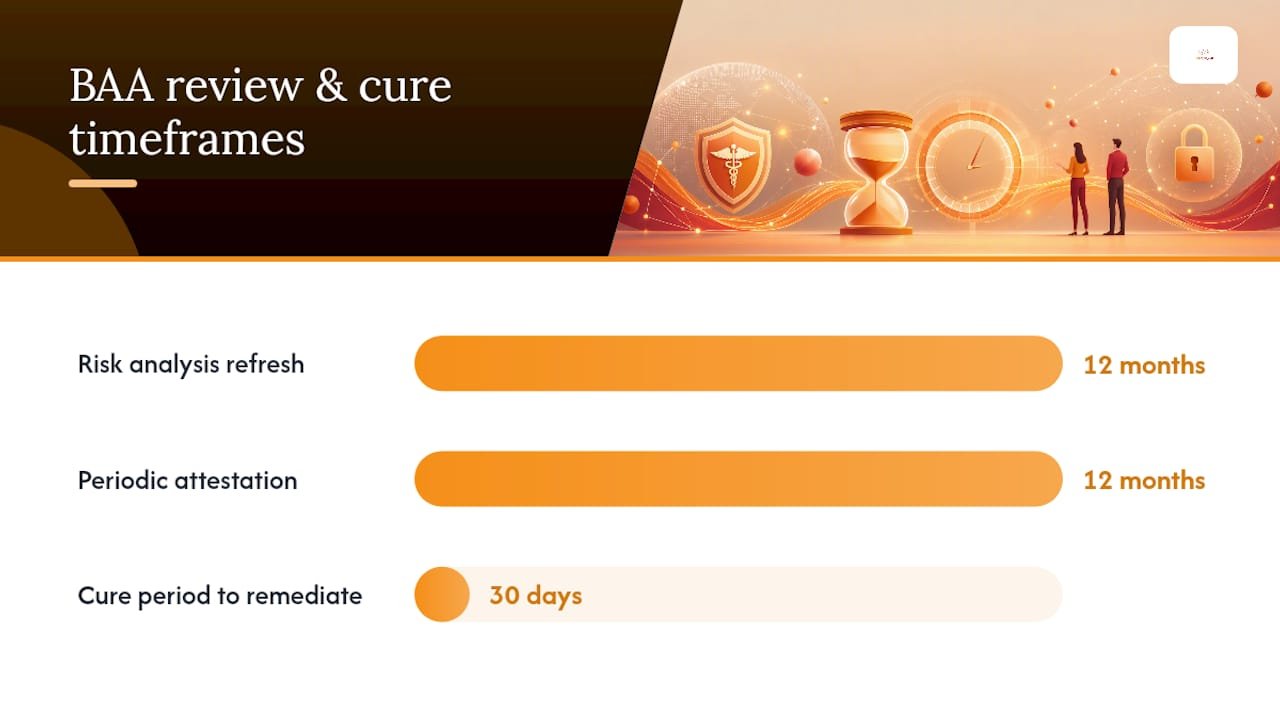
- A documented risk analysis, refreshed on a set schedule (annually is common)
- Multi-factor authentication on any system with PHI access
- Encryption for PHI at rest and in transit
- Logging and monitoring sufficient to reconstruct who accessed what, and when
- Periodic attestation, ideally every 12 months, confirming these controls remain in place
Pro Tip: Don’t accept “we follow industry best practices” as a substitute for specifics. Ask the vendor to attach their actual encryption standard, MFA policy, and last risk assessment date as exhibits to the BAA. If they can’t produce them, that tells you something.
Negotiation points matter just as much as required clauses. Push for audit and cooperation rights, so you can verify compliance rather than take it on faith. Insist on clear liability and cyber insurance language, specifying who bears cost if a breach originates on the vendor’s side. Nail down termination rights that let you exit quickly if the vendor’s security posture deteriorates. If any part of the vendor’s operation touches PHI outside the United States, address cross-border data access explicitly. And set a defined cure period, typically 30 days, for the vendor to fix a discovered gap before the relationship terminates.
How Do You Adapt HHS Model Clauses for Your Vendors?
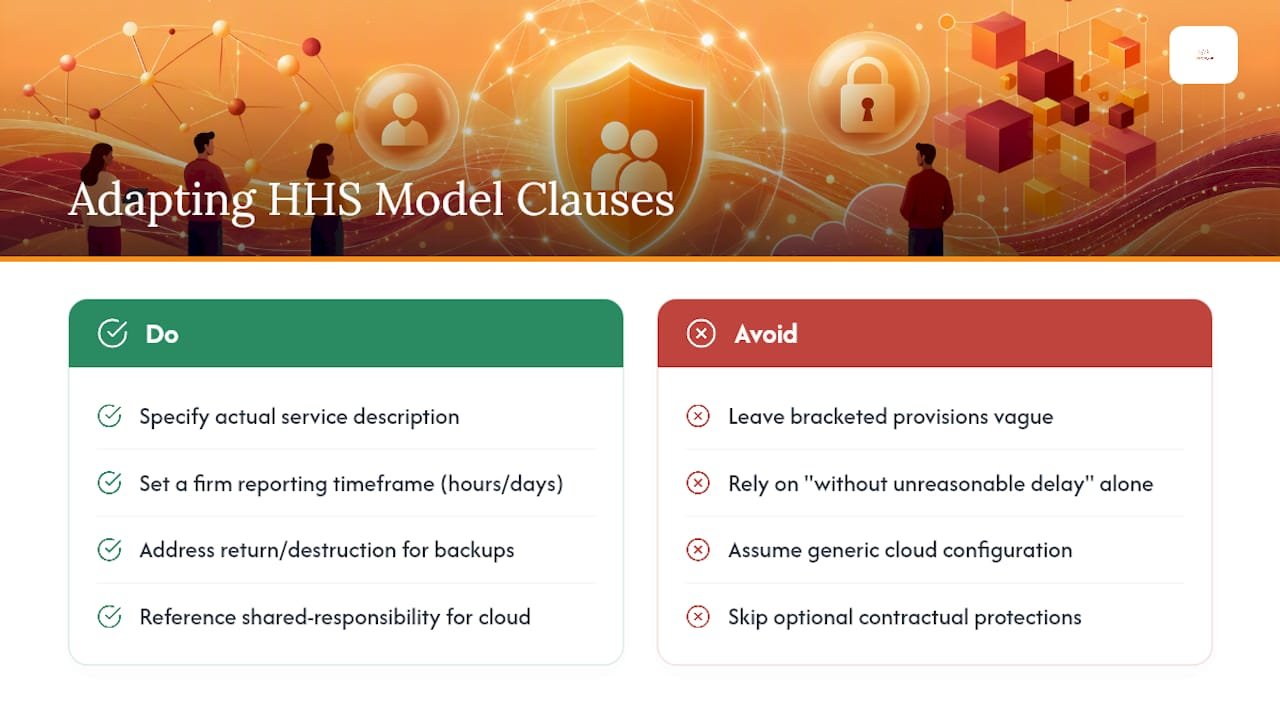
The HHS model BAA isn’t a form you fill in blindly. It’s a framework built around bracketed placeholders that you have to adapt to the actual vendor relationship in front of you.
The permitted uses clause in the model language typically reads something like “Business Associate may use or disclose Protected Health Information as necessary to perform the services set forth in [Service Agreement].” That bracket needs the actual service description, whether it’s claims processing, IT infrastructure management, or transcription. Vague brackets produce vague contracts.
The reporting clause follows a similar pattern, with HHS sample provisions requiring notice “without unreasonable delay” but leaving the exact timeframe open for negotiation. Many organizations tighten this to a specific number of hours or days rather than relying on an ambiguous standard.
Return or destruction language is where HHS gives useful flexibility. The model addresses situations where destruction isn’t feasible, such as data trapped in backup systems, by requiring the protections to extend indefinitely instead. That’s a critical adaptation point for cloud-based vendors whose backup architecture makes clean deletion complicated.
For cloud services specifically, the clause language should reference the shared responsibility model. A CSP that stores or processes ePHI is a business associate regardless of whether it ever actually looks at the data, and the BAA needs to reflect that the covered entity’s risk analysis accounts for the CSP’s specific configuration, not a generic cloud assumption.
Optional protections worth inserting beyond the HHS baseline include audit rights, insurance minimums, and indemnification language for costs tied to a vendor-side breach. None of these are required by regulation, but all three show up repeatedly in stronger, negotiated agreements.
Subcontractors and Cloud Providers: Who Signs What?
Every business associate that uses a subcontractor touching PHI has to get that subcontractor to sign an agreement with terms at least as protective as its own BAA with the covered entity. This is the flow-down requirement, and HHS is explicit that it expects covered entities to hold their business associates accountable for enforcing this chain, not just assume it happens.
In practice, this means a single covered entity’s PHI might pass through three or four contractual layers before it reaches whoever’s actually storing or processing it. Each layer needs its own signed BAA. Miss one link, and the entire chain is technically noncompliant, even if every individual vendor has reasonable security.
Cloud service providers deserve particular attention because SLA terms and BAA obligations aren’t automatically the same thing. A service level agreement covers uptime, support response times, and performance guarantees. A BAA covers what happens to PHI. A CSP can meet every SLA metric while still falling short of BAA obligations around breach notification or subcontractor flow-down, so both documents need to align, not just coexist.
Managing this at scale takes a real vendor-management process, not a filing cabinet full of signed contracts:
- Keep a live inventory of every vendor with PHI access, updated when relationships start or end
- Collect attestations on a set cadence rather than accepting a one-time signature as permanent proof
- Request penetration test summaries or evidence of recent security assessments from vendors handling significant PHI volume
- Confirm every subcontractor in the chain has its own signed, equivalent BAA on file, not just a verbal assurance
A cloud security posture that looks solid on paper can still hide gaps in how a CSP’s subcontractors handle data, which is exactly why the inventory step matters more than most organizations initially assume.
What Breach Reporting Should a BAA Require?
Not every security event is a reportable breach, and a BAA needs to draw that line clearly rather than leave it for a crisis moment to sort out. A security incident, like a blocked phishing attempt or an unsuccessful intrusion try, is different from a breach of unsecured PHI, which typically triggers a notification obligation and can start the clock on OCR reporting timelines.
A well-drafted BAA should require, in sequence:
- Immediate informal notice to the covered entity as soon as the business associate discovers a potential incident, even before full details are confirmed.
- A formal written breach report within a defined window, commonly 10 to 30 business days depending on negotiated terms, containing what PHI was involved, how many individuals were affected, and what containment steps were taken.
- Ongoing cooperation through the covered entity’s own OCR reporting process, since the covered entity, not the business associate, generally bears the ultimate notification duty to HHS and affected individuals.
By the numbers: Business associates carry direct regulatory liability for certain HIPAA violations and for failing to safeguard ePHI under the Security Rule, a shift introduced by the HIPAA Omnibus Rule that made vendors accountable in their own right, not just through the covered entity.
Coordination responsibilities belong in the contract too. Specify who leads containment, who preserves forensic evidence, and how joint communications to affected patients or regulators get handled so two parties aren’t drafting conflicting public statements during an active incident. A breach notification checklist built around a specific timeline can help clarify these overlapping duties before an actual event forces the question.
How Do You Keep a BAA Effective Over Time?
Signing a BAA is the easy part. Keeping it meaningful for the life of the vendor relationship takes ongoing verification, not a file-and-forget approach.
Periodic verification should include:
- Annual or semiannual attestations confirming the vendor’s safeguards remain in place
- Documented risk assessments that specifically address the vendor’s role in your PHI environment
- Evidence of workforce training the vendor provides its own staff on PHI handling
- Recent penetration test or vulnerability scan results, especially for vendors with direct system access
Termination triggers the return or destruction clause, and this is where organizations often stumble. If PHI lives in backup systems or archived logs that can’t be cleanly purged, the contract should already specify that protections extend to that residual data indefinitely rather than leaving a gap once active service ends.
Retention obligations don’t disappear at termination either. Both parties should keep documentation of the BAA relationship, including attestations and incident records, for at least six years to satisfy HIPAA’s general documentation retention standard and to have evidence ready if OCR ever opens an inquiry.
Where to Find Reliable BAA Templates
Start with the primary source. The HHS model BAA and its accompanying sample provisions page are free, authoritative, and updated to reflect current regulatory expectations. A detailed checklist of required and optional terms from experienced health law practitioners fills the practical gaps the government template leaves open.
A template works fine for straightforward vendor relationships, like a single-purpose billing service with a narrow scope. Retain legal counsel when the arrangement involves complex service stacks, cross-border data flows, high-risk PHI volumes, or a subcontractor chain more than two layers deep. Adapting official HHS language is generally permitted since it’s public domain, but confirm any third-party checklist’s licensing terms before copying language verbatim into a live contract.
How Total Cyber Solutions Supports BAA Readiness
This cybersecurity and IT services company helps organizations meet regulatory obligations without guessing their way through it. Health care clients and their vendors seek assistance for HIPAA risk assessments, policy compliance support, breach response planning, workforce training, and ongoing vendor oversight, the same categories that show up throughout every section of a well-built BAA.
The practical path looks like this: an assessment identifies where PHI actually flows through your vendor ecosystem, remediation closes the gaps a BAA review turns up, and ongoing monitoring keeps attestations, risk assessments, and incident response plans current instead of stale. Submit an inquiry through the MSP intake form and a member of the team will walk through your current vendor landscape and flag where your BAAs need reinforcement.
An Editorial Take: Three Moves That Actually Reduce Risk
Most organizations treat the BAA as a signature to collect and file away. That’s backwards. The agreement only does its job if someone actually enforces what it says.
If I had to prioritize, I’d start with scoping. Narrow the minimum necessary language in every BAA before worrying about anything else, because broad access is the single easiest thing to fix and the single most common way vendor relationships turn into liabilities. Second, chase down subcontractor BAAs specifically. Covered entities rarely verify the third and fourth layer of a vendor chain, and that’s exactly where OCR expects enforcement to happen. Third, actually test breach response with your vendors before you need it. A contract clause requiring notice “without unreasonable delay” means nothing if nobody has rehearsed what happens in the first 24 hours.
The reputational cost of PHI mishandling tends to outlast the regulatory penalty. Patients remember which organization lost their data long after the settlement gets paid.
— Alden
Get Help Turning Your BAAs Into Real Protection
Reading through 45 CFR 164.504(e) is one thing. Verifying that every vendor touching your organization’s PHI actually meets those standards, and keeping that verification current as vendors change, is a different job entirely, and it’s the job Total Cyber Solutions specializes in for small and mid-sized health care organizations.

Total Cyber’s Managed Cybersecurity Services and Policy Compliance offering exist for exactly the gap most compliance officers run into: knowing what a BAA should require in theory, and confirming a specific vendor actually meets it in practice. That includes HIPAA risk assessments that map your PHI vendor relationships, workforce training that keeps staff from creating the access sprawl a BAA is supposed to prevent, and ongoing monitoring so attestations don’t quietly go stale a year after signing.
Fill out the MSP intake form to start. After you submit it, expect a conversation about your current vendor landscape, where your BAAs stand today, and what an assessment would look like for your specific environment before anything moves to remediation or ongoing monitoring.
This article is general information, not a substitute for advice from a qualified lawyer. Consult a qualified legal professional about your own circumstances before acting on anything here.
Sources
FAQ
Does HIPAA Require a Business Associate Agreement?
Yes. HIPAA requires a signed BAA whenever a covered entity discloses PHI to a vendor that will create, receive, maintain, or transmit that data on its behalf, according to HHS.
Does the HIPAA Privacy Rule Apply to Business Associates?
Yes, though indirectly at first. The Privacy Rule’s restrictions on PHI use and disclosure apply to business associates through the terms required in their BAA, and the HIPAA Omnibus Rule made business associates directly liable for certain violations rather than only through the covered entity.
What Are the Requirements for a BAA Agreement?
At minimum, a BAA must define permitted PHI uses, prohibit unauthorized use, require Security Rule safeguards, mandate breach reporting, ensure subcontractor flow-down, support individual rights requests, allow HHS access for compliance review, and require return or destruction of PHI at termination, per 45 CFR 164.504(e).
What Is an Example of a Business Associate Under HIPAA?
Common examples include cloud hosting providers, medical billing companies, managed IT and cybersecurity providers, transcription services, and health data analytics vendors, any organization performing a function involving PHI on behalf of a covered entity or another business associate.
When Is a BAA Not Required?
A BAA typically isn’t required for treatment-related disclosures between health care providers, or for conduits like postal services and internet providers that transport data without meaningfully accessing its content.