

Cybersecurity compliance is defined as the practice of adhering to laws, regulations, and industry standards designed to protect digital assets, systems, and data from unauthorized access or breach. Frameworks like GDPR, HIPAA, and the NIST Cybersecurity Framework establish the minimum security baselines that organizations must meet to operate legally and responsibly. For business owners and compliance officers at small to medium-sized enterprises, understanding what is cybersecurity compliance is not optional. It is the foundation of both legal standing and customer trust. This guide breaks down the key standards, practical steps, and real consequences you need to know.
What is cybersecurity compliance and why does it matter for SMEs?
Cybersecurity compliance means your business meets the specific legal and regulatory requirements that apply to your industry, location, and the type of data you handle. It covers everything from how you store customer records to how you respond when something goes wrong. Compliance builds trust with customers and partners while helping you avoid costly penalties. For an SME, that combination is not a nice-to-have. It is a business requirement.
The importance of cybersecurity compliance goes beyond checking boxes. Regulators expect you to demonstrate ongoing adherence, not just a one-time audit pass. Compliance also gives your team a clear structure. Instead of guessing what security controls to put in place, you follow a defined framework that tells you exactly what is required.

What are the main cybersecurity compliance standards for SMEs?
Compliance frameworks vary by industry and geography, so the rules that apply to a healthcare clinic differ from those that apply to an e-commerce retailer. Mapping the right regulations to your business is the first step.
Here are the frameworks SMEs most commonly encounter:
- GDPR (General Data Protection Regulation): Applies to any business that handles personal data of EU residents, regardless of where the business is located. Penalties reach up to 4% of annual global turnover.
- HIPAA (Health Insurance Portability and Accountability Act): Required for healthcare providers, insurers, and their business associates in the United States. Covers the protection of patient health information.
- PCI-DSS (Payment Card Industry Data Security Standard): Mandatory for any business that accepts, processes, or stores credit card payments. Applies across industries.
- CMMC (Cybersecurity Maturity Model Certification): Required for companies that work with the U.S. Department of Defense. Learn more about CMMC requirements and what they mean for your contracts.
- NIST CSF (National Institute of Standards and Technology Cybersecurity Framework): A voluntary but widely adopted framework that provides a common language for managing cybersecurity risk. Many federal contractors treat it as mandatory in practice.
- SOX (Sarbanes-Oxley Act): Applies to publicly traded companies and their financial data security controls.
| Standard | Sector | Key requirement |
|---|---|---|
| GDPR | Any (EU data) | Data protection, breach notification |
| HIPAA | Healthcare (US) | Protected health information safeguards |
| PCI-DSS | Payment processing | Cardholder data security controls |
| CMMC | Defense contractors | Tiered cybersecurity maturity levels |
| NIST CSF | Cross-sector | Risk-based security framework |
| SOX | Public companies | Financial data integrity controls |
The NIST Cybersecurity Framework is a strong starting point for SMEs that are not sure which standard to follow first. It maps well to most other frameworks and gives you a practical structure to build from.
How does cybersecurity compliance differ from general cybersecurity?
Compliance is the floor, not the ceiling. Compliance sets the legal minimum your business must meet. Cybersecurity is the broader, ongoing effort to defend against threats that go well beyond what any regulation requires.
Think of it this way. A regulation might require you to encrypt stored data. That is compliance. But a sophisticated attacker targeting your employees through phishing emails is a threat that no checklist automatically stops. That is where active cybersecurity practice takes over.
The two work together, but they are not the same thing:
- Compliance answers the question: “Are we meeting the legal requirements?”
- Cybersecurity answers the question: “Are we actually protected against real threats?”
A business can pass a compliance audit and still suffer a breach. That happens when teams treat compliance as a destination rather than a guardrail. The goal is to use compliance frameworks as a foundation and then build stronger defenses on top of them.
Pro Tip: Map your existing security controls to your required compliance framework before your next audit. You will often find you are already meeting more requirements than you think, which makes the gaps easier to prioritize.
How to achieve cybersecurity compliance: practical steps for SMEs
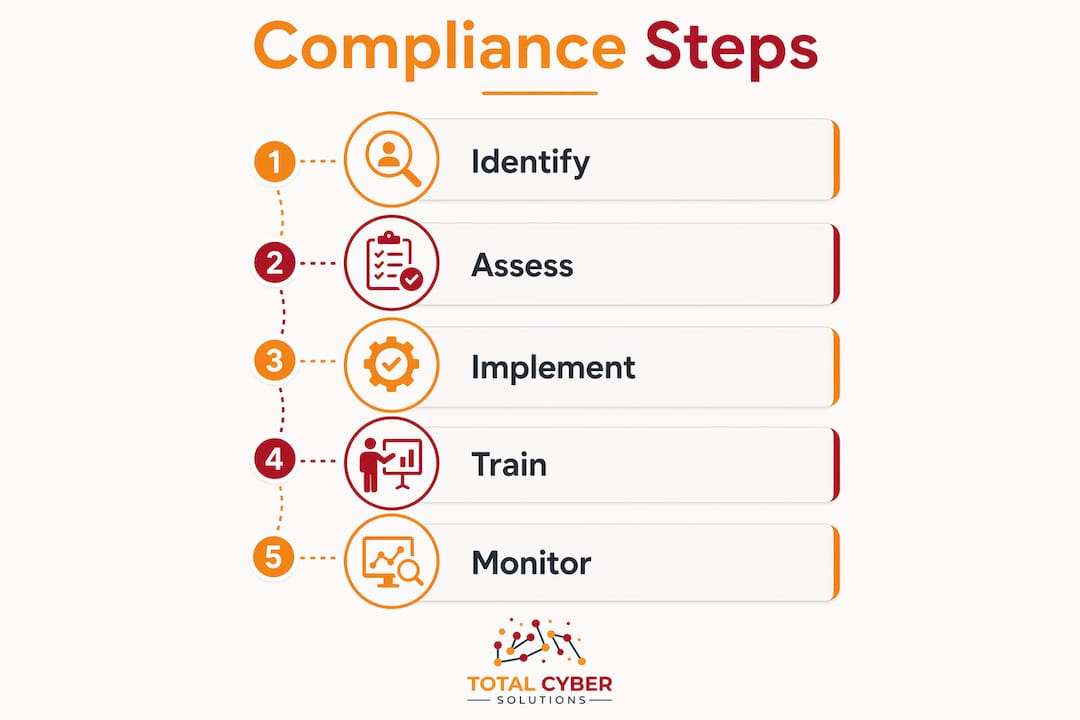
Getting compliant does not require a massive IT department. It requires a clear process. Key compliance activities include risk assessments, access controls, data encryption, incident response plans, and breach notifications. Here is how to work through them.
1. Identify which regulations apply to you.
Start by listing the types of data you collect, the industries you serve, and the locations of your customers. A healthcare billing company in Texas, for example, must address HIPAA and likely PCI-DSS. A defense subcontractor must address CMMC. Getting this wrong means preparing for the wrong audit.
2. Conduct a risk assessment.
A risk assessment identifies where your data lives, who can access it, and what could go wrong. This is the foundation of any compliance program. Totalcyber’s vulnerability assessment services help SMEs find and prioritize gaps before regulators or attackers do.
3. Implement required security controls.
Controls are the specific technical and administrative measures you put in place. Common requirements across most frameworks include:
- Multi-factor authentication for system access
- Encryption of data at rest and in transit
- Role-based access controls that limit who sees what
- A documented incident response plan
- Regular patch management and software updates
4. Train your employees.
Continuous compliance requires training, technology, and policy enforcement working together. A phishing email that bypasses your firewall still gets stopped if your employee recognizes it and reports it. Training is not a one-time event. It needs to happen regularly and cover real scenarios your team actually faces.
5. Monitor continuously and audit regularly.
Regular audits and monitoring are necessary to maintain ongoing compliance. Set a schedule for internal reviews, log monitoring, and third-party audits. Compliance is not a one-time effort. Regulations change, your systems change, and your risk profile changes with them.
Pro Tip: Build a simple cybersecurity compliance checklist tied to your specific framework. Review it quarterly. A short, focused review every 90 days beats a frantic scramble before an annual audit every time.
What are the risks of failing cybersecurity compliance?
The consequences of non-compliance are not theoretical. They are financial, legal, and reputational, and they hit SMEs harder than large enterprises because smaller businesses have less capacity to absorb the damage.
“Failure to comply can lead to severe consequences beyond fines, including loss of business licenses and irreparable reputational harm.” Cleveland State University College of Law
The specific risks include:
- Regulatory fines: GDPR penalties reach up to 4% of annual global turnover. For a business generating $5 million in revenue, that is a $200,000 fine for a single violation.
- Data breach costs: A breach that follows a compliance failure often triggers both regulatory penalties and civil litigation. The costs compound quickly.
- Loss of contracts: Defense contractors who fail CMMC certification lose their eligibility to bid on federal contracts. Healthcare vendors who fail HIPAA audits lose hospital partnerships.
- Reputational damage: Customers who learn their data was exposed because you skipped required safeguards do not come back. That loss of trust is harder to recover from than any fine.
- Business license suspension: Regulators in certain industries can suspend or revoke operating licenses for repeated or severe non-compliance.
Non-compliance risks go well beyond fines. The operational disruption alone from a breach investigation can shut down a small business for days or weeks. The question is not whether compliance is worth the effort. The question is whether you can afford to skip it.
Key Takeaways
Cybersecurity compliance is the legal and regulatory baseline every SME must meet, and failing it carries financial, legal, and reputational consequences that most small businesses cannot absorb.
| Point | Details |
|---|---|
| Compliance is the legal floor | Meeting frameworks like GDPR, HIPAA, or NIST CSF is the minimum required, not the full security picture. |
| Frameworks vary by industry | Map your applicable regulations based on your sector, data type, and customer location before building controls. |
| Compliance and cybersecurity differ | Passing an audit does not mean you are protected; active defense goes beyond what any checklist requires. |
| Five steps to get compliant | Identify regulations, assess risk, implement controls, train staff, and monitor continuously. |
| Non-compliance is costly | Penalties, lost contracts, and reputational damage hit SMEs harder than large enterprises. |
Compliance is a process, not a project
I have worked with enough SMEs to know that most of them treat compliance like a fire drill. Something happens, a contract requires a certification, or an auditor shows up, and suddenly everyone scrambles. The problem is that scrambling produces paperwork, not real security.
The businesses that handle compliance well treat it as an ongoing process built into how they operate. They do not wait for an audit to review their access controls. They do not train employees once a year and call it done. They build compliance into their calendar, their vendor contracts, and their hiring decisions.
The other thing I see underestimated constantly is incident response planning. Most SMEs have some version of a firewall and antivirus. Very few have a written, tested plan for what happens when something gets through. That plan is a compliance requirement under most major frameworks. It is also the difference between a contained incident and a business-ending breach.
Compliance is not the enemy of growth. Done right, it is the guardrail that lets you grow without the kind of exposure that wipes out years of work in a single bad week.
— Alden
How Totalcyber helps SMEs stay compliant year-round
Running a business is already a full-time job. Adding compliance management on top of it stretches most teams past their limit.

Totalcyber is a veteran-owned cybersecurity and IT services company built specifically to help SMEs meet and maintain their compliance requirements without building an internal security department from scratch. From managed cybersecurity services that cover continuous monitoring and policy enforcement, to compliance consulting that maps your business to the right frameworks, Totalcyber handles the technical work so you can focus on running your business. Ready to find out where you stand? Contact Totalcyber today and get a clear picture of your compliance posture.
FAQ
What is cybersecurity compliance in simple terms?
Cybersecurity compliance is the process of meeting the legal and regulatory requirements that govern how your business protects digital data and systems. It is defined by frameworks like GDPR, HIPAA, and NIST CSF, depending on your industry.
What is the difference between cybersecurity and compliance?
Compliance sets the legal minimum your business must meet. Cybersecurity is the broader, ongoing practice of defending against threats that go beyond what any regulation requires. You need both.
What happens if an SME fails cybersecurity compliance?
Non-compliance can result in regulatory fines, loss of business licenses, contract termination, and reputational damage. GDPR penalties alone can reach up to 4% of annual global turnover.
How do I know which cybersecurity regulations apply to my business?
Start by identifying the type of data you collect, the industry you operate in, and where your customers are located. A healthcare business in the U.S. faces HIPAA. A business processing credit cards faces PCI-DSS. A defense contractor faces CMMC.
How often should SMEs review their compliance status?
Compliance requires continuous monitoring, not annual reviews. Regulations change, systems change, and new threats emerge. Quarterly internal reviews combined with annual third-party audits give SMEs the coverage they need to stay current.