

DFARS 252.204-7012 and NIST SP 800-171 remain mandatory today, even though CMMC Phase II third-party assessments are paused. Self-assessments, Supplier Performance Risk System (SPRS) score postings, and annual affirmations still carry legal weight. If you’re bidding on federal work, your next three moves are simple: check every solicitation for DFARS and CMMC clause language, refresh your SPRS score and System Security Plan (SSP), and search SAM.gov for opportunities that match your NAICS codes now.
TL;DR:
- Contractors must continue to comply with DFARS 252.204-7012 and update their SPRS scores, even though CMMC third-party assessments are currently paused.
- Building and maintaining an evidence-backed SSP and POA&M that map controls to actual implementation is critical for defense contracts.
- Prime contractors are responsible for ensuring subcontractor compliance with CUI handling and flowdown requirements, with regular verification and audit rights.
- The proposed FAR rule may extend NIST SP 800-171 safeguarding obligations to all federal contractors handling CUI, not just defense firms.
- The ongoing policy trend emphasizes documentation, verification, and enforcement, making proactive compliance efforts more cost-effective than waiting for final rule releases or assessment resumption.
Table of Contents
- Your Government Contractor Cybersecurity Checklist for Right Now
- What Rules Apply Now: DFARS, NIST SP 800-171, and the CMMC Pause
- How to Prepare Your Cybersecurity Posture Step by Step
- Where to Find Government Cybersecurity Contract Opportunities
- What to Put in Your SSP, POA&M, and SPRS Submission
- Enforcement Risk: False Claims Act Exposure and Incident Reporting
- How Total Cyber Solutions Helps Contractors Get Bid-Ready
- Executive Orders and Federal Directives Shaping Contractor Requirements
- Cyber Incident Response Planning Beyond DFARS 252.204-7012
- Controlled Unclassified Information Categories and Marking Requirements
- Cybersecurity Requirements in Subcontractor Management
- Prime Contractor and Subcontractor Responsibilities Explained
- Upcoming Regulatory Changes Contractors Should Watch
- Why the “Wait for CMMC to Settle” Strategy Is Backward
- Get Contract-Ready with Total Cyber Solutions
- Sources
- FAQ
Your Government Contractor Cybersecurity Checklist for Right Now
Before you submit another proposal, work through this list. It’s short on purpose. Each item protects your eligibility or your evidence trail.
- Read every solicitation line by line for DFARS 252.204-7012, DFARS 252.204-7021, and any CMMC level requirement before you spend hours on a proposal.
- Post or refresh your SPRS self-assessment score and confirm your annual affirmation is current.
- Cross-check your SSP and Plan of Action and Milestones (POA&M) against controls you’ve actually implemented, not just planned.
- Confirm your incident reporting process meets the required notification timelines.
- Set aside budget for remediation work, and keep your evidence organized as if a third-party assessor could show up next quarter.
Pro Tip: Don’t treat the CMMC pause as a green light to slow down. Government assessors under the Defense Contract Management Agency (DCMA) can still show up, and a stale POA&M is the fastest way to lose a contract you already won.
What Rules Apply Now: DFARS, NIST SP 800-171, and the CMMC Pause
DFARS 252.204-7012 has not gone anywhere. It still requires defense contractors handling covered defense information to implement NIST SP 800-171 controls and report cyber incidents on a strict timeline. That obligation exists independent of where CMMC stands.
CMMC itself is a different story. The Department of War suspended Phase II third-party assessments, and Revision 3 pushed the universal certification requirement out to November 10, 2028. In practice, contractors can satisfy Level 1 and Level 2 through self-assessment for now instead of hiring a Certified Third-Party Assessment Organization (C3PAO).
That doesn’t mean CMMC is dead. Contracting officers can still require specific CMMC levels case by case, and the DoD CIO’s program overview confirms that DCMA keeps its authority to run government-led assessments whenever it wants. Meanwhile, a proposed FAR rule (FAR Case 2026-001) could extend NIST SP 800-171 safeguarding requirements to every federal contractor touching Controlled Unclassified Information (CUI), not just defense contractors. Watch that rulemaking closely if you sell to civilian agencies.
How to Prepare Your Cybersecurity Posture Step by Step
Federal contractor security risks usually trace back to one thing: controls that exist on paper but not in practice. Here’s the order that actually works for small and mid-size firms.
- Lock down the core controls first. Multifactor authentication, access restrictions, encryption for data at rest and in transit, patch management, and centralized logging cover the majority of NIST SP 800-171’s 110 requirements.
- Build an SSP that maps controls to evidence. Every implemented control needs a corresponding log excerpt, configuration screenshot, or policy document, not just a checkbox.
- Write a POA&M you could defend under questioning. List every unresolved gap with a realistic timeline and a named owner. Vague entries like “in progress” invite scrutiny.
- Train your team and name an affirming official. Someone in your organization has to sign off on SPRS submissions and understand what they’re attesting to.
- Bring in outside help if you’re stretched thin. A vCSO or managed cybersecurity partner can compress a six-month readiness timeline into weeks.
Pro Tip: Start with access control and MFA before anything else. They’re the two controls DCMA assessors check first, and they’re the cheapest to fix.
Where to Find Government Cybersecurity Contract Opportunities
Most contractors miss opportunities because they’re relying on generic keyword alerts instead of structured searches. SAM.gov rewards specificity.
- Filter Sam by NAICS codes like 541512, 541519, and 541511, plus Product Service Codes relevant to information assurance work, instead of searching “cybersecurity” alone.
- Subscribe to agency procurement forecasts, which list upcoming buys months before a solicitation posts.
- Use set-aside filters for Service-Disabled Veteran-Owned Small Business (SDVOSB) or 8(a) status if you qualify. It narrows the field significantly.
- Attend agency industry days. Firms that show up early sometimes influence how a requirement gets written before the RFP drops.
- Watch for DFARS 252.204-7021 language inserted into new solicitations. It signals the buyer expects a CMMC status and SPRS score on file.
The SBA’s contracting guidance points to the same pattern: winning work depends as much on forecast monitoring as it does on the technical work itself.
What to Put in Your SSP, POA&M, and SPRS Submission
An assessor doesn’t want a narrative. They want proof, organized fast. Here’s what actually holds up.
- Keep your SPRS entry current, including the unique identifier and score, and renew your annual affirmation on schedule under DFARS 252.204-7021.
- Map each SSP control to a specific artifact: a log excerpt, a firewall configuration export, or a signed policy document.
- Store snapshot evidence so it’s ready inside the 14-business-day window a government assessment typically allows for rebuttal or clarification.
- Require subcontractors handling CUI to provide their own SPRS score and flow down the same DFARS clauses your prime contract carries.
Contractors who scramble to assemble evidence after a request lands almost always lose time they don’t have. Building the mapping now, while nothing is on the line, is the difference between a defensible file and a panicked one.
Enforcement Risk: False Claims Act Exposure and Incident Reporting
An inaccurate SPRS self-attestation isn’t just a paperwork problem anymore. The government has signaled a heightened enforcement posture tied to False Claims Act exposure for contractors who overstate their compliance status.
- Never post an SPRS score you can’t back up with evidence. A gap between claimed and actual implementation is the exact fact pattern that draws a False Claims Act referral.
- Follow DFARS incident reporting timelines exactly, and watch for the proposed 72-hour compromise-reporting standard under discussion in the FAR rulemaking.
- If DCMA or a contracting officer requests an assessment, respond fast with organized evidence. Delay reads as unpreparedness even when the underlying controls are solid.
- Talk to your broker about cybersecurity insurance and contractual risk transfer language to limit financial exposure if an incident happens anyway.
How Total Cyber Solutions Helps Contractors Get Bid-Ready
Total Cyber Solutions works with small and mid-size contractors on the pieces that actually move a bid forward: managed cybersecurity, CMMC consulting, vCSO leadership, penetration testing, and hands-on SSP and POA&M support. The goal is a defensible SPRS entry, evidence you can produce in minutes instead of days, and a proposal that reads as genuinely ready rather than aspirational. If you want a straight conversation about where your posture stands, request a discovery call through the MSP form.
Executive Orders and Federal Directives Shaping Contractor Requirements
Federal cybersecurity policy hasn’t stood still. Executive-level directives over the past several years have consistently pushed toward stronger baseline requirements for anyone touching federal systems or data, and that pressure filters down into acquisition rules like DFARS and the FAR.
The practical thread connecting these directives is a shift from voluntary best practice to contractual obligation. What used to be “recommended” cybersecurity hygiene, things like multifactor authentication and endpoint logging, now shows up as a scored requirement in NIST SP 800-171 and gets checked against your SPRS submission. The proposed FAR Case 2026-001 rule fits this pattern exactly: it would take a requirement that currently applies mainly to defense contractors and extend it government-wide to anyone handling CUI.
For a small or mid-size contractor, the lesson isn’t to track every directive individually. It’s to recognize the direction of travel. Federal cybersecurity policy over the past decade has moved in exactly one direction, toward more documentation, more verification, and more consequences for getting it wrong. Firms that build strong compliance habits now, rather than waiting for a rule to force their hand, consistently spend less on emergency remediation later. Waiting for the CMMC pause to resolve before investing in controls is a bet against that trend, and it’s a bet that hasn’t paid off for contractors in the past.
Cyber Incident Response Planning Beyond DFARS 252.204-7012
DFARS 252.204-7012 sets a floor, not a ceiling. It requires rapid reporting of cyber incidents involving covered defense information, but a defensible incident response plan needs to go further than the bare regulatory minimum.
A workable plan names specific people, not just roles. Who decides whether an event qualifies as a reportable incident? Who contacts legal counsel? Who drafts the notification? If those answers live only in someone’s head, you’ll lose critical hours when an actual incident hits and everyone’s improvising simultaneously.
Build in a communication tree that includes your contracting officer, your legal team, and, if you carry cybersecurity insurance, your carrier’s incident response hotline. Many policies require notification within a specific window, and missing it can jeopardize coverage right when you need it most.
Test the plan at least annually with a tabletop exercise. Walk through a plausible scenario, a phishing-based compromise of a system holding CUI, and time how long it takes your team to reach a reportable-incident determination. If it takes days instead of hours, you have a documentation gap, not just a training gap.
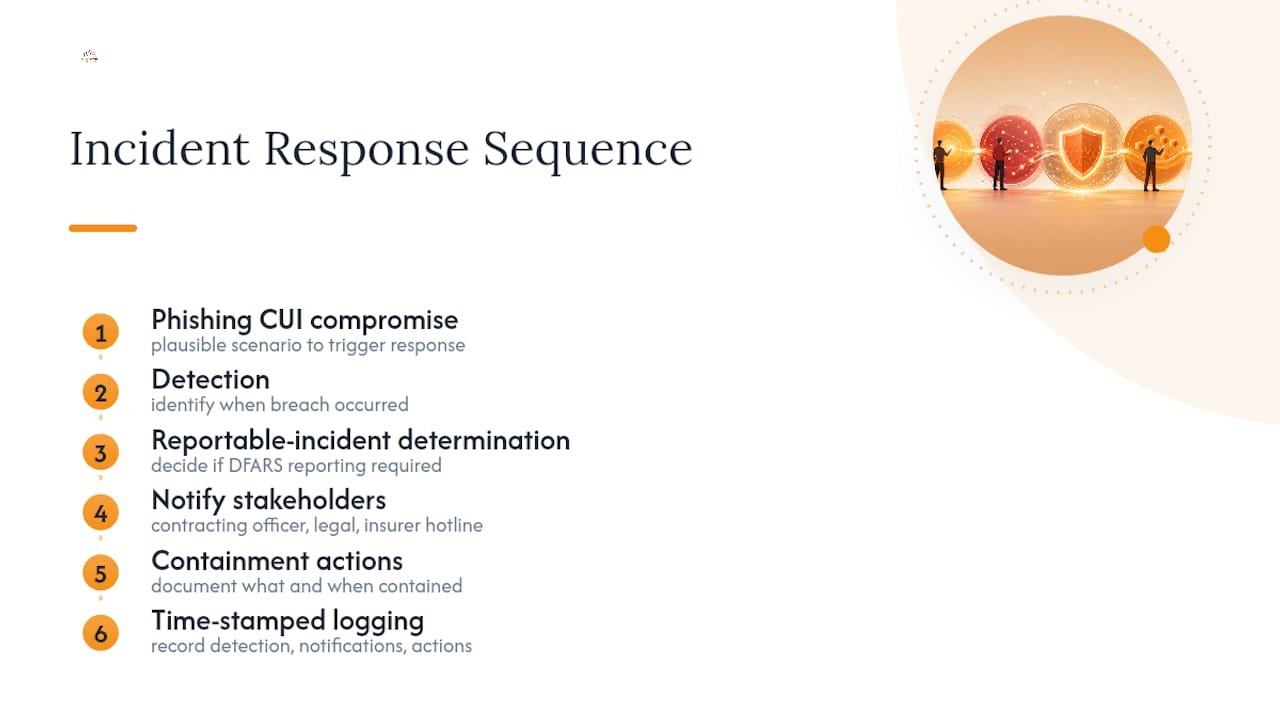
Beyond DFARS’s own timeline, keep a running log of every step taken during an incident: when it was detected, who was notified, what containment actions happened and when. That log becomes the evidence base if a contracting officer or DCMA assessor later asks how you handled the event. A response that looks organized after the fact matters almost as much as the response itself.
Controlled Unclassified Information Categories and Marking Requirements
CUI isn’t one category. The National Archives’ CUI Registry breaks it into dozens of specific categories, from Controlled Technical Information to Export Control data to Privacy information, each with its own handling rules.
For a contractor, the practical question is simpler: does your contract identify what CUI you’ll receive, and does your team know how to mark it? Improperly marked CUI, or CUI that’s mixed into unmarked files, is one of the most common findings in government assessments. It signals that a contractor doesn’t fully understand what they’re protecting.
Every document containing CUI should carry a banner marking identifying it as such, along with the specific category when the contract specifies one. Your SSP should describe exactly how CUI is marked, stored, and transmitted within your environment, not just that “CUI is protected.”
Train new employees on CUI recognition during onboarding, not as an afterthought months later. A single unmarked file forwarded to the wrong distribution list can trigger an incident report even without an actual breach, simply because CUI handling procedures weren’t followed. Building marking discipline into your document workflow now avoids that entirely.
Cybersecurity Requirements in Subcontractor Management
If you’re a prime contractor, your subcontractors’ security gaps become your security gaps. DFARS 252.204-7021 explicitly requires flowdown of CMMC and cybersecurity requirements to subcontractors handling CUI, and a weak link anywhere in that chain exposes the whole contract.
Start every subcontractor relationship with a security questionnaire that mirrors what your own prime contract requires. Ask for their SPRS score and confirm they’ve filed an annual affirmation if the contract requires one. Don’t take a verbal assurance at face value.
Write specific cybersecurity clauses into subcontract agreements rather than a generic reference to “applicable federal requirements.” Spell out which DFARS clauses apply, what incident notification timeline the subcontractor must meet toward you, and what documentation they need to provide on request.
Set a recurring review cadence, at minimum annually, to reconfirm subcontractor compliance status hasn’t lapsed. A subcontractor’s SPRS score can go stale just as easily as your own, and you won’t know unless you’re checking.
Finally, build audit rights into the subcontract itself. If a government assessment flags a gap traced to a subcontractor, you need the contractual authority to inspect their controls directly rather than relying on their word after the fact.
Prime Contractor and Subcontractor Responsibilities Explained
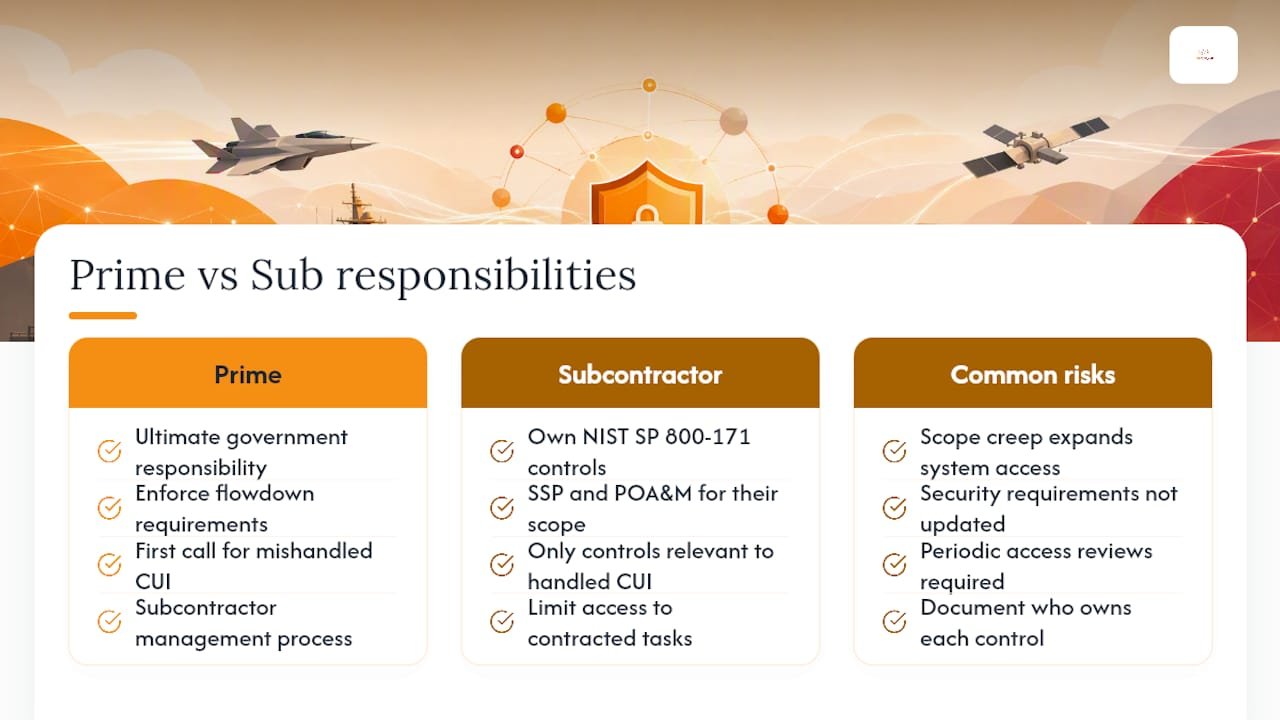
The division of responsibility between primes and subs trips up more contractors than almost any other compliance question. The short version: the prime holds ultimate responsibility to the government, but each subcontractor holds responsibility for their own piece of the CUI environment.
As the prime, you’re accountable for ensuring every subcontractor touching CUI meets the flowdown requirements in your contract. If a subcontractor mishandles CUI, the contracting officer’s first call is to you, not to them. That means your subcontractor management process isn’t optional paperwork. It’s a direct extension of your own compliance posture.
Subcontractors, meanwhile, are responsible for implementing and documenting their own NIST SP 800-171 controls for the CUI they actually handle. A subcontractor that only touches a narrow slice of a project may only need a subset of controls relevant to that scope, but they still need their own SSP and POA&M covering that scope.
Where this breaks down most often is scope creep. A subcontractor brought on for a narrow task ends up with broader system access than the contract intended, and nobody updates the security requirements to match. Review subcontractor access rights against their actual contractual scope periodically, and revoke access that’s outlived its purpose. Clear documentation of who’s responsible for which controls, agreed upon before work starts, prevent the finger pointing that happens after an assessment flags a gap.
Upcoming Regulatory Changes Contractors Should Watch
The regulatory picture isn’t static, and contractors who wait for final rules before preparing will find themselves behind. The proposed FAR Case 2026-001 rule stands out as the biggest near-term shift, potentially extending NIST SP 800-171 safeguarding requirements to all federal contractors handling CUI, not just those under DFARS. If you sell to civilian agencies without any current cybersecurity clause exposure, that rule could change your obligations significantly.
The 72-hour incident reporting standard under discussion alongside that rule would tighten timelines considerably compared to current DFARS requirements. Contractors currently comfortable with their incident response speed should stress test it against a tighter window now, before it becomes mandatory.
The CMMC Phase II pause itself bears watching. Revision 3 set November 10, 2028 as the universal trigger date, but government guidance frames the pause as procedural rather than substantive. Nothing prevents DoD from accelerating that timeline or reinstating third-party assessment requirements for specific contract types before then. Firms that stopped remediation work when the pause started could face a scramble if that happens.
Track FAR Council and DoD CIO announcements directly rather than relying on secondhand summaries, since rule text often includes scoping details, effective dates, and applicability thresholds that general commentary tends to smooth over.
Why the “Wait for CMMC to Settle” Strategy Is Backward
The conventional advice floating around contractor forums right now is to sit tight until CMMC Phase II resumes and the rules stop shifting. That’s backward, and the evidence supports saying so plainly.
DFARS 252.204-7012 never paused. NIST SP 800-171 never paused. The only thing that paused was third-party verification, which means contractors are currently on an honor system with real False Claims Act teeth behind it. Treating a pause in verification as a pause in obligation is the single most common misreading of where things stand, and it’s the one most likely to cost a contractor a contract, or worse, an enforcement action, when the government does look closely.
What gets underestimated is how much of this work is documentation discipline rather than technical difficulty. Most small contractors already have reasonable technical controls in place. What they lack is a POA&M that names real owners and dates, an SSP that maps to actual evidence, and an SPRS score that reflects reality rather than aspiration. That’s not a budget problem. It’s a follow-through problem, and it’s fixable in weeks, not years.
Prioritize the paper trail before you prioritize new tools. A contractor with modest controls and airtight documentation will outcompete one with excellent controls and no evidence to show for it.
— Alden
Get Contract-Ready with Total Cyber Solutions
Cybersecurity service providers offer a comprehensive alternative to piecing together compliance yourself from government PDFs and forum threads. Security is embedded into every managed service by experienced cybersecurity professionals, with the goal of providing enterprise-grade compliance readiness scaled for small or mid-size contractors.

Whether you need managed cybersecurity services to close NIST SP 800-171 gaps, a vulnerability analysis before your next assessment, or policy compliance support to get your SSP and POA&M defensible, Total Cyber builds the evidence trail contracting officers and DCMA assessors actually want to see. Pricing for these engagements is available on request based on your scope. If you’re ready to find out exactly where your compliance posture stands, request a discovery call through the MSP form and start the conversation today.
Sources
- Defense Federal Acquisition Regulation Supplement — final rule (Federal Register, Sept 10, 2025)
- DoD CMMC program overview — Office of the DoD CIO
- Sam
- Get started with contracting — SBA
FAQ
Who are the top cybersecurity government contractors?
Large defense-focused firms dominate the biggest CUI-handling contracts, but thousands of small and mid-size businesses win cybersecurity work through set-aside programs and subcontracting relationships found via SAM.gov and agency procurement forecasts.
Can you make $500,000 a year in cybersecurity?
Individual salaries at that level are uncommon and typically limited to senior executives or specialized consultants, but firms providing compliance consulting, managed cybersecurity, and CMMC readiness services can generate revenue well beyond that figure through multiple client engagements.
Who are the “Big Five” defense contractors?
The five largest U.S. defense contractors by revenue are commonly cited as Lockheed Martin, RTX (formerly Raytheon Technologies), Boeing, Northrop Grumman, and General Dynamics, all of which maintain extensive cybersecurity compliance programs to meet DFARS and NIST SP 800-171 requirements.
Who are the top government contractors in the United States overall?
Beyond the major defense primes, top federal contractors span IT services, healthcare, and infrastructure sectors, and many rely on smaller subcontractors and specialized cybersecurity firms like Total Cyber Solutions to meet their own compliance obligations under contract flowdown requirements.
Does the CMMC pause mean I don’t need to comply with NIST SP 800-171?
No. NIST SP 800-171 and DFARS 252.204-7012 remain fully enforceable regardless of the CMMC Phase II pause, and self-assessment plus SPRS posting are still required for most defense contracts.