

The NIST Cybersecurity Framework is defined as a voluntary, outcome-focused structure that helps organizations manage and reduce cybersecurity risk across their entire operation. Published by the National Institute of Standards and Technology, Version 2.0 launched in February 2024 as the current standard. You cannot earn a NIST certification, but aligning with the framework is often required for federal contracts and increasingly expected by regulators and customers. If you are a business owner or cybersecurity professional trying to make sense of the NIST cybersecurity framework explained in plain terms, this guide covers everything that matters.
What are the core functions of the NIST Cybersecurity Framework?
The NIST CSF organizes every cybersecurity activity into six core functions: Govern, Identify, Protect, Detect, Respond, and Recover. These functions do not run in sequence. They operate at the same time, forming a continuous lifecycle rather than a one-time project.
Here is what each function covers:
- Govern: Sets the strategy, assigns roles, defines policies, and connects cybersecurity decisions to business goals. This function is new to Version 2.0 and places accountability at the leadership level.
- Identify: Maps your assets, data, systems, and supply chain risks so you know what needs protecting.
- Protect: Puts controls in place, including access management, training, and data security measures, to limit the impact of a potential attack.
- Detect: Monitors your environment continuously to spot anomalies and security events before they become full breaches.
- Respond: Defines how your team acts when an incident occurs, covering communication, analysis, and containment.
- Recover: Guides restoration of systems and services after an incident, including lessons learned and improvements.
The Govern function deserves special attention. Before 2024, governance lived inside other functions and often got overlooked. Adding Govern to CSF 2.0 forces organizations to treat cybersecurity as a business priority, not just an IT problem. That shift changes how boards and executives engage with risk.
Pro Tip: Map each of your existing security activities to one of the six functions before you do anything else. This simple exercise reveals gaps you did not know you had and give leadership a clear picture of where the program stands.

How does NIST CSF differ from other cybersecurity standards?
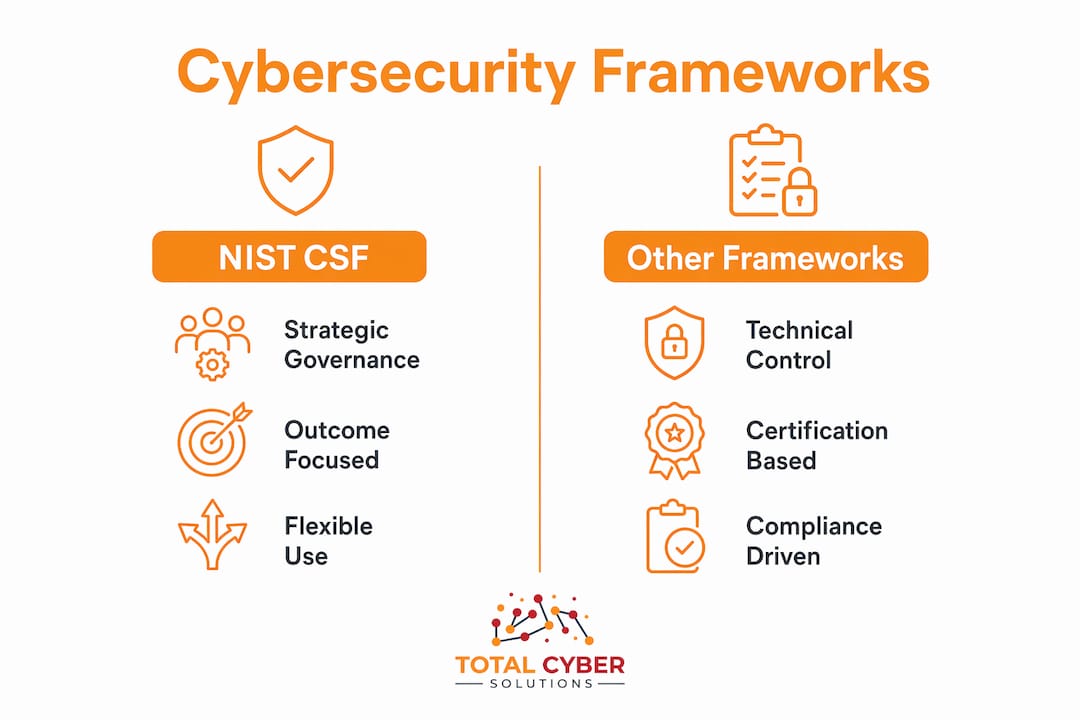
A common misconception is that one framework covers everything. Mature organizations layer NIST CSF for strategy, CIS Controls for technical implementation, and ISO 27001 for certification. Each plays a different role, and confusing them leads to wasted effort.
| Framework | Purpose | Certification available? | Best used for |
|---|---|---|---|
| NIST CSF | Strategic governance and risk management | No | Aligning security with business goals |
| CIS Controls | Prioritized technical security controls | No | Hands-on implementation guidance |
| ISO 27001 | Information security management system | Yes | Demonstrating compliance to clients or regulators |
NIST CSF acts as the strategic umbrella. CIS Controls provide the technical detail that CSF intentionally leaves open. ISO 27001 gives you a certification path if your customers or contracts require one. Using all three together produces a mature, well-rounded security program.
The key difference is that NIST CSF tells you what outcomes to achieve. It does not tell you exactly how to achieve them. That flexibility is a feature, not a flaw. It means the framework works for a 10-person company and a 10,000-person enterprise without requiring either to follow a rigid checklist.
Pro Tip: If you support federal contracts or are working toward CMMC compliance, check how CMMC requirements map to NIST CSF. The overlap is significant, and work you do for one directly supports the other.
What is the practical process for implementing the NIST CSF?
Implementation is a continuous cycle, not a one-time project. The most effective programs use Organizational Profiles to document where they are today and where they want to be. That gap becomes your roadmap.
Here is a practical sequence to follow:
- Create your Current Profile. Document your existing cybersecurity activities across all six functions. Be honest about what is missing.
- Define your Target Profile. Set realistic goals based on your risk tolerance, budget, and regulatory requirements.
- Assess your Implementation Tier. Tiers describe how consistently and formally you manage cybersecurity risk. Tier 3 indicates formalized, repeatable policies across the organization. Most small businesses start at Tier 1 or 2.
- Prioritize your gaps. Do not try to fix everything at once. Focus on the highest-risk gaps first.
- Act, measure, and repeat. Implement improvements, track progress, and update your profiles regularly.
| Implementation Tier | Description | Typical organization |
|---|---|---|
| Tier 1: Partial | Ad hoc, reactive practices | Early-stage or resource-limited |
| Tier 2: Risk-Informed | Some policies exist but not formalized | Growing SMBs |
| Tier 3: Repeatable | Formalized, consistent policies | Mid-market organizations |
| Tier 4: Adaptive | Continuously improving, threat-informed | Enterprise or high-risk sectors |
Continuous, iterative improvement beats a single large overhaul every time. Organizations that try to jump from Tier 1 to Tier 4 in one effort almost always stall. Small, consistent progress builds a program that actually holds up under pressure.
How can NIST CSF align cybersecurity with your business goals?
The framework’s flexibility is its greatest strength. NIST CSF allows organizations to tailor security investments to their specific risk tolerance, industry, and budget. A healthcare provider faces different threats than a logistics company. The framework accommodates both without forcing either into a one-size-fits-all mold.
The Govern function plays a direct role in this alignment. It requires leadership to define the organization’s risk appetite and assign clear ownership for cybersecurity decisions. That means your CEO, CFO, and board are part of the conversation, not just your IT team. When leadership understands the risk, budget decisions become easier to justify.
A few areas where CSF flexibility pays off in practice:
- Supply chain risk: The Identify function explicitly includes third-party and vendor risk. If a supplier gets breached, your organization feels it. Mapping that risk early gives you guardrails.
- Cloud security: CSF applies equally to on-premises and cloud environments. Your cloud services strategy should map directly to CSF Protect and Detect outcomes.
- Budget prioritization: Because the framework is outcome-focused, you can justify spending based on risk reduction rather than technology trends.
- Regulatory alignment: NIST CSF supports both voluntary adoption and contract-driven compliance, making it useful whether you are building trust with customers or meeting federal requirements.
The role of cybersecurity frameworks like NIST CSF is not to add bureaucracy. The role is to give your security decisions a structure that leadership can understand and support. That buy-in is what separates programs that grow from programs that stall.
Key Takeaways
The NIST Cybersecurity Framework is the most practical starting point for any organization that wants to manage cyber risk with structure, leadership involvement, and room to grow.
| Point | Details |
|---|---|
| Six core functions | Govern, Identify, Protect, Detect, Respond, and Recover operate simultaneously as a continuous lifecycle. |
| Govern is new in 2024 | CSF 2.0 added Govern to place cybersecurity accountability directly at the leadership level. |
| Not a certification | NIST CSF is voluntary and outcome-focused; organizations align with it but cannot be certified. |
| Layer multiple frameworks | Use NIST CSF for strategy, CIS Controls for technical guidance, and ISO 27001 if certification is needed. |
| Iterate, do not overhaul | Organizational Profiles and Implementation Tiers guide continuous, prioritized improvement over time. |
Why I think most organizations misuse the NIST CSF
After working with organizations across industries, the pattern I see most often is this: a team downloads the framework document, treats it like a checklist, and declares victory after checking boxes. That approach misses the point entirely.
NIST CSF is a governance tool first. The Govern function is not an administrative formality. It is the mechanism that connects your security program to your business strategy. When leadership does not engage with it, the rest of the framework becomes a technical exercise that never gets funded properly.
The organizations that get real value from the framework are the ones that use it to have better conversations, not just better documentation. They bring their Current and Target Profiles into budget meetings. They use Implementation Tiers to explain maturity to their board in plain language. They treat the framework as a living document, not a one-time deliverable.
The other mistake I see is expecting NIST CSF alone to cover everything. It does not. Layering it with policy compliance practices and technical controls from CIS gives you depth. The framework tells you what to achieve. Your team and your partners figure out how. That division of responsibility is intentional, and it works when you respect it.
— Alden
How Totalcyber helps you put the NIST CSF into practice
Building a NIST CSF-aligned program takes more than reading the documentation. It takes honest assessment, leadership engagement, and consistent execution over time.

Totalcyber is a veteran-owned cybersecurity and IT services company that helps organizations at every stage of that process. From managed cybersecurity services that support your Detect and Respond functions to cyber awareness training that strengthens your Protect function from the inside out, Totalcyber brings structure to programs that need it. Whether you are starting at Tier 1 or working toward federal contract compliance, the team at Totalcyber meets you where you are. Contact Totalcyber today to start building a program that actually holds up.
FAQ
What is the NIST Cybersecurity Framework in simple terms?
The NIST Cybersecurity Framework is a voluntary set of guidelines that helps organizations identify, manage, and reduce cybersecurity risk. It organizes security activities into six functions: Govern, Identify, Protect, Detect, Respond, and Recover.
Is NIST CSF mandatory for my business?
NIST CSF is voluntary for most private organizations, but alignment is often required for federal contracts and increasingly expected by regulators and enterprise customers.
What changed in NIST CSF Version 2.0?
Version 2.0, released in february 2024, added the Govern function, which places cybersecurity risk management responsibility explicitly at the leadership and board level.
How long does NIST CSF implementation take?
Implementation is a continuous process with no fixed endpoint. Most organizations start by creating Organizational Profiles and addressing their highest-priority gaps first, then iterate over time.
How does NIST CSF relate to CMMC compliance?
NIST CSF and CMMC share significant overlap. Organizations working toward CMMC certification will find that a strong CSF-aligned program covers much of the required groundwork.