

Run an unannounced baseline phishing simulation this week, turn on one-click reporting, and start a continuous microlearning cycle for anyone who clicks. That combination beats an annual training module every time. Training only lowers your risk when it’s measured, repeated, and backed by real technical controls, not treated as a once-a-year checkbox.
TL;DR:
- Continuous, measured phishing simulations with increasing lure difficulty significantly outperform annual training modules in reducing click rates.
- Key metrics such as click rate, report rate, and time-to-report should be tracked monthly to assess progress effectively.
- Fast, targeted remediation immediately after a simulated click enhances long-term behavior change, especially for high-risk roles.
- Pairing training with technical controls like email filtering and multi-factor authentication helps contain real threats beyond employee awareness.
- Outsourcing program management can simplify implementation, ensuring real-time testing, monitoring, and rapid response without overburdening internal teams.
Table of Contents
- What Is Phishing Training for Employees, and Why Does It Need a Program?
- How Should You Design the Program for Different Teams?
- How Do You Run Simulations and Measure What Matters?
- What Actually Changes Behavior Over Time?
- What Technical Controls Have to Run Alongside Training?
- Why Total Cyber Built Its Awareness Program This Way
- How Total Cyber Solutions Runs This Program for You
- Sources
What Is Phishing Training for Employees, and Why Does It Need a Program?
Phishing training for employees is the ongoing practice of testing staff with simulated phishing emails, teaching them to spot and report real ones, and tracking whether their behavior improves over time. It’s not a single course. Security awareness training topics like password hygiene or social engineering matter, but phishing gets its own track because it’s the entry point for most breaches that start with a human click.
The IC3 2024 Annual Report shows how much money and operational disruption ride on that single click, which is exactly why a documented, continuous program matters more than a slide deck people forget by Friday.
Here’s the six-step version you can start this month:
- Run a baseline simulation. Pick a representative sample across departments, not just IT, and send an unannounced test using a mid-difficulty lure. Give it two to three weeks before you draw conclusions.
- Turn on one-click reporting. A phish-report button in the email client, tied to a triage inbox someone actually checks daily, is the single highest-leverage habit you can build.
- Deliver instant remediation. Anyone who clicks gets a short module within minutes, not a stern email a week later.
- Segment your high-risk groups. Finance, HR, and executives get sharper, more targeted follow-up because they’re the accounts attackers actually want.
- Set metrics and a reporting cadence. Track click rate, report rate, and time-to-report, and put those numbers in front of leadership monthly or quarterly.
- Build a decay-aware schedule. Monthly touches for high-risk roles, quarterly at minimum for everyone else, with lure difficulty increasing as scores improve.
CISA’s phishing guidance backs most of this directly, including free tabletop exercises you can adapt for step one without building anything from scratch. Total Cyber runs this exact sequence for clients who’d rather hand the mechanics to a managed team, which we’ll get to later. For now, the point stands: sequence matters more than sophistication.
How Should You Design the Program for Different Teams?
Start with objectives you can actually measure, not vague ones like “improve awareness.” A realistic first-year target might be cutting click rate from a baseline near industry norms down toward the single digits, while report rate climbs and time-to-report shrinks from days to minutes.
From there, build around these principles:
- Segment by role and exposure. Finance staff who approve wire transfers need different scenarios than a warehouse crew with no email-based financial authority.
- Keep modules short. Five to ten minutes beats an hour-long annual course that nobody retains past lunch.
- Cover multiple channels. Email is the obvious target, but SMS phishing and voice-based social engineering are growing fast enough to need their own scenarios.
- Make reporting safe. A no-punishment policy for anyone who reports a suspicious message, plus public recognition for top reporters, changes behavior faster than any lecture.
Contractors and part-time staff often get skipped in this process entirely, which is a mistake since they frequently have the same inbox access as full-timers with none of the onboarding.
How Do You Run Simulations and Measure What Matters?
Baseline testing tells you where you actually stand, and the numbers are usually worse than leadership expects. Give your first simulation two to three weeks, then look at three numbers: phish-prone percentage (the click rate), report rate, and time-to-report.
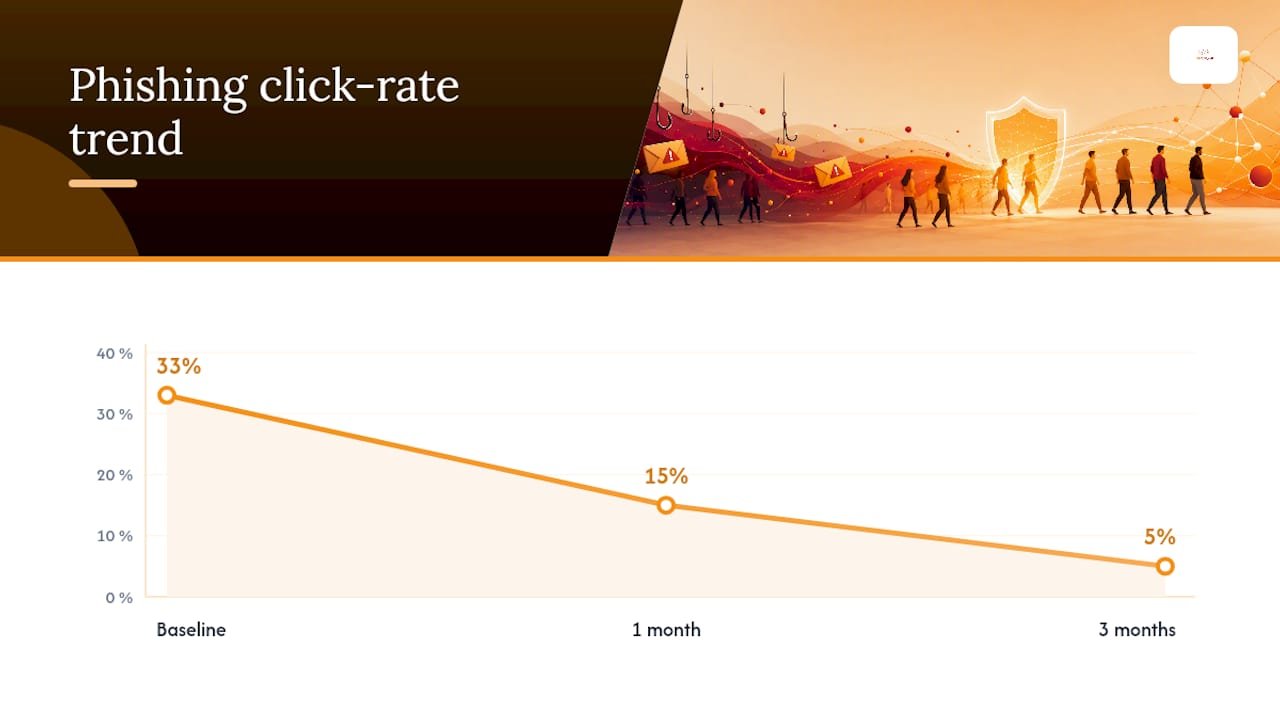
Untrained workforces show baseline phish-prone percentages around one in three employees, and organizations running continuous programs have driven that down to single digits within a year in some reported cases.
Difficulty matters as much as the raw click number. A large-scale reproduction study grounded in the NIST Phish Scale found that lure difficulty alone predicts click rates far more reliably than the training method used, with click rates ranging from roughly 7% on easy templates to 15% on hard ones. If your simulations only use easy, generic templates, your “good” numbers are an illusion. The same study found no statistically significant effect from common training formats on click or report rates, which is an uncomfortable finding worth sitting with: the modality of your training may matter less than how honestly you’re testing it.
Realistic targets after a sustained program land in the 3% to 5% click-rate range, with early gains often visible within 90 days. Plot your numbers monthly. A flat line despite training effort usually means your lures are too easy, not that your people are hopeless.
What Actually Changes Behavior Over Time?
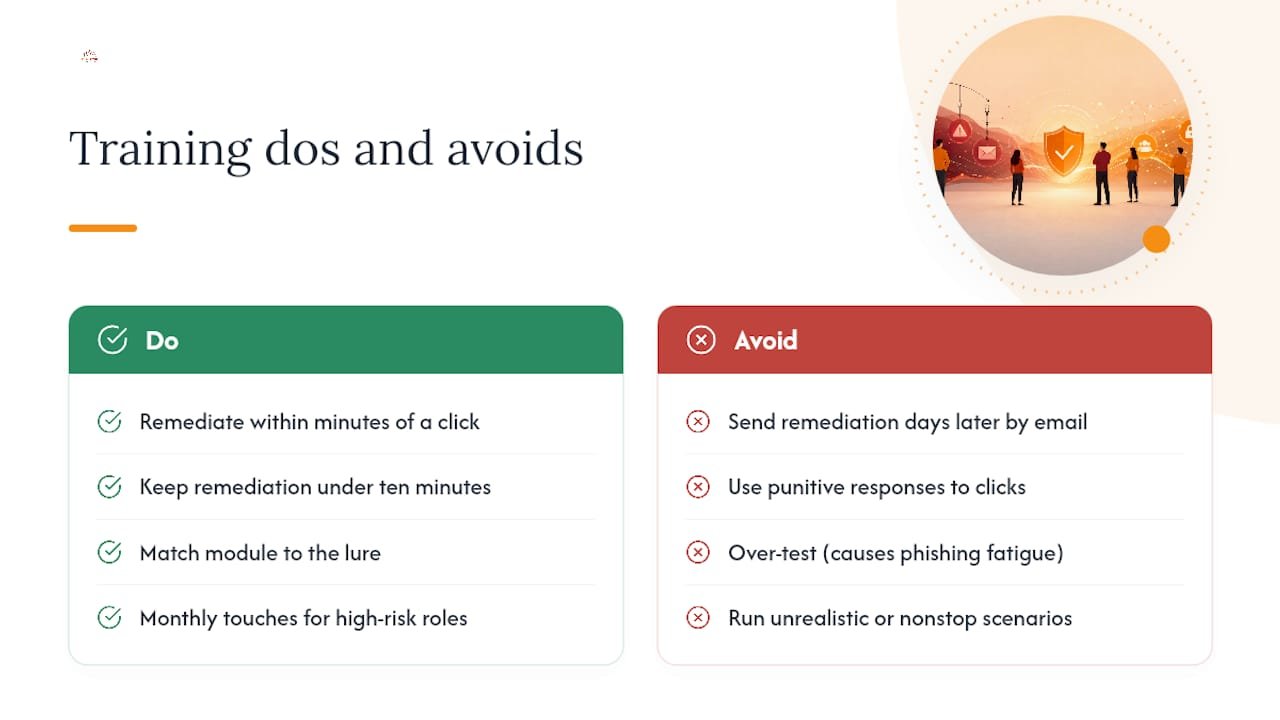
Remediation timing beats remediation content. A short module delivered within minutes of a simulated click, while the moment is still fresh, sticks far better than a follow-up email sent days later. Keep it under ten minutes and built around the specific lure the employee just fell for.
Cadence matters just as much. Detection skills decay, so high-risk roles need monthly touches while everyone else can hold at a quarterly minimum. Recognize employees who report suspicious emails, publicly if your culture supports it, and treat clicking as a training trigger rather than a disciplinary one. Punitive responses just teach people to stop reporting, which is the opposite of what you want.
Pro Tip: Don’t over-test. Running simulations too frequently creates phishing fatigue, where employees start reflexively distrusting every email, including legitimate ones from vendors and coworkers. Keep scenarios realistic, brief, and spaced enough to measure genuine improvement rather than exhaustion.
What Technical Controls Have to Run Alongside Training?
Training reduces risk. It doesn’t eliminate it. Pair every phishing program with the controls that catch what people miss:
- Email filtering, attachment sandboxing, and URL rewriting to intercept malicious content before it reaches an inbox.
- Multi-factor authentication and account monitoring to blunt the damage when credentials do get stolen.
- Direct integration between your phish-report button and your SOC or IT triage workflow, so a report becomes an action within minutes, not a ticket that ages in a queue.
Attackers increasingly build lures from information scraped off social media and company sites, a tactic worth reviewing through resources like Street Safe Self Defence’s guide to digital fraud awareness. When reporting and controls work together, a live campaign against your organization can be contained in the time it takes one alert employee to hit “report.”
Why Total Cyber Built Its Awareness Program This Way
I’m Alden, and I’ve watched enough security programs fail to notice a pattern: most of them treat phishing training as a compliance line item instead of an operating discipline. The evidence backs a harder truth. Training modality barely moves the needle. What moves it is baseline measurement, honest lure difficulty, fast remediation, and reporting that leadership actually reviews.
Total Cyber, a veteran-owned firm, builds its client programs around exactly that sequence: baseline tests, continuous simulations with NIST Phish Scale-calibrated difficulty, instant remediation, and managed monitoring that ties reports straight into incident response. The clients who see real drops in click rate are the ones who stop treating this as an annual event.
— Alden
How Total Cyber Solutions Runs This Program for You
Building and maintaining a phishing training program takes real bandwidth: someone has to design realistic lures, track metrics monthly, and remediate clickers fast enough for it to matter. Total Cyber’s managed cybersecurity services run that entire loop for you, so your team gets the results without owning the mechanics.
Clients get baseline testing calibrated to real-world difficulty, targeted microlearning by role, reporting integrated directly into managed SOC triage, and ongoing incident response support when a real campaign slips through. It’s the same layered approach covered above: technical controls, continuous training, and fast reporting working as one system instead of three separate line items on a budget sheet. If your current program is a once-a-year video nobody remembers, request a consultation through our contact form and we’ll walk through what a measured, continuous version looks like for your team.
Sources
- Teach Employees to Avoid Phishing – CISA
- Anti-Phishing Training (Still) Does Not Work: A Reproduction of Phishing Training Inefficacy Grounded in the NIST Phish Scale – arXiv
- 2026 Phishing by Industry Benchmarking Report: Findings on Human Risk – KnowBe4
- IC3 2024 Annual Report – IC3