

For most U.S. small businesses, the fastest way to reduce cloud risk is to deploy a business-tier cloud storage platform with strong admin controls, signed BAAs where you handle protected health information, and immutable backups configured from day one. If your team has no dedicated IT staff, skip the DIY setup entirely and engage a managed provider. Three concrete next steps: run a quick data-classification check to identify what you’re storing and under which compliance rules, confirm BAA availability with any vendor you’re evaluating, and either start a free trial of the highest-fit SaaS option or request a managed assessment from Totalcyber if you need compliance-ready, hands-on deployment.
The managed pick for SMBs that need end-to-end compliance support is Total Cyber Solutions (Totalcyber). For teams comfortable managing their own admin controls, the leading SaaS options are Google Workspace, Microsoft 365, Dropbox Business, Box, AWS, Sync.com, and IDrive, each suited to a different use case and risk profile.
Table of Contents
- What are the best secure cloud storage options for small businesses?
- How do these options compare on security, compliance, and SMB needs?
- How do you choose secure cloud storage for your small business?
- What security fundamentals do you actually need to manage yourself?
- What do secure cloud storage costs and timelines actually look like?
- Why Total Cyber Solutions is the recommended managed option for SMBs
- Key Takeaways
- What most small businesses get wrong about cloud security
- Totalcyber’s managed cloud assessment: what you get
What are the best secure cloud storage options for small businesses?
Every option below earns its place for a specific use case. None of them are interchangeable.
- Total Cyber Solutions (Totalcyber): — The recommended managed option for SMBs that need compliance-ready deployment, continuous monitoring, BAA support, and vCSO leadership without hiring in-house security staff. Totalcyber handles configuration, hardening, and ongoing posture management so you don’t have to.
How do these options compare on security, compliance, and SMB needs?
The table below maps each option across the decision dimensions that matter most for data protection in cloud storage.
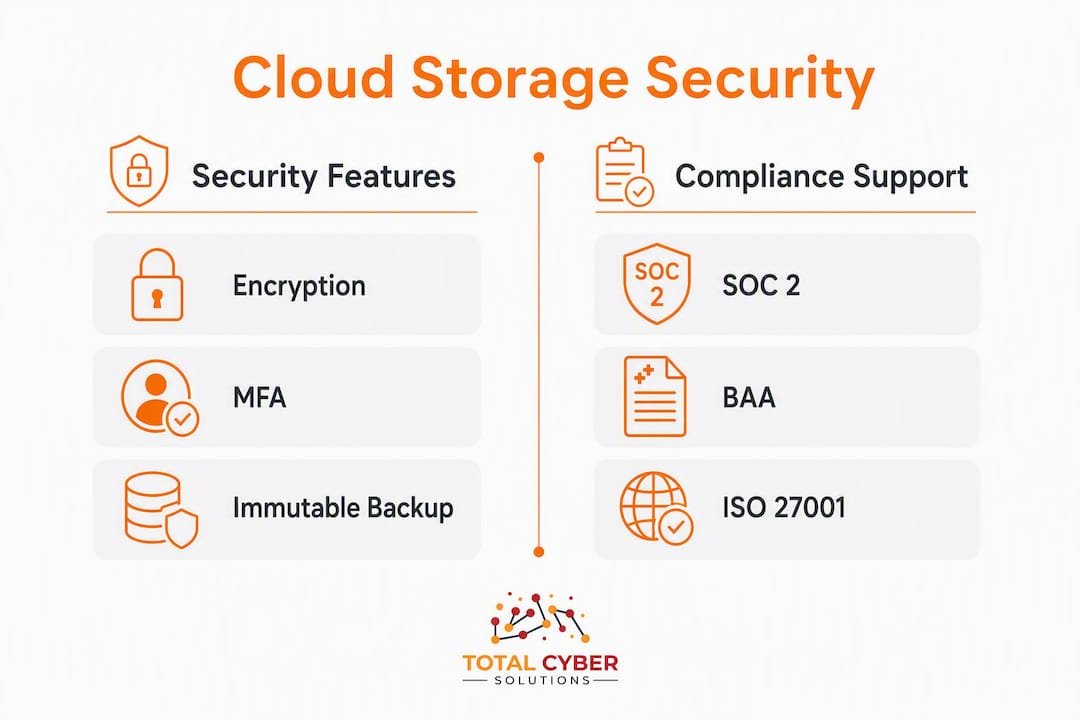
| Option | Best for | Security features | Compliance readiness | Admin & identity controls | Data protection | Pricing (typical SMB) | Storage / scalability | Support & SLA | Deployment timeline |
|---|---|---|---|---|---|---|---|---|---|
| Totalcyber (managed) | SMBs needing end-to-end compliance + monitoring | AES-256 at rest, TLS 1.3 in transit, CMK support, hardened config | HIPAA, SOC 2, NIST, CMMC, CJIS, BAA support | SSO, SCIM, RBAC, MFA enforced, IAM audit | Immutable backups, ransomware recovery, cross-provider replication | Totalcyber offers managed services with pricing available upon inquiry. | Scales with business; no storage ceiling | Dedicated MSP, SLA-backed, vCSO included | Managed deployment timelines typically range from a few weeks to two months depending on engagement scope. |
| Google Workspace | Collaboration, Gmail-native teams | AES-256, TLS 1.3, Google-managed keys (CMK via Cloud KMS add-on) | BAA available, SOC 2, ISO 27001, HIPAA | Admin Console, SSO, SCIM, MFA, RBAC | Version history, Vault add-on for retention | — | PBS storage tiers; pooled storage | — | Days (self-serve) |
| Microsoft 365 | Windows shops, Office-heavy teams | AES-256, TLS 1.2/1.3, Microsoft-managed keys (CMK via Purview add-on) | BAA available, SOC 2, ISO 27001, HIPAA, FedRAMP | Microsoft 365 Admin Center, SSO, SCIM, MFA, Conditional Access | Version history, Backup add-on | $6–$22/user/month | 1 TB–unlimited per user | — | Days (self-serve) |
| Dropbox Business | File sharing, simple UX | AES-256, TLS 1.3, provider-managed keys (CMK on Business Plus) | BAA available, SOC 2 Type II, ISO 27001 | SSO, SCIM, MFA, admin console | Version history, no native immutable backup | — | 9 TB–unlimited (team) | Priority support on higher tiers | Days (self-serve) |
| Box | Regulated industries, compliance workflows | AES-256, TLS 1.2/1.3, CMK via Box KeySafe | BAA available, SOC 2, ISO 27001, FedRAMP, HIPAA | SSO, SCIM, RBAC, MFA, granular permissions | Version history, retention policies, legal hold | — | Unlimited (Business+) | — | Days to 1–2 weeks |
| AWS S3 / WorkDocs | Developers, hyperscale object storage | AES-256, TLS 1.3, CMK via AWS KMS, object lock | BAA available, SOC 2, ISO 27001, FedRAMP, HIPAA | IAM, SSO via IAM Identity Center, MFA, RBAC | Object lock (WORM), versioning, cross-region replication | AWS pricing is consumption-based and varies depending on usage. | Effectively unlimited | AWS Support plans (paid tiers) | Days to weeks (technical setup) |
| Sync.com | Privacy-first, zero-knowledge | AES-256, TLS 1.3, zero-knowledge E2E encryption | BAA available, HIPAA, SOC 2 | Admin console, MFA, RBAC, user provisioning | Version history, remote wipe | Sync.com offers competitively priced business plans catering to privacy-focused SMBs. | 1 TB–6 TB per user | Email/chat support | Days (self-serve) |
| IDrive | Multi-device backup, cost-sensitive SMBs | AES-256, TLS, user-managed encryption key option | BAA available, HIPAA | Admin console, MFA, user management | Continuous backup, versioning, snapshots | ~IDrive offers a range of team plans at competitive annual pricing tiers. | — | Email/phone support | Hours to days |
A note on shared responsibility: Every SaaS provider above secures the underlying infrastructure, physical data centers, and network. You are responsible for identity management, access controls, configuration, and data classification. Misconfiguration on the customer side is a dominant source of cloud security incidents, not provider-side failures. That gap is exactly what a managed provider like Totalcyber closes.
Configuration errors, weak IAM, and missing MFA are among the most frequent root causes of cloud breaches affecting small businesses. CISA guidance specifically calls out poor account hygiene and the absence of multi-factor authentication as foundational exposures that SMBs must address before any other control.
How do you choose secure cloud storage for your small business?
Start with what you’re storing, not with which product looks best. The right answer depends on your data types, your compliance obligations, and whether you have someone capable of managing admin controls day to day.
Decision checklist
Work through these before you open a vendor’s pricing page:
- Data classification: What types of data will you store? PHI (protected health information), PCI-scoped cardholder data, PII, or general business files? Each category carries different legal obligations.
- Compliance requirements: Which frameworks apply? HIPAA, the FTC Safeguards Rule, PCI-DSS, CCPA/CPRA, and NIST are the most common for U.S. SMBs. Where frameworks overlap, follow the stricter rule.
- Admin and IAM needs: Do you need SSO, SCIM provisioning, role-based access control, and MFA enforcement? If yes, consumer-grade plans won’t cut it.
- Data residency: Does your compliance framework or contract require U.S.-based storage? CISA flags foreign-jurisdiction storage as a material risk for regulated sectors.
- Backup and retention: Do you need immutable backups, WORM/object lock, or cross-provider replication? What are your recovery time and recovery point targets?
- Internal capacity: Does your team have someone who can configure, monitor, and audit the environment? If not, a managed provider is the lower-risk path.
Ten questions to ask any vendor or MSP
- Will you sign a BAA, and what does it cover (subprocessors, breach reporting timelines, ePHI handling)?
- Who manages encryption keys, and can I use customer-managed keys? Where do those keys live?
- Do you provide audit logs, and how long are they retained?
- Do you support immutable backups or object lock? Can I verify a restore?
- What is your uptime SLA, and what remedies apply if you miss it?
- Can you share a recent penetration test summary and remediation history?
- What is your incident response process, and what is your notification timeline?
- Which third-party certifications do you hold (SOC 2, ISO 27001, FedRAMP)? Can I see the certificates?
- Where is my data stored geographically, and under which legal jurisdiction?
- What are the full costs, including egress fees, migration support, key management, and audit assistance?
Red flags that should stop you cold
- No BAA available when you’re handling PHI. Full stop.
- Consumer accounts (personal Google Drive, personal Dropbox) used for business data.
- No customer-managed key option when your compliance framework requires it.
- No immutable backup or cross-provider replication option for critical data.
- Opaque SLAs with no defined remedies or credits.
- Vendor lock-in terms that make data export prohibitively expensive or technically difficult.
- A vendor that can’t produce a SOC 2 report or ISO 27001 certificate on request.
Pro Tip: When requesting compliance artifacts, triage them in this order: (1) a recent SOC 2 or ISO 27001 certificate, (2) a BAA template, (3) a penetration test summary with remediation history. If a vendor can’t produce all three, that gap warrants deeper diligence before you sign anything.
What security fundamentals do you actually need to manage yourself?
The single most important control in cloud storage security is correct configuration and active posture management, handled by you or your MSP. The vendor’s encryption and certifications mean very little if your admin console is misconfigured or your access controls are too permissive.

The shared responsibility model in plain terms
Think of it as a building lease. The landlord (your cloud provider) secures the structure, the locks on the front door, and the electrical system. You’re responsible for who has a key, what they do inside, and whether you left the windows open. Specifically:
Provider’s responsibility: Physical data centers, network infrastructure, hypervisor security, platform availability, and baseline encryption of stored data.
Your responsibility: User identity and access management, MFA enforcement, permission configuration, data classification, encryption key management (if using CMKs), audit log review, backup configuration, and ongoing monitoring.
The AWS Well-Architected Security Pillar is explicit that misconfiguration on the customer side drives the majority of cloud security incidents. That’s not a knock on AWS specifically; it’s a structural truth across every major platform.
BAAs: more than a legal checkbox
A Business Associate Agreement is a legally binding contract that transfers specific ePHI protection duties to your cloud provider. It defines breach reporting obligations, subprocessor usage, and what happens if the provider fails to meet its security commitments. Storing PHI without a signed BAA creates direct liability for your business, regardless of how secure the platform claims to be. Consumer accounts are not a substitute, even if the underlying technology is identical to the business version.
Pro Tip: Treat your BAA as an operational control, not just a legal formality. Read the subprocessor list, the breach notification timeline (HIPAA requires notification within 60 days), and the termination and data-return clauses before you sign.
Encryption: what the standards actually mean
Most major platforms support TLS 1.2/1.3 for data in transit and AES-256 for data at rest. That’s the baseline. The meaningful distinction is who holds the keys.
With provider-managed keys, the vendor can technically access your plaintext data. That’s fine for most SMBs. With customer-managed keys (CMKs), you control the key management service (KMS), which means the provider cannot access your data without your keys. CMKs add compliance leverage but also add operational complexity. If you lose the keys, you lose the data.
Zero-knowledge (end-to-end) encryption, as offered by Sync.com, goes further: the provider never has access to plaintext under any circumstances. The trade-off is that provider-side search, indexing, and some collaboration features become unavailable.
For high-risk environments, require an architecture diagram showing where CMKs live, who can access the KMS, and how key rotation and backup work. These diagrams often reveal hidden single points of failure that marketing materials don’t mention.
Ransomware, immutable backups, and posture management
Ransomware attackers increasingly target backup repositories directly, making commercial camera cybersecurity basics for businesses a critical component of overall IoT and video data protection strategies. Immutable backups using WORM or object lock features prevent attackers from deleting or encrypting your backup copies, even if they gain admin-level access. For regulated or critical-data environments, cross-provider replication (object lock on your primary provider plus an independent cold copy on a second provider) breaks the single-provider failure mode.
CISA recommends continuous evaluation and posture management rather than one-time setup. That means regular IAM hygiene reviews, least-privilege access audits, audit log monitoring, and periodic risk assessments. For SMBs without in-house security staff, this is where a managed provider earns its cost.
What do secure cloud storage costs and timelines actually look like?
The price gap between self-serve SaaS and managed deployment is real, but so is the risk gap.
Typical SaaS pricing bands
- Entry-level business tiers — (Google Workspace Business Starter, Microsoft 365 Business Basic): $6–$7/user/month. Limited storage, basic admin controls.
Managed deployment timelines and costs
Self-serve SaaS is live in days. A managed, compliance-ready deployment takes longer because it’s done right.
- Risk and data-classification assessment: 1–2 weeks.
- Configuration, hardening, and BAA coordination: 1–3 weeks.
- Immutable backup design and cross-provider replication setup: 1–2 weeks.
- Monitoring, logging, and IAM audit: Ongoing from day one.
Total managed onboarding typically runs from a few weeks to two months depending on engagement scope, number of users, and compliance complexity. Monthly managed service fees vary by provider and scope; contact Totalcyber directly for a scoped quote.
Hidden costs to budget for
- Migration and professional services: Moving data from an existing platform or on-premises storage rarely costs nothing. Budget for it.
- Egress fees: AWS and some other platforms charge for data transfer out of their environment. This adds up during migrations or large restores.
- Retention and immutable backup licensing: Longer retention windows and object lock features often require higher-tier plans or add-ons.
- Audit support: When a compliance audit arrives, vendor-provided audit evidence packages and your own log exports take time and sometimes cost extra.
- Key management infrastructure: CMK setups require a KMS, which carries its own licensing and operational overhead.
For a deeper look at cloud migration and managed deployment options, Totalcyber’s cloud services page covers what a scoped engagement typically includes.
How we selected and compared these options
Security controls, compliance readiness, admin features, and SMB operational fit drove every decision in this shortlist. A platform that scores well on marketing but lacks a BAA or customer-managed key option didn’t make the cut for regulated use cases.
Evaluation criteria, in priority order: encryption standards and key management options, compliance certifications and BAA availability, admin and IAM controls (SSO, SCIM, RBAC, MFA enforcement), backup and immutability features, pricing model and total cost of ownership, support quality and SLA terms, and realistic deployment timelines for a small business without dedicated IT staff.
“Operational security posture — configuration, IAM, and logging — often matters more than vendor marketing claims. SMBs lacking in-house expertise should strongly consider a managed partner that provides continuous monitoring and vCSO guidance.” — AWS Well-Architected Security Pillar
Sources consulted include CISA cloud guidance, NIST SP 800-66 Rev. 2 on HIPAA security, HHS guidance on HIPAA and cloud computing, the AWS Well-Architected Security Pillar, academic research on SMB cloud compliance frameworks, and independent analyses of cloud backup security. Vendor compliance claims were cross-checked against publicly available SOC 2 reports, ISO 27001 certificates, and BAA templates where accessible.
Why Total Cyber Solutions is the recommended managed option for SMBs
Total Cyber Solutions is the recommended managed option for SMBs that need compliance-ready, hands-on secure cloud storage deployments, not just a platform subscription.

The difference is operational. Any of the SaaS platforms above will give you a login and a storage bucket. Totalcyber gives you a configured, monitored, and continuously hardened environment with someone accountable for keeping it that way. For a small business owner juggling everything else, that accountability gap is where breaches happen.
What Totalcyber’s managed cloud service covers
- Risk and data-classification assessment to identify what you’re storing, where it lives, and which compliance rules apply.
- Configuration and hardening of your chosen platform(s), including admin controls, MFA enforcement, and least-privilege access setup.
- BAA coordination and compliance mapping across HIPAA, NIST, CMMC, CJIS, and the FTC Safeguards Rule.
- Customer-managed key support and KMS architecture review, including key rotation and backup procedures.
- Immutable backup design with cross-provider replication for regulated or critical-data environments.
- Continuous monitoring and audit logging so you have evidence when an auditor or regulator asks.
- vCSO leadership for SMBs that need strategic security guidance without hiring a full-time CISO.
One pattern Totalcyber sees repeatedly: a small business migrates to Microsoft 365 or Google Workspace, leaves the default admin settings in place, skips MFA enforcement, and assumes the platform’s marketing language means they’re covered. It doesn’t. A managed assessment typically surfaces misconfigured sharing permissions, overprivileged accounts, and missing backup configurations within the first week. Fixing those issues before an incident is far less expensive than responding after one.
Pro Tip: If you’re handling any regulated data, schedule a cloud security posture review before you renew your current platform contract. Misconfiguration found during a review costs a fraction of what a breach or compliance violation costs after the fact.
Request a managed assessment from Totalcyber to get a scoped inventory, risk findings, and a prioritized remediation plan.
Key Takeaways
Secure cloud storage for small businesses requires correct configuration and active posture management, not just a business-tier subscription with strong marketing claims.
| Point | Details |
|---|---|
| Configuration is the real risk | CISA identifies misconfiguration, weak IAM, and missing MFA as the top root causes of SMB cloud breaches. |
| BAAs are non-negotiable for PHI | Storing protected health information without a signed BAA creates direct legal liability, regardless of platform security. |
| Immutable backups stop ransomware | WORM/object lock features prevent attackers from deleting backup copies, even with admin-level access. |
| Self-serve vs. managed timelines differ | SaaS platforms go live in days; a compliant managed deployment typically takes a few weeks to two months and covers configuration, BAAs, and monitoring. |
| Totalcyber covers the full stack | Totalcyber’s managed service handles risk assessment, hardening, BAA coordination, CMK support, immutable backup design, and continuous monitoring for SMBs. |
What most small businesses get wrong about cloud security
Misconfiguration, not vendor failure, causes most SMB cloud incidents. That’s the honest answer after seeing how these deployments actually play out.
Two mistakes come up constantly. First, businesses sign up for a business-tier plan, see “HIPAA compliant” on the vendor’s website, and assume they’re done. They’re not. HIPAA compliance on a platform means the platform can be configured to support HIPAA. It doesn’t mean your specific instance is configured correctly, that you’ve signed a BAA, or that your access controls meet the standard. The platform is a tool. The configuration is your responsibility, or your MSP’s.
Second, businesses skip immutable backups because they assume their cloud provider’s native backup is sufficient. When ransomware hits and the attacker has admin credentials, native backups on the same platform are often encrypted or deleted alongside the primary data. Cross-provider replication with object lock is the control that actually survives that scenario.
A managed approach closes both gaps. Totalcyber’s team configures the environment correctly from the start, enforces MFA and least-privilege access, sets up immutable cross-provider backups, and monitors continuously so misconfigurations get caught before they become incidents. For SMBs that want to understand their current exposure before committing to a managed engagement, a cybersecurity risk assessment is the right first step.
Schedule a cloud security assessment with Totalcyber and get a clear picture of where you stand.
Totalcyber’s managed cloud assessment: what you get
Totalcyber’s managed cybersecurity services give small businesses a complete cloud security assessment that covers data inventory, risk findings, compliance mapping, and a prioritized remediation plan, delivered by a veteran-owned team with hands-on experience in HIPAA, NIST, CMMC, and CJIS environments.
You don’t need to figure out which settings to change or which certifications to request. Totalcyber’s team does the technical work, coordinates BAAs with your vendors, designs your backup architecture, and stays engaged through continuous monitoring. The result is a cloud environment that’s actually secure, not just marketed as secure.
If you’re storing regulated data, handling client records, or simply tired of not knowing whether your current setup would survive an audit or an incident, the next step is straightforward. Request your assessment at totalcyber.com/msp-form and a member of the Totalcyber team will reach out to scope the engagement.
Authoritative sources and further reading
Verify vendor compliance claims by requesting certificates and recent audit reports directly. Marketing language is not a substitute for a current SOC 2 report, a signed BAA template, or a penetration test summary with remediation history.
- Guidance on HIPAA & Cloud Computing | HHS.gov: The primary federal resource explaining how HIPAA obligations apply to cloud service providers and covered entities. Start here if you handle any ePHI.
- NIST SP 800-66 Rev. 2: Implementing the HIPAA Security Rule: NIST’s practical cybersecurity resource guide for HIPAA compliance. Useful for mapping specific technical safeguards to your cloud configuration.
- Get the Most out of Cloud Storage and Services while Minimizing Risk | CISA: CISA’s operational guidance on cloud storage risk, covering shared responsibility, IAM hygiene, MFA, and data residency considerations.
- AWS Well-Architected Security Pillar: AWS’s own framework for secure cloud architecture, including shared responsibility, IAM, key management, and logging. Applicable beyond AWS as a general security reference.
- HIPAA Cloud Storage: The Small Practice Checklist | ComplyDome: Practical BAA and HIPAA compliance checklist for small practices using Google Drive, Dropbox, or AWS.
- Cloud Backup Cybersecurity for U.S. Small Businesses | Cloud Backup Authority: Independent analysis of backup architecture choices, immutable backup strategies, and ransomware defense for SMBs.
- Cloud Compliance for SMBs: Navigating HIPAA, PCI-DSS and CMMC Requirements: Academic research mapping U.S. regulatory frameworks to SMB cloud deployments, including overlap analysis and control prioritization.