

A cybersecurity policy is a written document that defines your business’s security rules, responsibilities, and procedures to protect digital assets and meet legal requirements. Most small and medium-sized business owners know they need better security. Few realize that a written policy is the foundation everything else rests on. Without one, your employees make security decisions on their own, and that is when the click happens. The role of cybersecurity policies is not just administrative. It is the difference between a business that recovers from an incident and one that does not.
What are the essential components of an effective cybersecurity policy?
A cybersecurity policy, also called a written information security program (WISP) in regulatory language, covers far more than a list of dos and don’ts. It defines who owns security decisions, what controls are in place, and how your team responses when something goes wrong.
Governance comes first. Every policy needs a named owner and an executive sponsor, typically the CEO or founder. The NIST Cybersecurity Framework 2.0 introduced a dedicated Governance function that requires exactly this, along with a formal annual review and event-driven updates after incidents. Without a named owner, no one enforces the policy when things get busy.
Technical controls are the backbone. The five most critical controls for SMBs in 2026 are:
- Multi-factor authentication (MFA) on all accounts
- A current asset inventory of every device and system
- Tested 3-2-1 backups (three copies, two media types, one offsite)
- A documented incident response plan
- Monthly security training with phishing simulations
These five controls address the top causes of small business breaches. They also satisfy the baseline questions most cyber insurance carriers ask before issuing a policy.
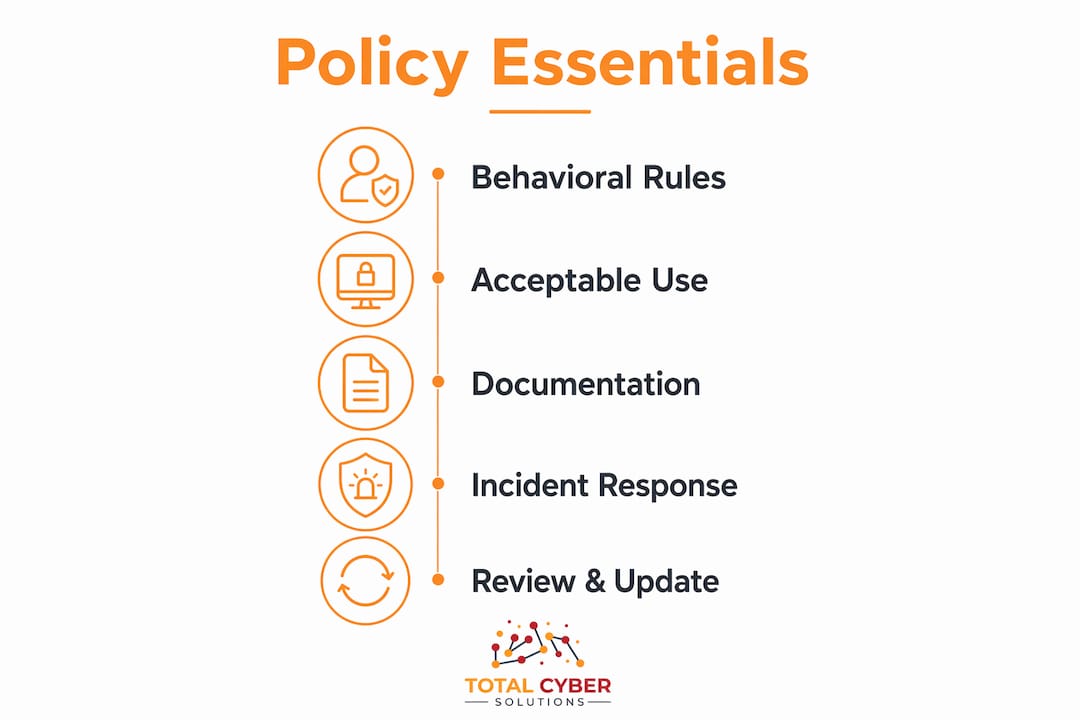
Behavioral policies set expectations. Acceptable use policies tell employees what they can and cannot do on company devices and networks. Access control policies define who can reach which data. Password and authentication standards remove ambiguity about what “strong” means. When your team knows the rules, they make better decisions without waiting for you to weigh in.

Documentation closes the loop. Training logs, risk assessments, and incident records are not busywork. Regulators treat missing enforcement evidence the same as having no policy at all. Keep records of every training session, every policy acknowledgment, and every security review.
Pro Tip: Start with a one-page acceptable use policy and a simple incident response checklist. Getting something written and signed is more valuable than waiting to build a perfect document.
How do cybersecurity policies support legal compliance?
Written policies are not optional for most businesses. They are a legal requirement under several federal and state regulations that directly apply to SMBs.
The FTC Safeguards Rule requires any business handling customer financial data to maintain a written information security program. Businesses managing fewer than 5,000 consumer records are exempt from continuous monitoring and annual penetration testing, but they still must maintain core policies and training records. That exemption is narrower than most owners assume.
HIPAA applies to any business handling protected health information, including dental offices, physical therapy practices, and medical billing companies. HIPAA penalties for non-compliance range from $100 to $50,000 per violation, with annual caps reaching millions for willful neglect. The scale of the penalty depends on how negligent the violation was.
“Regulators require documented evidence of policy enforcement, such as training logs, risk assessments, and incident response records. Mere policy existence is insufficient. Audit readiness demands consistent documentation.”
The table below summarizes the key regulations SMBs encounter most often.
| Regulation | Who it applies to | Core policy requirement |
|---|---|---|
| FTC Safeguards Rule | Financial services businesses | Written information security program |
| HIPAA | Healthcare and related businesses | Privacy and security policies with training records |
| NIST CSF 2.0 | Any business seeking a security baseline | Governance function with named owner and review cadence |
| State data breach laws | Businesses holding resident data | Incident response plan and notification procedures |
Compliance also affects your vendor relationships. Many enterprise clients and government contractors now require proof of a written security program before signing contracts. Your policy is not just a legal shield. It is a business qualification.
What are best practices for implementing cybersecurity policies?
Building a policy does not require a lawyer or a six-figure consultant. A concise, enforceable policy beats a fifty-page binder that no one reads. Here is how to build one that actually works.
-
Start with a template adapted for your size. Free templates from NIST and the FTC provide a solid starting structure. Customize them to reflect your actual systems, your team size, and the data you handle. Generic policies that do not match your operations confuse employees and fail audits.
-
Integrate policies into onboarding. New employees should read and sign your policy on day one. This sets expectations before bad habits form. It also creates a signed acknowledgment record, which regulators look for during audits.
-
Name an executive sponsor and hold them accountable. Policies without accountability decay rapidly. When the CEO or founder owns the policy, it signals to the entire team that security is not optional. Assign a backup owner for when the primary contact is unavailable.
-
Schedule annual reviews and event-driven updates. Review your policy every year at minimum. Trigger an immediate review after any security incident, a significant vendor change, or a new regulatory requirement. Stale policies create false confidence.
-
Run monthly security training and phishing simulations. Training reinforces policy rules in a way that a signed document cannot. Cyber awareness training programs that include simulated phishing emails show employees what real attacks look like before a real one arrives.
-
Enforce consequences consistently. A policy with no consequences is a suggestion. Define what happens when someone violates the acceptable use policy or bypasses access controls. Consistent enforcement is what separates a security culture from a security document.
Pro Tip: After your first policy review, ask three employees to explain the policy in their own words. If they cannot, the document is too complex. Simplify it until they can.
What is the measurable impact of security policies on risk management?
Cybersecurity policies are the key to consistent security behavior across a business. They clarify expectations and responsibilities even when you are not in the room. That consistency is where the real risk reduction happens.
Policies directly affect your ability to get cyber insurance. Carriers ask about MFA, backups, and incident response plans during the application process. Businesses without written policies that document these controls pay higher premiums or get denied coverage. A written policy is evidence that your controls exist and are enforced.
The financial case is straightforward. Developing a compliant security program costs a few hundred dollars and a weekend’s work. A single data breach or regulatory penalty can reach tens of thousands of dollars. The return on that investment is not theoretical.
Policies also protect your reputation with customers and partners. When a prospect asks how you handle their data, a written policy gives you a concrete answer. That answer builds trust in a way that verbal reassurances cannot.
Key risk management benefits of a written security policy include:
- Reduced breach likelihood through defined access controls and training
- Faster incident response because procedures are documented before a crisis
- Lower cyber insurance premiums tied to documented controls
- Stronger vendor and client relationships built on verifiable security practices
- Improved risk scoring that reflects actual security posture rather than assumptions
Key Takeaways
A written cybersecurity policy is the single most cost-effective security investment an SMB can make, reducing breach risk, supporting compliance, and enabling cyber insurance coverage.
| Point | Details |
|---|---|
| Policies require governance | Name an executive sponsor and schedule annual reviews to keep policies enforceable. |
| Five controls cover most risk | MFA, asset inventory, tested backups, incident response, and monthly training address top SMB breach causes. |
| Documentation is compliance | Training logs and risk assessments are required evidence; a policy alone does not satisfy regulators. |
| Cost vs. penalty math is clear | A compliant program costs hundreds of dollars; breach penalties can reach tens of thousands. |
| Policies build business credibility | Written security programs support vendor contracts, cyber insurance, and customer trust. |
What I have learned about policies SMBs will actually use
Working with small business owners on security, the most common mistake I see is treating a cybersecurity policy like a legal document. Owners either avoid writing one because they think it requires expensive consultants, or they download a 40-page template and file it away. Neither approach works.
The policies that actually protect businesses are short, specific, and signed by leadership. When the CEO treats the policy as a real operating document, the rest of the team follows. When it lives in a shared drive no one opens, it protects no one.
Staff turnover is the hidden threat to policy effectiveness. Every time a key employee leaves, institutional knowledge about your security practices walks out with them. A written policy with clear ownership survives turnover. A verbal understanding does not.
The other thing I have seen consistently: businesses that wait for a breach to write their first policy pay far more than the cost of writing it early. Regulators do not accept “we were planning to” as a defense. The compliance and risk reduction benefits of a written policy are immediate, not eventual.
My honest advice is to start this week. Write one page. Name an owner. Schedule a review date. That is enough to be ahead of most SMBs and to give your team something real to follow.
— Alden
How Totalcyber helps SMBs build and maintain security policies
Building a cybersecurity policy from scratch takes time you probably do not have. Totalcyber works with small and medium-sized businesses to develop written security programs that meet FTC Safeguards Rule, HIPAA, and NIST CSF 2.0 requirements without the complexity of enterprise-level consulting.

Totalcyber’s managed cybersecurity services include policy development, enforcement support, and ongoing compliance documentation so your records are audit-ready at all times. The team also provides security awareness training with phishing simulations that reinforce your written policies through real practice. If you are ready to get a written program in place, contact Totalcyber today and get started with a straightforward assessment of where your business stands.
FAQ
What is a cybersecurity policy?
A cybersecurity policy is a written document that defines a business’s security rules, responsibilities, and procedures for protecting digital assets and meeting regulatory requirements. It is also called a written information security program (WISP) under regulations like the FTC Safeguards Rule.
Why do small businesses need a written cybersecurity policy?
Regulators treat missing enforcement evidence the same as having no policy, meaning a verbal security approach does not satisfy compliance requirements. A written policy also reduces breach risk, supports cyber insurance applications, and sets clear expectations for every employee.
What regulations require a cybersecurity policy for SMBs?
The FTC Safeguards Rule requires a written information security program for businesses handling customer financial data. HIPAA requires documented privacy and security policies for any business handling protected health information, with penalties reaching $50,000 per violation for willful neglect.
How often should a cybersecurity policy be reviewed?
The NIST Cybersecurity Framework 2.0 requires at least an annual formal review, plus event-driven updates after security incidents, significant vendor changes, or new regulatory requirements. Policies that are not reviewed regularly become outdated and unenforceable.
How long does it take to write a basic cybersecurity policy?
Developing a basic, compliant cybersecurity program costs a few hundred dollars and a weekend’s work for most SMBs. Starting with a NIST or FTC template and customizing it for your business size and data types is the fastest path to a usable document.