

Cybersecurity risk scoring is a numerical method that quantifies the likelihood and potential impact of cyber threats, giving your business a clear, prioritized picture of where you are most exposed. The role of cybersecurity risk scoring goes well beyond a simple checklist. It transforms raw threat data into a single, actionable number that tells you what to fix first, what can wait, and where your defenses are holding. Frameworks like NIST SP 800-30 and compliance standards like FATF both depend on this kind of structured, evidence-based approach. For small to medium-sized enterprises, that clarity is not a luxury. It is the difference between reacting to breaches and preventing them.
What is cybersecurity risk scoring and how does it work?
A cyber risk score is a composite numerical value that reflects your organization’s overall exposure to threats at any given moment. It is not a raw count of vulnerabilities. A server with 50 low-severity patches outstanding may score lower than a single unpatched authentication flaw on a customer-facing system. The score weighs what matters most.
Risk scoring blends multiple inputs into a single prioritized value. Those inputs typically include:
- Vulnerabilities: Known weaknesses in software, firmware, or configurations
- Telemetry: Real-time signals from endpoints, firewalls, and logs
- Configuration drift: Deviations from your approved security baseline
- Asset criticality: How important a given system is to your operations
- Recent incidents: Active threat activity or near-miss events
Two main modeling approaches exist. Probabilistic models estimate the likelihood of a threat materializing based on historical data and threat intelligence. Deterministic models apply fixed rules, such as “any critical CVE on a production server scores 90 or above.” Most enterprise-grade platforms combine both.
Cyber risk scores turn complex, multidimensional threat data into a unified number that finance, operations, and security teams can all read and act on. That shared language matters enormously in an SMB, where the IT manager often has to explain risk to a business owner who has no security background.

Pro Tip: Start by scoring your five most critical assets before rolling out a full scoring program. You will learn how your chosen model behaves and catch calibration issues before they affect your entire environment.
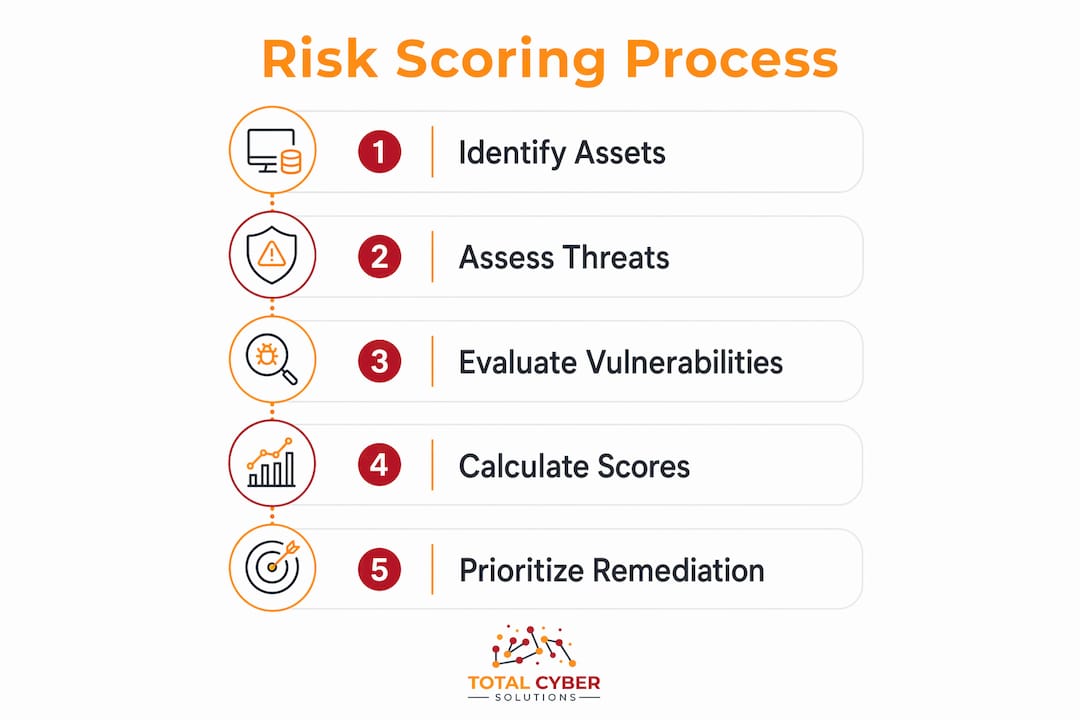
The scoring process itself follows a logical chain. You identify an asset, assess the threats targeting it, evaluate the controls protecting it, and generate a score that reflects the gap between exposure and defense. NIST SP 800-30 formalizes this by decomposing risk as a function of threat sources, vulnerabilities, and business impact. That framework gives your scoring model a trusted, auditable foundation.
Why is cybersecurity risk scoring important for SMBs?
SMBs face the same threat actors as large enterprises but operate with a fraction of the security budget and staff. Risk scoring levels that playing field by telling you exactly where to spend your limited time and money.
Mapping risks to specific business impacts allows you to prioritize the 20–30% of critical assets that account for most of your cyber exposure. That concentration effect is significant. Fixing the right 20% of your vulnerabilities can eliminate the majority of your actual risk.
The benefits of risk scoring for an SMB are concrete:
- Faster remediation: Scores direct your team to critical issues first, cutting the time it takes to close dangerous gaps
- Smarter resource use: You stop wasting hours patching low-risk systems while high-risk ones sit exposed
- Compliance support: Organizations that fail to adjust risk scores regularly risk non-compliance with frameworks like FATF, which require a documented, risk-based approach
- Board-level communication: A score of 78 out of 100 is easier to explain to a business owner than a spreadsheet of 400 CVEs
- Reduced mean time to remediate (MTTR): Focused prioritization means your team spends less time triaging and more time fixing
Compliance is worth calling out separately. Why compliance reduces cyber risk is a question many SMB owners ask only after an audit. Risk scoring answers it proactively by creating a documented, repeatable process that regulators and auditors can verify.
Risk scoring also improves communication across your business. When your IT manager, CFO, and operations lead all see the same score, they make decisions from the same facts. That alignment reduces the friction that slows down security investments.
How does risk scoring fit into your risk management process?
Risk scoring does not replace your broader cybersecurity risk assessment. It feeds into it. Think of the score as the output of your assessment process and the input to your remediation decisions.
A structured integration looks like this:
- Identify assets and threats. Catalog what you own and what threatens it, following the NIST SP 800-30 framework for decomposing risk by threat source, vulnerability, and impact.
- Run your assessment. A cybersecurity risk assessment identifies assets, threats, and vulnerabilities, then evaluates combined severity to guide mitigation priorities.
- Generate scores. Feed assessment findings into your scoring model to produce prioritized values for each asset or control domain.
- Map scores to business impact. A score of 85 on your billing system means something different than an 85 on a test server. Context determines urgency.
- Automate alerts and mitigations. Risk scoring supports automated mitigations and integrates into CI/CD pipelines to halt risky deployments before they reach production.
- Report to leadership. Scores give executives a consistent metric to track over time and justify security spending.
Here is how scores typically map to response priorities:
| Score range | Risk level | Recommended action |
|---|---|---|
| 80–100 | Critical | Immediate remediation required |
| 60–79 | High | Remediate within 7 days |
| 40–59 | Medium | Schedule remediation within 30 days |
| 0–39 | Low | Monitor and address in next cycle |
Vulnerability scanning feeds directly into this process by supplying the raw vulnerability data that scoring models need to generate accurate results. Without regular scanning, your scores go stale and lose their value as a decision-making tool.
Common challenges and best practices in implementing risk scoring
Risk scoring works well when it is set up correctly. It creates a false sense of security when it is not. These are the pitfalls SMBs hit most often.
Over-reliance on automated models. A score is only as good as the data behind it. If your asset inventory is incomplete or your threat intelligence is outdated, your scores will mislead you. Automation handles volume. Human judgment handles context.
Failure to recalibrate. Threat environments change. A scoring model tuned to last year’s threat landscape will underweight emerging attack vectors. Schedule quarterly recalibrations as a standard practice.
Alert fatigue. Without thresholds, every score change triggers a notification. Properly designed risk scoring systems reduce alert fatigue by triggering alerts only when scores exceed defined thresholds. That focus keeps your team working on high-impact issues instead of chasing noise.
Misalignment with business goals. A score that treats all assets equally ignores the fact that your customer database is worth more to an attacker than your internal wiki. Align scoring weights to business value, not just technical severity.
Best practices that actually work:
- Tie asset criticality ratings to revenue impact, not just IT classification
- Review and update your scoring model whenever you add new systems or change your tech stack
- Use scores to drive security ROI measurement and demonstrate the value of security investments to leadership
- Combine automated scoring with periodic expert review to catch what the model misses
Pro Tip: Set a “score floor” for your most critical assets. Any system that supports revenue or customer data should never drop below a defined minimum score without triggering an immediate review, regardless of other factors.
Human oversight is non-negotiable in any scoring program. Risk scoring should inform expert judgment, not replace it. The model tells you where to look. Your team decides what to do about it.
Key Takeaways
Cybersecurity risk scoring is the most direct method SMBs have for turning complex threat data into clear, prioritized decisions that protect critical assets and satisfy compliance requirements.
| Point | Details |
|---|---|
| Scores prioritize critical assets | Focus remediation on the 20–30% of assets that carry most of your cyber exposure. |
| NIST SP 800-30 grounds your model | Use this framework to decompose risk by threat source, vulnerability, and business impact. |
| Compliance depends on regular updates | Failing to recalibrate scores risks non-compliance with FATF and similar regulatory standards. |
| Automation needs human oversight | Scoring models inform decisions; expert judgment must validate and act on the results. |
| Alert thresholds reduce operational toil | Trigger notifications only on scores that exceed defined limits to keep your team focused. |
Why I think most SMBs are using risk scoring wrong
Most SMBs I talk to treat their risk score like a report card. They check it after an audit, feel relieved if it is passing, and move on. That is the wrong mental model entirely.
A risk score is a live instrument, not a grade. It should change week to week as your environment changes. When it does not move, that is a red flag, not a sign of stability. It usually means your data inputs have gone stale.
The other mistake I see constantly is treating the score as the end of the conversation. Executives get a number, nod, and consider the job done. The score is actually the start of the conversation. It tells you where to direct resources, which controls need attention, and which business functions carry the most exposure. That conversation has to happen between IT and leadership, regularly, with the score as the shared reference point.
The SMBs that get the most value from risk scoring are the ones that tie it directly to budget decisions. When a score climbs above a threshold, a remediation budget gets unlocked. When it drops, that improvement gets reported as a measurable security win. That feedback loop is what turns a scoring program from a compliance checkbox into a genuine security tool.
— Alden
How Totalcyber helps SMBs put risk scoring to work
Running a risk scoring program takes more than software. It takes consistent data, calibrated models, and people who know how to act on the results.

Totalcyber’s managed cybersecurity services give SMBs a complete risk management operation without the overhead of building one in-house. The team handles vulnerability scanning, asset classification, score monitoring, and remediation prioritization, all aligned to frameworks like NIST SP 800-30. You get a clear picture of your risk posture and a team that knows what to do about it. If you are ready to move from guesswork to a scored, prioritized security program, contact Totalcyber to get started.
FAQ
What is the role of cybersecurity risk scoring?
Cybersecurity risk scoring quantifies your organization’s exposure to threats as a single numerical value, enabling you to prioritize remediation and allocate security resources where they matter most.
How do you score cybersecurity risk?
Scoring combines inputs like vulnerabilities, asset criticality, telemetry, and recent incidents into a weighted value using probabilistic or deterministic models, often grounded in frameworks like NIST SP 800-30.
Why is risk scoring important for small businesses?
SMBs operate with limited security budgets, and risk scoring directs that budget toward the critical assets that carry the most exposure, reducing mean time to remediate and supporting regulatory compliance.
How often should risk scores be updated?
Risk scores should update continuously as new vulnerabilities are discovered and your environment changes, with formal model recalibration at least quarterly to reflect current threat conditions.
Does risk scoring replace a full cybersecurity risk assessment?
No. Risk scoring is the output of a cybersecurity risk assessment, not a replacement for it. The assessment identifies assets and threats; the score translates those findings into prioritized decisions.