

Security benchmarks are defined as standardized, measurable frameworks that organizations use to assess and improve their cybersecurity controls against established industry baselines. The role of security benchmarks goes far beyond checking boxes. They turn vague security activities into concrete, quantifiable risk data that your leadership team can actually act on. Frameworks like CIS Benchmarks, NIST, and ISO 27001 each serve a distinct purpose, and knowing how to use them together is what separates a reactive security program from a proactive one. If you are a business owner or IT manager trying to justify security spending or prove your program is working, benchmarks are the tool that makes that conversation possible.
What is the role of security benchmarks in risk management?
Cybersecurity benchmarking is defined as the process of assessing your security maturity and controls against industry baselines, turning subjective security efforts into measurable business risk management. That shift matters more than most leaders realize. Without a baseline, you cannot tell whether your security program is improving, stagnating, or quietly falling behind.
Benchmarks answer the questions your CFO and board are actually asking. Are we spending the right amount? Are our controls working? How do we compare to peers in our industry? Industry benchmarks recommend security budgets typically between 6–15% of IT spend, varying by sector and threat profile. That range gives you a defensible floor when you walk into a budget conversation.
The most important shift benchmarking creates is moving security from a cost center narrative to a risk management narrative. When you can show leadership that your control coverage improved from 60% to 85% against a CIS baseline, that is a business result. It is not an IT update.
- Control coverage: What percentage of recommended controls are active and verified?
- Rotation cadence: How frequently are privileged credentials rotated, and does it meet benchmark standards?
- Patch compliance rate: What share of systems meet the patching timelines defined in your chosen framework?
- Incident response readiness: Does your program meet the maturity level required by NIST or your sector’s regulatory body?
Pro Tip: Present benchmarking results to leadership using risk language, not technical severity scores. Frame findings as “we reduced exposure in this control area by X%” rather than listing CVE counts or tool names.
Which security benchmarking frameworks should you use?
Three frameworks dominate the field, and each one serves a different purpose. Confusing them is one of the most common mistakes organizations make when starting a benchmarking program.
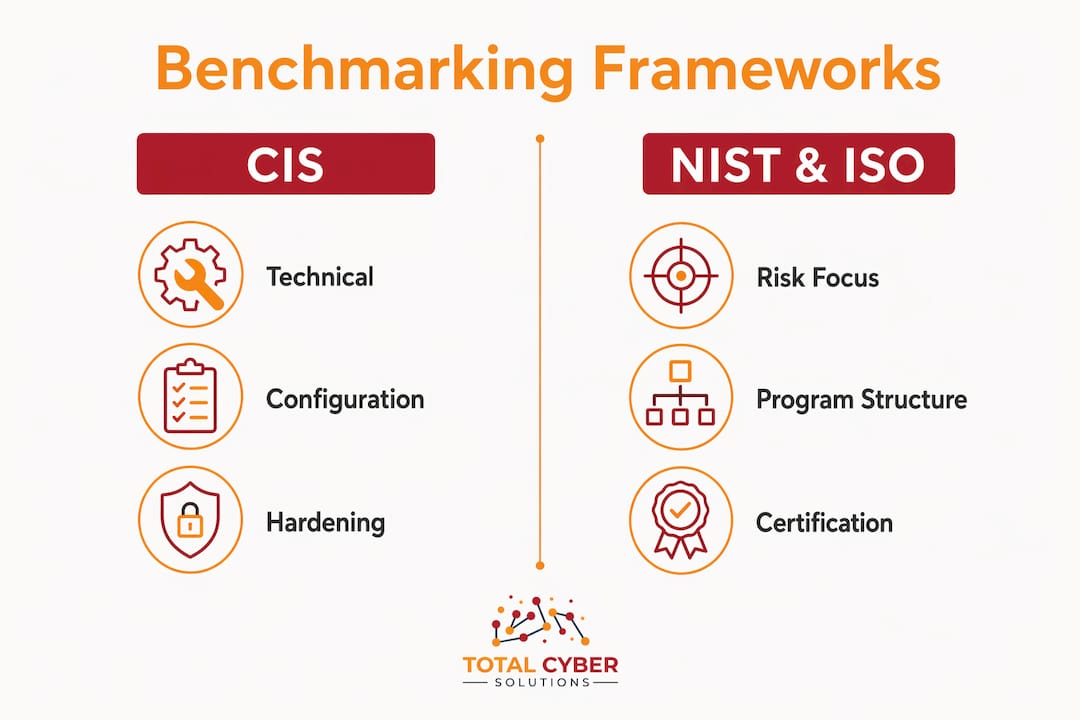
CIS Benchmarks deliver detailed, prescriptive technical configuration guidance for hardening systems across operating systems, cloud platforms, and network devices. Think of CIS as your technical playbook. It tells your IT team exactly how to configure a Windows server or an AWS environment to reduce attack surface. CIS also offers the CIS Maturity Model, which provides a concrete baseline to transform abstract security goals into measurable data points.
NIST provides a risk-oriented framework for structuring your overall cybersecurity program, while ISO 27001 defines a certifiable management system for governance. These two complement the technical depth of CIS Benchmarks rather than replace it. NIST is the right tool for organizing your program around five core functions: Identify, Protect, Detect, Respond, and Recover. ISO 27001 is what you pursue when customers or regulators require a formal, auditable certification.
| Framework | Primary focus | Typical use case | Scope |
|---|---|---|---|
| CIS Benchmarks | Technical configuration hardening | System and cloud hardening | Device and platform level |
| NIST CSF | Risk-oriented program structure | Program design and gap analysis | Organization-wide |
| ISO 27001 | Governance and management systems | Certification and audit readiness | Enterprise governance |
Most organizations benefit from using all three in combination. CIS handles the technical layer, NIST structures the program, and ISO 27001 provides the governance wrapper that satisfies auditors and enterprise clients. If you are also pursuing government contracts, the CMMC maturity model adds another layer of required benchmarking aligned to defense sector standards.
How do you apply security benchmarks in practice?
Knowing which frameworks exist is only half the work. The real value comes from operationalizing them inside your daily security program.

Configuration hardening is the most direct application. CIS Benchmarks publish specific configuration profiles for hundreds of platforms. Your IT team applies those settings, then runs automated scans to measure compliance. The gap between your current state and the benchmark target becomes your remediation roadmap.
Vulnerability management gets sharper when tied to benchmarks. Instead of chasing every CVE in isolation, you prioritize based on whether a vulnerability affects a system that is already out of benchmark compliance. That context changes which patches matter most. Vulnerability analysis paired with benchmark scoring gives you a risk-ranked list, not just a raw count.
Regulatory alignment becomes far less painful when your internal policies already map to a recognized framework. Compliance reduces cyber risk most effectively when your controls are built on benchmarks rather than assembled reactively before an audit. Regulators in healthcare, finance, and defense all reference NIST or CIS as acceptable control baselines.
Third-party risk management is an area where benchmarks deliver outsized value. Standardized assessments against CIS Controls reveal vendor weaknesses before incidents occur. When you evaluate a new cloud provider or managed service partner, asking them to demonstrate benchmark compliance gives you an objective comparison point instead of relying on their marketing materials.
- Require vendors to provide CIS or NIST self-assessment results as part of onboarding.
- Include benchmark compliance requirements in vendor contracts and annual reviews.
- Use benchmark gaps as a trigger for escalation or contract renegotiation.
- Align your internal audit schedule to your chosen framework’s review cycle.
For a practical look at measuring the return on these efforts, the security ROI measurement guide from Totalcyber walks through how to connect benchmark improvements to financial outcomes your leadership team will recognize.
What are the biggest mistakes in security benchmarking?
The most common mistake is treating benchmarking as a one-time audit rather than an ongoing process. Effective benchmarking is a continuous cycle of assessment, remediation, and reassessment. Organizations that benchmark once and file the results away are not managing risk. They are creating a false sense of security.
The second mistake is measuring the wrong things. Only 5.7% of organizations have full visibility into service accounts, and 97% of non-human identities carry excessive privileges. Those are governance failures, not tool failures. Benchmarks must focus on governance outcomes such as privilege containment and rotation cadence rather than vanity metrics like tool counts. Counting how many security tools you have installed tells you nothing about whether any of them are working.
A third pitfall is the confusion between maturity benchmarking and technical hardening benchmarks. Maturity benchmarking compares your program’s overall capabilities against industry peers. Hardening benchmarks specify exact technical configurations for individual systems. Mixing these up leads to programs that score well on paper but miss critical gaps in practice.
Pro Tip: Schedule a formal benchmark review at least twice per year and tie it to your budget planning cycle. That timing gives you data to support funding requests before they are due, not after.
Communicating results to non-technical leadership requires a deliberate translation effort. Using benchmarking data allows leaders to justify budgets and demonstrate risk-reducing impact to CFOs and boards. Lead with risk reduction percentages and peer comparisons, not technical severity ratings. A board member does not need to know what a CVSS score means. They do need to know whether your program is above or below the industry median.
Key Takeaways
Security benchmarks are the most direct tool available for turning cybersecurity spending into a defensible, measurable business risk management program.
| Point | Details |
|---|---|
| Benchmarks quantify risk | They convert vague security activities into measurable control coverage and maturity scores. |
| Three frameworks work together | CIS handles technical hardening, NIST structures the program, and ISO 27001 provides governance certification. |
| Governance outcomes matter most | Measure privilege containment and rotation cadence, not just tool counts or installation rates. |
| Third-party risk needs benchmarks | Require vendors to demonstrate CIS or NIST compliance as part of onboarding and annual reviews. |
| Benchmarking is continuous | Schedule formal reviews at least twice per year and align them to your budget planning cycle. |
Why benchmarking belongs in every board conversation
Most security programs I have seen struggle not because of bad technology, but because leadership cannot see what the program is actually doing. Benchmarking fixes that. When you walk into a board meeting with a maturity score, a peer comparison, and a clear remediation roadmap, the conversation changes completely. You are no longer defending a budget line. You are presenting a risk management position.
The misconception I hear most often is that benchmarking is an IT exercise. It is not. It is a business risk exercise that happens to require IT execution. The moment you frame it that way internally, you get more support, more budget, and more accountability across the organization. Benchmarking data also gives you something rare in cybersecurity: a way to show progress over time. That matters enormously when you are trying to build a culture where security is taken seriously at every level.
I would also push back on the idea that benchmarking is only for large enterprises. Small and mid-sized organizations face the same threats and often have less margin for error. Starting with CIS Implementation Group 1 controls and a basic NIST self-assessment is entirely achievable without a large team. The cybersecurity risk scoring guide from Totalcyber is a good starting point for organizations that want to connect benchmark results to a risk score their leadership can track over time.
— Alden
How Totalcyber supports your benchmarking program
Running a benchmarking program well requires consistent effort, the right tools, and people who know how to interpret the results. Most IT teams are already stretched thin.

Totalcyber’s managed cybersecurity services include continuous security benchmark assessment, control gap analysis, and alignment with CIS, NIST, and regulatory frameworks relevant to your industry. As a veteran-owned firm, Totalcyber brings a disciplined, process-driven approach to security performance measurement that translates directly into audit-ready documentation and board-level reporting. You get a team that knows the frameworks, runs the assessments, and helps you communicate results in terms your leadership understands. Contact Totalcyber to schedule a benchmark assessment for your organization.
FAQ
What are security benchmarks?
Security benchmarks are standardized frameworks that define measurable controls and configuration standards for cybersecurity programs. Examples include CIS Benchmarks, NIST CSF, and ISO 27001.
How do security benchmarks help with budget justification?
Benchmarking data lets you show leadership how your security posture compares to industry peers and where gaps exist, making budget requests concrete and defensible rather than speculative.
What is the difference between CIS Benchmarks and NIST?
CIS Benchmarks provide prescriptive technical configuration guidance for specific systems and platforms. NIST CSF provides a risk-oriented structure for organizing your overall security program.
How often should you run a security benchmark assessment?
A formal benchmark assessment should run at least twice per year, aligned to your budget planning cycle so findings can directly inform funding decisions.
Can small businesses use security benchmarks?
Yes. CIS Implementation Group 1 controls and a basic NIST self-assessment are designed to be achievable for organizations without large security teams, making them practical starting points for small and mid-sized businesses.
Recommended
- Cybersecurity Maturity Model Certification (CMMC) | Total Cyber Solutions
- The Role of Cybersecurity Risk Scoring for SMBs | Total Cyber Solutions
- The Role of Cybersecurity Policies for SMB Owners | Total Cyber Solutions
- NIST Cybersecurity Framework Explained for Business Leaders | Total Cyber Solutions