

Vulnerability scanning is the automated process of detecting security weaknesses in systems, software, and networks before attackers find them first. The role of vulnerability scanning goes far beyond a simple checklist item. It is a foundational practice that reduces cyber risk proactively, supports compliance with frameworks like PCI DSS, HIPAA, SOC 2, and GDPR, and gives your security team a fighting chance against a threat environment that never slows down. With 50,000 new CVEs disclosed annually and attackers exploiting known flaws within five days of disclosure, waiting is not a strategy.
What is the role of vulnerability scanning in your security program?
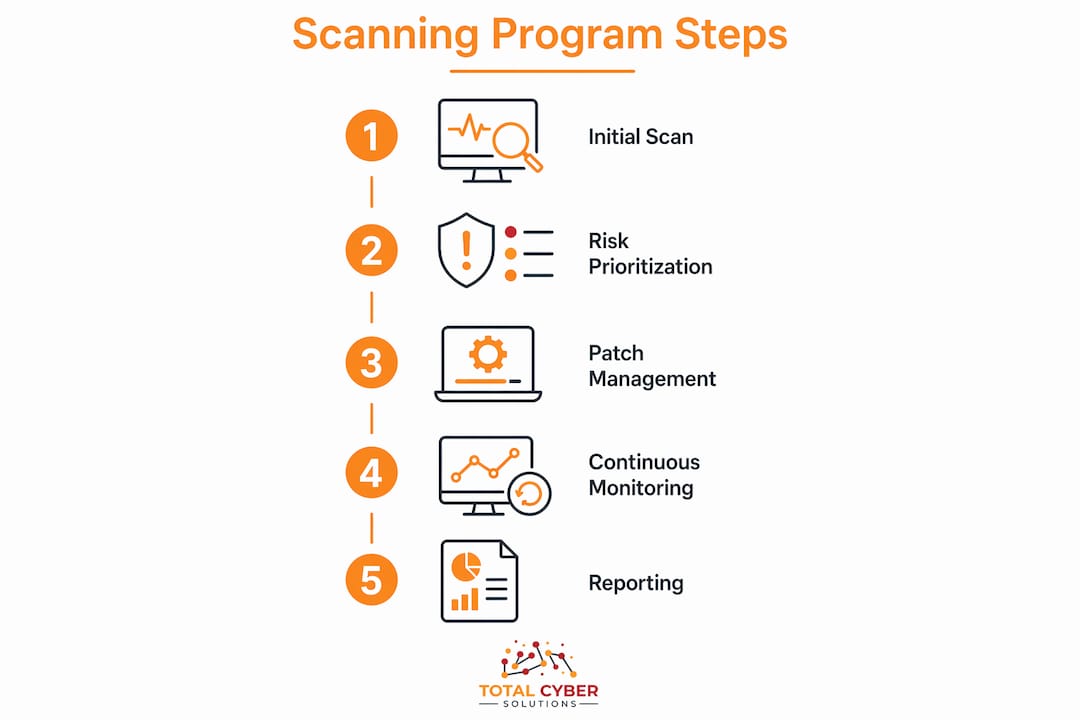
Vulnerability scanning, formally called vulnerability assessment, is the systematic process of identifying, classifying, and prioritizing security weaknesses across your IT environment. Scanners compare live system data against databases like the National Vulnerability Database (NVD) and the Common Vulnerabilities and Exposures (CVE) catalog. When a match appears, the scanner flags it for review and assigns a severity score.
Three core functions define how a scanner operates:
- Discovery: The scanner maps every device, application, and service on your network. You cannot protect what you cannot see.
- Assessment: It checks each discovered asset against known vulnerability databases, identifying misconfigurations, outdated software, and unpatched flaws.
- Prioritization: It ranks findings by severity, exploitability, and business context so your team knows where to act first.
The prioritization step is where most teams struggle. Enterprise scans generate up to 50,000 critical findings per run. Only about 1.6% of those findings represent genuinely exploitable risks when filtered with threat intelligence and business context. That gap between raw output and real risk is exactly why prioritization matters more than scan volume.
Pro Tip: Do not treat every critical CVE as equally urgent. Filter findings by whether the vulnerable asset is internet-facing, holds sensitive data, or sits on a path an attacker could realistically use.
Alert fatigue is the single biggest operational pitfall in vulnerability management. When your team sees thousands of findings every week, the instinct is to tune out. The fix is not fewer scans. It is smarter filtering and contextual prioritization built into your workflow from day one.
Why does vulnerability scanning matter for compliance?
Compliance is not optional for most small to medium-sized businesses. If you handle payment card data, protected health information, or personal data from EU residents, you are already subject to frameworks that mandate regular vulnerability scanning.
The four most common frameworks requiring scanning are:
- PCI DSS: Requires quarterly external scans by an Approved Scanning Vendor and internal scans after any significant network change.
- HIPAA: Mandates regular technical security reviews, which include vulnerability scanning of systems that store or transmit protected health information.
- SOC 2: Auditors expect evidence of continuous monitoring and vulnerability management as part of the Common Criteria.
- GDPR: Requires organizations to implement appropriate technical measures to protect personal data, and documented scanning programs satisfy that requirement.
Vulnerability scanning is a core requirement across all four frameworks. Missing a required scan cycle does not just create security risk. It creates audit findings, potential fines, and reputational damage.
Treating vulnerability scanning as a compliance checkbox misses the point. The frameworks require it because it works. Regular scanning gives you documented evidence of due diligence and a continuous record of your security posture over time.
Automated scanning tools generate reports that map directly to compliance controls. That means your policy compliance team spends less time manually gathering evidence and more time fixing actual problems. Audit readiness becomes a byproduct of good security practice, not a separate project.
What are the key benefits and best practices of a scanning program?
The benefits of vulnerability scanning programs extend well beyond finding flaws. A well-run program shrinks your attack surface continuously, improves patch management discipline, and gives your team a clear picture of where risk actually lives.

The practical benefits break down clearly:
| Benefit | What it means for your team |
|---|---|
| Proactive risk reduction | Catch weaknesses before attackers do, not after a breach |
| Attack surface visibility | Know every exposed asset, including forgotten systems |
| Patch management focus | Prioritize patches by real exploitability, not just severity scores |
| Compliance documentation | Generate audit-ready reports automatically |
| Cost savings | Fix issues early, before they become incidents |
Modern best practices push scanning further than a monthly or quarterly schedule. Integrating scanning into your software development lifecycle catches vulnerabilities early, when fixes are cheap and fast. Catching a flaw in development costs a fraction of what it costs to remediate after deployment.
Pro Tip: Build scanning into your CI/CD pipeline so every code change triggers an automated check. This shifts security left and removes the bottleneck of waiting for a scheduled scan window.
Contextual prioritization is the other modern shift worth adopting. Experts recommend focusing on what security teams call “toxic combinations,” such as unpatched internet-facing servers with access to sensitive data. A single unpatched server with critical data access is more dangerous than 200 low-severity findings on isolated internal systems. Your scanning program should reflect that reality.
Four best practices that separate effective programs from ineffective ones:
- Maintain a complete and current asset inventory. Scanners only find what they can reach.
- Run authenticated scans where possible. Unauthenticated scans miss a large portion of internal vulnerabilities.
- Combine automated scanning with periodic manual review to catch configuration issues scanners miss.
- Establish a remediation SLA. A scan that produces findings nobody acts on is security theater.
You can also use vulnerability analysis services to add expert interpretation on top of automated scan results, which is especially useful when your internal team is stretched thin.
How does vulnerability scanning compare to penetration testing?
Vulnerability scanning and penetration testing are not the same thing. Treating them as interchangeable is a common mistake that leaves real gaps in your security program.
Scanning is automated and broad. It covers your entire environment continuously and flags known weaknesses quickly. Penetration testing is manual and focused. A skilled tester simulates a real attack to validate whether a vulnerability is actually exploitable in your specific environment.
The key differences:
- Scope: Scanning covers everything. Penetration testing targets specific systems or scenarios.
- Speed: Scanning runs in hours. A penetration test takes days or weeks.
- Depth: Scanning identifies what might be vulnerable. Penetration testing proves what is.
- Frequency: Scanning runs continuously or weekly. Penetration testing typically runs annually or after major changes.
Scanning alone cannot detect behavioral risks or zero-day vulnerabilities. It works from known vulnerability databases, so anything not yet cataloged is invisible to it. That is not a flaw in the tool. It is a limitation you need to account for by layering in other controls.
The right approach combines both. Use scanning to maintain continuous visibility across your attack surface. Use penetration testing to validate that your highest-priority findings are genuinely exploitable and to uncover logic flaws that automated tools miss. One without the other leaves you either overwhelmed with unvalidated findings or blind between annual test cycles.
Key takeaways
Vulnerability scanning is the most cost-effective way for small to medium-sized businesses to maintain continuous visibility into their security posture and meet compliance requirements.
| Point | Details |
|---|---|
| Scanning is foundational | Automated vulnerability assessment is required by PCI DSS, HIPAA, SOC 2, and GDPR. |
| Prioritization beats volume | Only about 1.6% of scan findings represent real exploitable risk. Focus there first. |
| Shift left saves money | Integrating scanning into development catches flaws early, before they reach production. |
| Scanning has limits | It cannot detect zero-days or behavioral risks. Pair it with penetration testing. |
| Compliance is a byproduct | A well-run scanning program generates audit-ready documentation automatically. |
What I have learned running scanning programs for SMBs
Working with small and medium-sized businesses on vulnerability management has taught me one uncomfortable truth: most teams are not failing because they lack tools. They are failing because they have too many findings and no clear system for deciding what to fix first.
Alert fatigue is real. When a scan returns 3,000 findings on a Monday morning, the natural response is to close the report and move on. The teams that succeed are the ones that build a triage process before they run their first scan. They define what “critical” means in their environment, not just what the scanner labels as critical.
The other thing I have seen consistently is that scanning works best when it is boring. That sounds counterintuitive. But when scanning is automated, scheduled, and integrated into your workflow, it stops being a project and starts being infrastructure. The businesses that treat it as a quarterly fire drill never get ahead of their risk. The ones that make it routine do.
My honest recommendation for any SMB security team: start with a complete asset inventory, run your first authenticated scan, and triage the results by attack path rather than CVE score. You will find that a small number of findings deserve immediate attention. Fix those. Then build the process to keep doing it. Pair that with cyber awareness training for your staff, because technology controls and human behavior have to work together.
Vulnerability scanning does not replace a security strategy. It gives you the data to build one.
— Alden
How Totalcyber supports your vulnerability scanning program
Running a vulnerability scanning program well takes more than a tool. It takes a process, expertise, and time your team may not have.
Totalcyber is a veteran-owned cybersecurity company that provides managed cybersecurity services built specifically for small and medium-sized businesses. That includes vulnerability scanning, remediation support, compliance-aligned reporting, and risk-based prioritization so your team focuses on what actually matters. Whether you need a one-time assessment or ongoing managed scanning, Totalcyber brings the expertise to make your program work. Contact us today to talk through your current security posture and find out where to start.
FAQ
What is a vulnerability scan?
A vulnerability scan is an automated process that checks your systems, applications, and network devices against known vulnerability databases like the NVD and CVE catalog to identify security weaknesses. It produces a prioritized list of findings your team can act on.
How often should you run vulnerability scans?
Most compliance frameworks require at least quarterly scans, but best practice is continuous or weekly scanning for internet-facing systems. The faster you find a vulnerability, the less time an attacker has to exploit it.
What is the difference between vulnerability scanning and penetration testing?
Vulnerability scanning is automated and covers broad attack surfaces continuously, while penetration testing is manual and validates whether specific vulnerabilities are actually exploitable. Both are needed for a complete vulnerability management program.
What are the benefits of vulnerability scanning programs for SMBs?
The core benefits include proactive risk reduction, improved patch management, compliance documentation, and attack surface visibility. For SMBs with limited security staff, automated scanning multiplies the team’s capacity to identify and address risk.
Can vulnerability scanning guarantee you will not be breached?
No. Scanning identifies known vulnerabilities but cannot detect zero-day exploits or behavioral risks. It is one critical layer in a broader security program that should also include penetration testing, employee training, and incident response planning.