

Network intrusions break down into a handful of repeatable playbooks: DoS/DDoS floods, injection and application-layer attacks, credential compromise and lateral movement, spoofing and man-in-the-middle interception, and malware or backdoors. Almost every incident you’ll ever triage traces back to one of these five families, whether it hits a web app, a wireless network, or a domain controller three hops deep.
The defender’s job is narrower than it looks. Get detection coverage across network-based, host-based, and behavior-analysis systems, keep patching current, segment your network so one compromised host doesn’t become the whole subnet, and require MFA everywhere credentials matter. Everything else in this guide builds on that foundation.
Three things to check before you finish reading:
- Confirm your IDPS actually covers network, host, and behavioral layers, not just one.
- Pull authentication logs and look for failed logins clustering outside business hours.
- Verify segmentation actually blocks east-west traffic between your critical assets and everything else.
Key Takeaways
Effective intrusion defense depends on layering detection types, patching consistently, segmenting networks, and tuning alerts so real threats don’t get buried in noise.
| Point | Details |
|---|---|
| Five method families | Most intrusions fall into DoS/DDoS, injection attacks, credential compromise, spoofing/MITM, or malware/backdoors. |
| Lifecycle has seven stages | Catching an attacker before lateral movement is far cheaper than after exfiltration. |
| Hybrid detection wins | NIST and independent reviews both recommend combining network-based and host-based IDPS. |
| Tuning prevents fatigue | Staged thresholds and correlated telemetry cut false positives and catch multi-stage attacks. |
| Total Cyber closes the gap | Total Cyber offers managed detection, vulnerability analysis, and awareness training for teams lacking 24/7 monitoring capacity. |
Table of Contents
- What Are the Common Types of Network Intrusion Methods?
- What Is the Typical Lifecycle of a Network Intrusion?
- How Do IDPS Categories and Detection Methods Differ?
- What Are the Warning Signs of a Network Intrusion?
- How Can You Prevent and Mitigate Network Intrusions?
- How Do You Tune Detection Systems to Reduce False Positives?
- A Defender’s Take on Where Effort Actually Pays Off
- How Total Cyber Solutions Helps You Close These Gaps
- Sources
What Are the Common Types of Network Intrusion Methods?
Every attacker eventually falls into one of these categories, even when the tooling changes year to year.
DoS/DDoS attacks flood a target with traffic or malformed requests until it can’t serve legitimate users. Volumetric floods (UDP amplification via DNS, NTP, or memcached), protocol attacks (SYN floods), and application-layer floods (HTTP request storms) all fall under this umbrella. MITRE catalogs this as Technique T1498, and the primary tell is a sudden spike in SYN rates or inbound bandwidth from a small set of source IPs, sometimes spoofed.
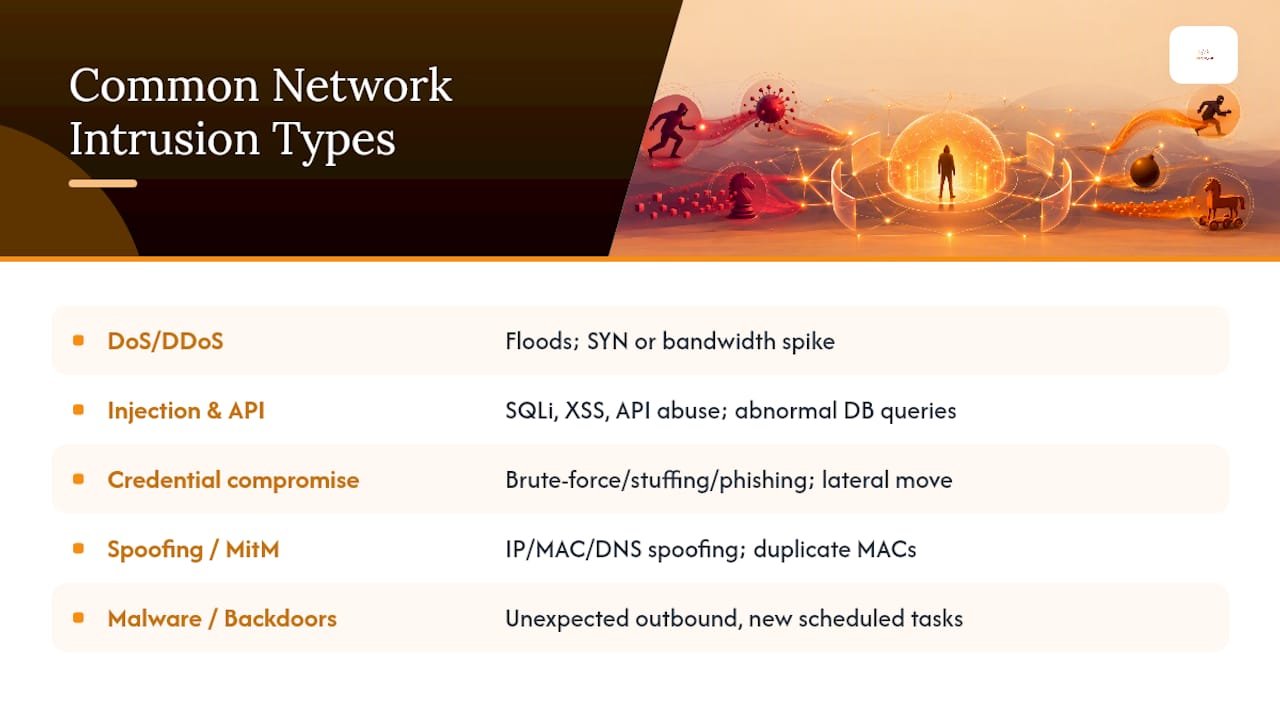
Malware and backdoors, including fileless variants that live in memory or abuse legitimate tools like PowerShell, give attackers persistent access without dropping a traditional executable. Watch for unexpected outbound connections to unfamiliar domains and new scheduled tasks.
SQL injection, XSS, and API abuse exploit unsanitized input to manipulate a database or hijack a session. A classic SQLi attack path runs from a vulnerable form field to a UNION-based query that exfiltrates customer records; the detection signal is often abnormal query patterns or unexpected data volume leaving a database server.
Buffer overflow and memory exploits overwrite adjacent memory to execute arbitrary code, frequently the entry point for zero-day exploits.
Spoofing (IP, MAC, or DNS) and man-in-the-middle attacks, like ARP poisoning, rogue Wi-Fi access points, or BGP hijacking, intercept or redirect traffic. Look for duplicate MAC addresses on a subnet or unexplained routing changes.
Packet sniffing, passive or active, captures unencrypted traffic on a shared segment. Port and host scanning precedes almost every serious intrusion, showing up as sequential connection attempts across a port range.
Credential-based attacks, brute force, credential stuffing, and phishing, remain the most common initial access vector. Once inside, attackers pursue lateral movement and privilege escalation, hopping between hosts using stolen credentials or misconfigured trust relationships.
Supply-chain compromise hits third-party software or update mechanisms, a category that broader attack-vector taxonomies treat as distinct from direct network exploitation because the initial breach happens outside your perimeter entirely.
What Is the Typical Lifecycle of a Network Intrusion?
Attackers rarely improvise. They move through a sequence, and each stage gives you a different chance to stop them.
- Reconnaissance — attackers gather information passively (public records, social media) or actively (DNS lookups, WHOIS). Threat intelligence feeds and DNS monitoring catch this early.
- Scanning — port and vulnerability scans map the attack surface. NIDS and firewall logs flag sequential connection attempts here.
- Initial access/exploitation — phishing, an unpatched vulnerability, or stolen credentials get the attacker in the door. MFA and patch management are your strongest levers.
- Privilege escalation and lateral movement — the attacker expands reach. Segmentation and least-privilege access controls limit how far a single compromised account can travel.
- Persistence — backdoors and scheduled tasks keep access alive. Host-based monitoring spots new services and unauthorized startup entries.
- Discovery, exfiltration, and impact — data leaves the network or systems get encrypted. Egress filtering and DLP tools matter most here.
- Cleanup/covering tracks — logs get deleted or altered, which is exactly why centralized, tamper-resistant logging matters.
A phishing email that drops malware, escalates privileges, moves laterally to a file server, and exfiltrates data over DNS tunneling touches five of these seven stages. Catching it at stage three, before lateral movement, is dramatically cheaper than catching it at stage six.
How Do IDPS Categories and Detection Methods Differ?
NIST’s Special Publication 800-94 groups intrusion detection and prevention systems into four categories: network-based (NIDS/NIPS), monitoring traffic at chokepoints; wireless (WIDS/WIPS), watching Wi-Fi-specific threats like rogue access points; network behavior analysis (NBA), which baselines normal traffic and flags deviations; and host-based (HIDS/HIPS), which watches individual endpoints for suspicious process activity or file changes.
Detection methodology matters as much as category. Signature-based detection matches traffic against known attack patterns, fast and reliable for documented threats, but blind to anything new. Anomaly-based detection builds a statistical baseline and flags deviations, catching novel attacks but generating more noise. Stateful protocol analysis compares traffic against vendor protocol specifications to catch violations signatures miss.
- Signature-based: low false positives on known threats, zero visibility into zero-days.
- Anomaly-based: catches novel attacks, but tuning determines whether it’s useful or just loud.
- Stateful protocol analysis: strong for protocol-level violations, resource-intensive at scale.
OWASP’s guidance on intrusion detection makes the trade-off explicit: signature systems handle known attacks reliably, while behavior-based systems catch what signatures can’t, at the cost of more tuning work. NIST’s own recommendation reflects this reality, urging organizations to combine network-based and host-based systems rather than rely on either alone. A 2025 review of IDS architectures reinforces the same point: hybrid systems that correlate host and network telemetry consistently outperform single-method deployments on both detection rate and false-positive rate.
What Are the Warning Signs of a Network Intrusion?
Certain patterns in your traffic and logs deserve immediate attention:
- Sustained high-volume flows to or from a single host, especially at odd hours.
- Unusual source/destination IP pairs that don’t match normal business traffic.
- Unexpected TLS certificates or SNI mismatches during handshakes.
- Sudden spikes in DNS query volume, particularly to newly registered domains.
- New listening ports or services that weren’t part of your baseline.
- Repeated failed authentication attempts against the same account or service.
A flow log entry showing 50,000 bytes/second to an unfamiliar external IP on port 4444, timestamped at 3 a.m., is worth investigating before a “normal” business-hours anomaly with lower confidence. Prioritize by potential impact first, confidence second.
How Can You Prevent and Mitigate Network Intrusions?
Controls work best layered, and some carry more weight than others.
- Patch and manage vulnerabilities on a defined cadence, prioritizing internet-facing and high-privilege systems first.
- Segment your network, since limiting lateral movement between segments is one of the most effective ways to contain a breach once initial access happens.
- Enforce MFA and strong authentication everywhere, particularly for remote access and administrative accounts.
- Apply least-privilege access controls so a compromised account can’t reach everything.
- Build secure coding practices and input validation into development pipelines to prevent SQLi and XSS at the source.
- Maintain DNS and TLS hygiene, including certificate monitoring and DNS filtering.
- Architect for DDoS mitigation with upstream scrubbing and rate limiting rather than relying on a single appliance to absorb a flood.
- Verify supply-chain and update integrity before trusting third-party code or patches.
Regular vulnerability analysis turns this list from theory into a repeatable process rather than a once-a-year scramble.
How Do You Tune Detection Systems to Reduce False Positives?
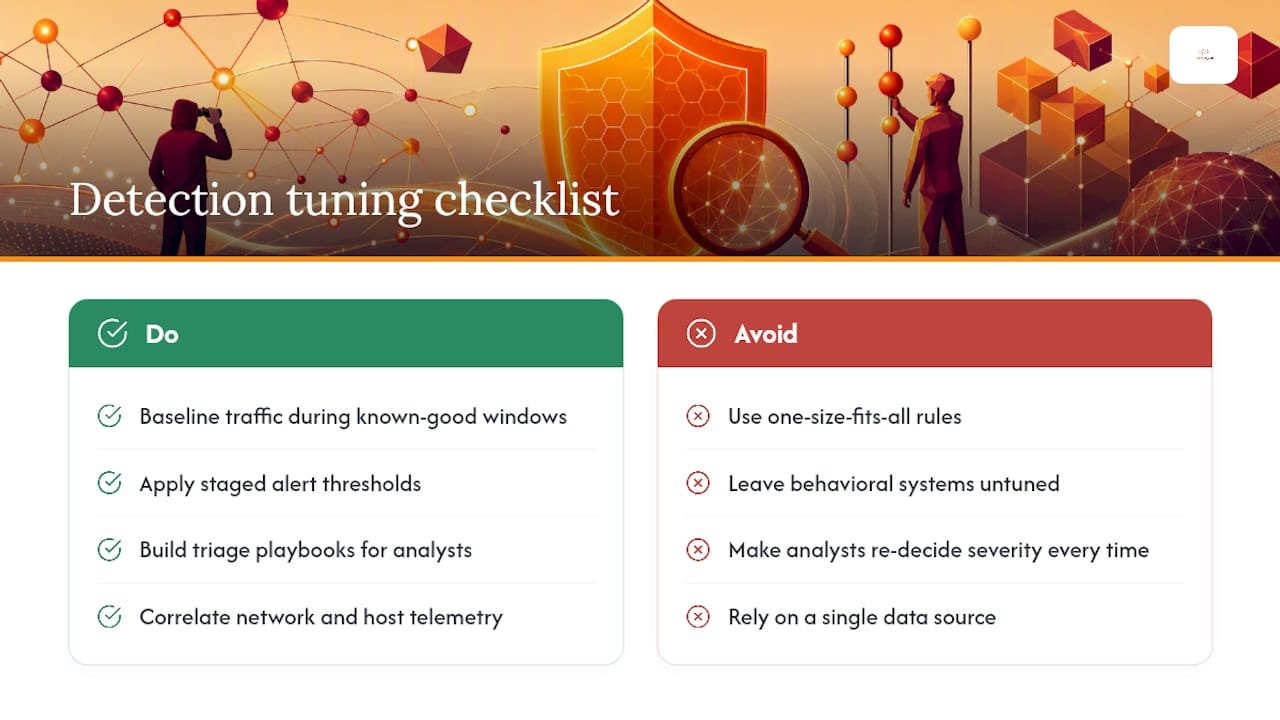
Pro Tip: Baseline your traffic during known-good windows, apply staged alert thresholds instead of one-size-fits-all rules, and build triage playbooks so analysts aren’t re-deciding severity every time. Un-tuned behavioral systems drive alert fatigue fast, and correlating network with host telemetry catches multi-stage attacks a single data source would miss.
If your team is drowning in alerts or lacks 24/7 coverage, that’s the signal to bring in managed detection and response.
A Defender’s Take on Where Effort Actually Pays Off
Detection coverage matters more than any single prevention control, because attackers only need one gap while you need to catch every attempt. Rapid containment beats perfect prevention. With limited resources, tune what you have before buying something new.
How Total Cyber Solutions Helps You Close These Gaps
Alert fatigue, tuning gaps, and the absence of 24/7 coverage are the three reasons most intrusions get caught late instead of early, and closing all three in-house takes headcount most small and mid-sized businesses don’t have. Total Cyber pairs managed cybersecurity services with ongoing vulnerability analysis and hands-on cyber awareness training, so your detection stack actually gets watched and your team stops falling for the phishing emails that start most of these attack chains.

A vCSO advisory session or a discovery call is the fastest way to find out where your current monitoring has blind spots. Request a discovery call through the MSP form and get a clear read on what’s covered, what’s missing, and what to fix first.
Sources
- Guide to Intrusion Detection and Prevention Systems (IDPS) — NIST Special Publication 800-94
- Guide to Intrusion Detection and Prevention Systems (legacy PDF) — NIST Special Publication 800-94
- Intrusion Detection — OWASP
- Network Denial of Service, Technique T1498 — MITRE ATT&CK