

Most U.S. businesses budget a few thousand to low tens of thousands of dollars per month for a mid-market virtual CISO retainer. Hourly advisory work generally costs from about one hundred to a few hundred dollars per hour, and project-based engagements often range widely depending on scope. Startups and smaller organizations typically start at a lower monthly cost range for entry-level vCISO services. The IANS 2024 CISO Compensation Summary Report puts fully loaded in-house CISO compensation well above $300,000 annually, which means even a $10,000/month vCISO retainer represents a fraction of that cost. Your immediate next steps: decide which pricing model fits your engagement style, estimate your monthly hours needed, and build a vendor evaluation checklist before your first call. Frameworks from NIST, certifications tracked by ISACA and ISC2, and providers like Total Cyber Solutions all shape what you should expect to pay and receive.
Key Takeaways
Mid-market retainers typically land between $5,000 and $12,000 per month depending on scope, certifications, and compliance requirements.
| Point | Details |
|---|---|
| Typical monthly ranges | Entry-level starts at $3,000–$5,000/month; mid-market retainers run $5,000–$12,000/month; enterprise/regulatory engagements reach $25,000+/month. |
| Biggest cost drivers | Required hours, regulatory frameworks in scope (HIPAA, CMMC, FedRAMP), seniority and certifications (CISM, CRISC), and incident response availability push fees up most. |
| Include tooling and IR in TCO | GRC platforms, SIEM subscriptions, and incident response retainers are often billed separately; budget $500–$5,000/month on top of the base retainer. |
| Use the vendor checklist | Require named deliverables, defined hours, overage rates, a transition clause, and references before signing any SOW. |
| Total Cyber Solutions | Total Cyber offers scoped vCISO packages for SMBs and mid-market companies with transparent pricing and a 90-day risk roadmap built into onboarding. |
Table of Contents
- What vCISO pricing models actually look like
- What you actually get at each price band
- Key factors that push vCISO fees up or down
- Sample budgets by company size and compliance needs
- How to build a 12-month vCISO budget
- How to evaluate proposals and avoid bad contracts
- How Total Cyber Solutions structures vCISO engagements
- A practitioner’s honest take on where buyers get this wrong
- Total Cyber Solutions: a practical next step for vCISO buyers
- Sources
What vCISO pricing models actually look like
The way you structure a virtual CISO engagement matters as much as the dollar figure. Four models dominate the U.S. market, and each one trades off flexibility against predictability in a different way.
Hourly / ad-hoc. You pay only for time used. This works for one-off advisory needs, a quick policy review, or a gap assessment before a board meeting. Rates typically run $150–$300 per hour. The risk is unpredictability: a complex incident or a compliance sprint can push hours far beyond your estimate.
Fractional (committed hour blocks). You purchase a defined block of hours each month, often 10–20 hours, at a negotiated rate. This gives the vCISO enough continuity to own a program rather than just answer questions. It is the most common model for SMBs that need ongoing leadership without a full-time commitment.
Monthly retainer. A fixed monthly fee covers a defined scope of deliverables, not just hours. Predictable for budgeting, and the vCISO is accountable to outcomes rather than a clock. Most mid-market engagements use this model.
Project-based. A fixed price for a bounded scope: SOC 2 readiness, a NIST SP 800-53 controls gap assessment, or a 90-day risk roadmap. Useful when you have a specific deliverable and a defined end date. It does not replace ongoing leadership.
One thing buyers often miss: the retainer model shifts accountability from hours to outcomes. That is a meaningful difference when you are trying to pass an audit or satisfy a cyber insurance requirement. Cybersecurity insurance requirements increasingly name CISO-level accountability as a condition of coverage, which makes the retainer model attractive even for smaller organizations.
What you actually get at each price band
Price bands translate directly into hours and deliverables. Here is what the U.S. market typically delivers at each tier, based on industry pricing guides for 2026.
| Price band | Monthly cost | Hours/month | Core deliverables |
|---|---|---|---|
| Entry | $3,000–$5,000 | 8–15 | Policy gap review, basic risk register, quarterly advisory call |
| SMB | $3,000–$5,000 | 15–30 | Risk register maintenance, vendor risk reviews, security awareness oversight, monthly reporting |
| Mid-market | $8,000–$12,000 | 30–50 | Board-level reporting, audit coordination, roadmap ownership, incident response planning |
| Enterprise / regulatory | $12,000–$25,000+ | 50–80+ | Full program ownership, multi-framework compliance (HIPAA, CMMC, FedRAMP), incident command, executive briefings |
A few things to keep in mind as you read those ranges:
- Entry band engagements rarely include proactive program management. You get advisory time, not a security leader who owns outcomes.
- SMB band is where you start getting a real risk register cadence, vendor risk reviews, and someone who can speak to your cyber insurer.
- Mid-market band typically includes board-ready reporting, which matters if your board or investors are asking security questions.
- Enterprise / regulatory band covers multi-framework environments. If you need simultaneous HIPAA and SOC 2 coverage, expect to be in this tier.
Tooling is a separate line item at every band. A vCISO who requires a specific GRC platform or SIEM adds that subscription cost to your total. Ask vendors upfront whether tooling is included or billed separately.
Key factors that push vCISO fees up or down
Understanding what drives the price helps you control scope before you sign anything. These are the levers that matter most.
- Required hours per month. The single biggest driver. More hours means more cost. Be honest about how much leadership time your program actually needs before you negotiate a retainer.
- Regulatory frameworks in scope. HIPAA, SOC 2, CMMC, and FedRAMP each add complexity. Multi-framework engagements routinely cost 30–50% more than single-framework work. The Verizon Data Breach Investigations Report documents the incident patterns that regulators focus on, and vCISOs in regulated sectors must address all of them.
- Company size and environment complexity. More employees, more locations, more cloud services, and more third-party integrations all add scope. A 50-person company with a single SaaS stack is a different engagement than a 400-person company with hybrid infrastructure and a dozen vendors.
- Seniority and certifications. A vCISO holding ISACA’s CISM credential commands higher rates because the market recognizes it as an executive-level security certification. ISACA’s CRISC signals specialized risk management capability, which matters for vendor-risk programs. EC-Council’s CCISO is another senior credential that often correlates with premium pricing. Federal-framework experience (FedRAMP, CMMC) adds another premium on top of base credentials.
- Incident response readiness. If you want your vCISO available to lead incident response, expect a higher retainer or a separate IR retainer. On-call availability is not typically included in standard fractional packages.
- Travel and on-site requirements. Remote-only engagements cost less. If you need your vCISO on-site for board meetings, audits, or tabletop exercises, travel costs add to the total.
- Mandatory tooling. Some providers bundle a GRC platform or SIEM into their retainer. Others require you to subscribe independently. Either way, budget for it.
Pro Tip: Ask vendors whether their retainer includes incident response hours or whether those are billed separately at a higher rate. Many contracts include a standard retainer for program management but bill incident response at $250–$400 per hour on top. Knowing this upfront prevents a surprise invoice after a breach.
Sample budgets by company size and compliance needs
Here is how vCISO cost typically shapes up across common company profiles. These are realistic ranges, not guarantees, and your actual number depends on the factors above.
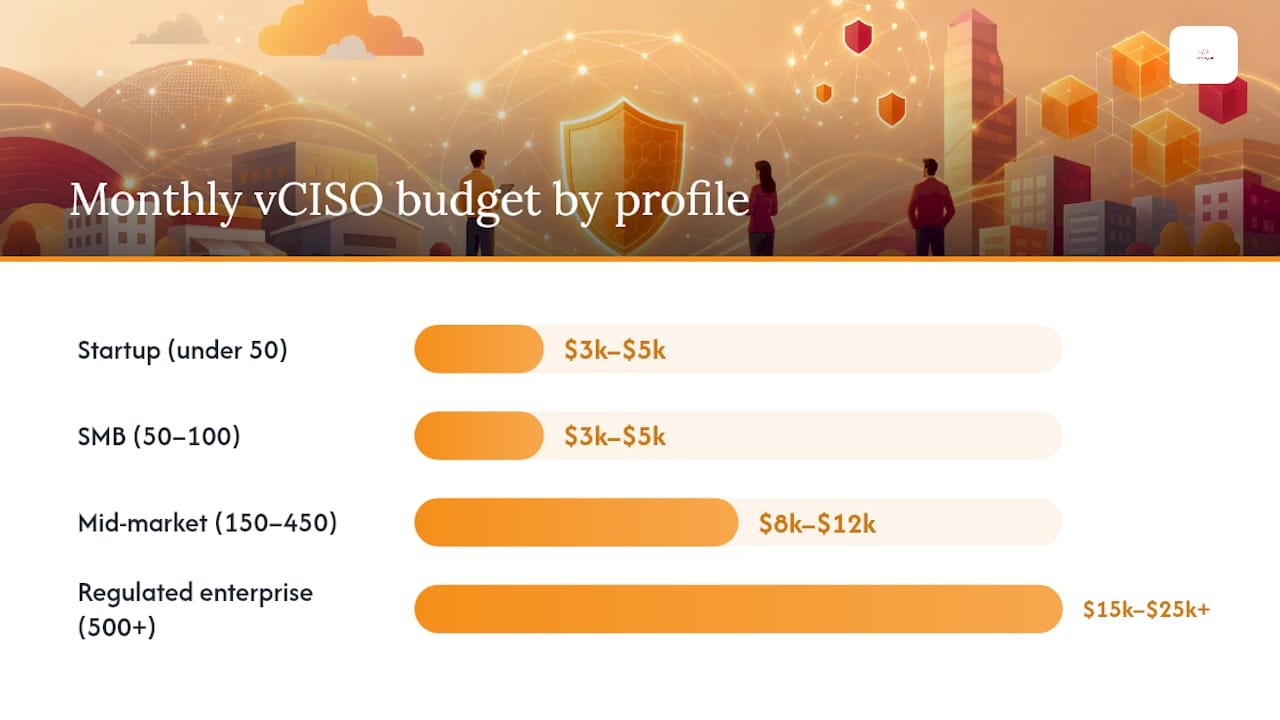
| Company profile | Recommended model | Monthly range | Hours/month |
|---|---|---|---|
| Startup (under 50 employees, pre-compliance) | Hourly or fractional | $3,000–$5,000 | 8–15 |
| SMB (50–100 employees, SOC 2 or basic compliance) | Fractional or retainer | $3,000–$5,000 | 15–30 |
| Mid-market (150–450 employees, HIPAA or multi-framework) | Monthly retainer | $8,000–$12,000 | 30–50 |
| Regulated enterprise (500+ employees, CMMC or FedRAMP) | Full retainer + IR | $15,000–$25,000+ | 50–80+ |
A few concrete scenarios help make those numbers real:
- Series A SaaS company preparing for SOC 2. A 40-person company with no existing security program typically needs a 3–6 month project engagement ($15,000–$30,000) to build the control environment, followed by a $3,000–$5,000/month retainer for ongoing program management and audit support.
- Mid-market healthcare with HIPAA obligations. A 250-person medical group needs risk assessments, a HIPAA security rule gap analysis, workforce training oversight, and breach response planning. Expect $8,000–$12,000/month for a retainer that covers all of that.
- Enterprise preparing for FedRAMP authorization. FedRAMP is among the most demanding federal frameworks. A vCISO with FedRAMP experience typically commands $18,000–$25,000/month, and the engagement often runs 12–18 months before authorization.
On the savings side: decision guides comparing vCISO to full-time CISO consistently show vCISO engagements costing 30–75% less than a fully loaded in-house hire. At $12,000/month, an annualized vCISO retainer runs $144,000. A full-time CISO with salary, benefits, equity, and overhead routinely exceeds $350,000 per year. The math is straightforward for most SMBs and mid-market companies.
If you operate in healthcare, defense contracting, or financial services, build that buffer into your initial budget. The ISC2 Cybersecurity Workforce Report documents the shortage of qualified security leaders, which keeps rates elevated across the board.
How to build a 12-month vCISO budget
Budgeting for a vCISO is not just the monthly retainer. Here is a numbered checklist you can use when building your estimate or asking vendors for proposals.
- Base retainer or hourly estimate. Start with your expected monthly hours and multiply by the hourly rate, or confirm the retainer fee. This is your floor, not your ceiling.
- Onboarding and discovery fees. Many providers charge a one-time onboarding fee ($2,000–$8,000) for the initial discovery, environment assessment, and 90-day risk roadmap. Confirm whether this is included or separate.
- Tooling subscriptions. GRC platforms, SIEM tools, and vulnerability scanning subscriptions can add $500–$3,000 per month depending on your environment. Get a list of required tools before signing.
- Overage hours. Define the overage rate upfront. If your retainer covers 20 hours and you use 28, what is the per-hour charge for the extra eight? Cap it contractually.
- Incident response retainer. If you want guaranteed IR availability, budget a separate IR retainer of $2,000–$5,000/month or confirm the hourly rate for unplanned incidents.
- Audit readiness spikes. The 60–90 days before a SOC 2 or HIPAA audit typically require more hours. Budget a 20–30% increase in hours during that window.
- Third-party assessments. Penetration testing, external vulnerability assessments, and third-party audits are usually not included in a vCISO retainer. Budget $5,000–$20,000 annually depending on scope.
- Tabletop exercises. Annual or semi-annual tabletop exercises for incident response are often billed separately. Budget $2,000–$5,000 per exercise.
- Travel and on-site costs. If on-site visits are required, budget travel expenses separately. Remote-only engagements avoid this entirely.
- Transition costs. If you switch providers or bring the function in-house, a transition period of 30–60 days is standard. Budget for overlap.
Front-load your budget for the first three to six months. That is when onboarding, gap assessments, and initial remediation projects happen. Steady-state retainer costs typically level off after month six once the program is running.
For measuring whether the spend is worth it, the SMB IT security ROI guide offers a practical framework for tying security investments to business outcomes.
How to evaluate proposals and avoid bad contracts
Getting a proposal is the easy part. Knowing what to push back on is where buyers typically leave money on the table or sign something they regret.
Questions to ask every vendor before signing:
- How many hours per month does the retainer cover, and what is the overage rate?
- Who specifically will serve as our vCISO, and what are their credentials?
- Do you use subcontractors, and if so, who and under what confidentiality terms?
- What is your incident response role, and is it included or billed separately?
- How do you handle knowledge transfer if we terminate the engagement?
- Can you provide references from clients in our industry or compliance environment?
- What SLAs govern your response time for urgent security questions?
Required items in every SOW or contract:
- Named deliverables with measurable outcomes (not just “security advisory services”)
- Defined hours per month and a clear overage rate
- Reporting frequency and format (monthly written report, quarterly board briefing)
- Escalation path for incidents and who has authority to act
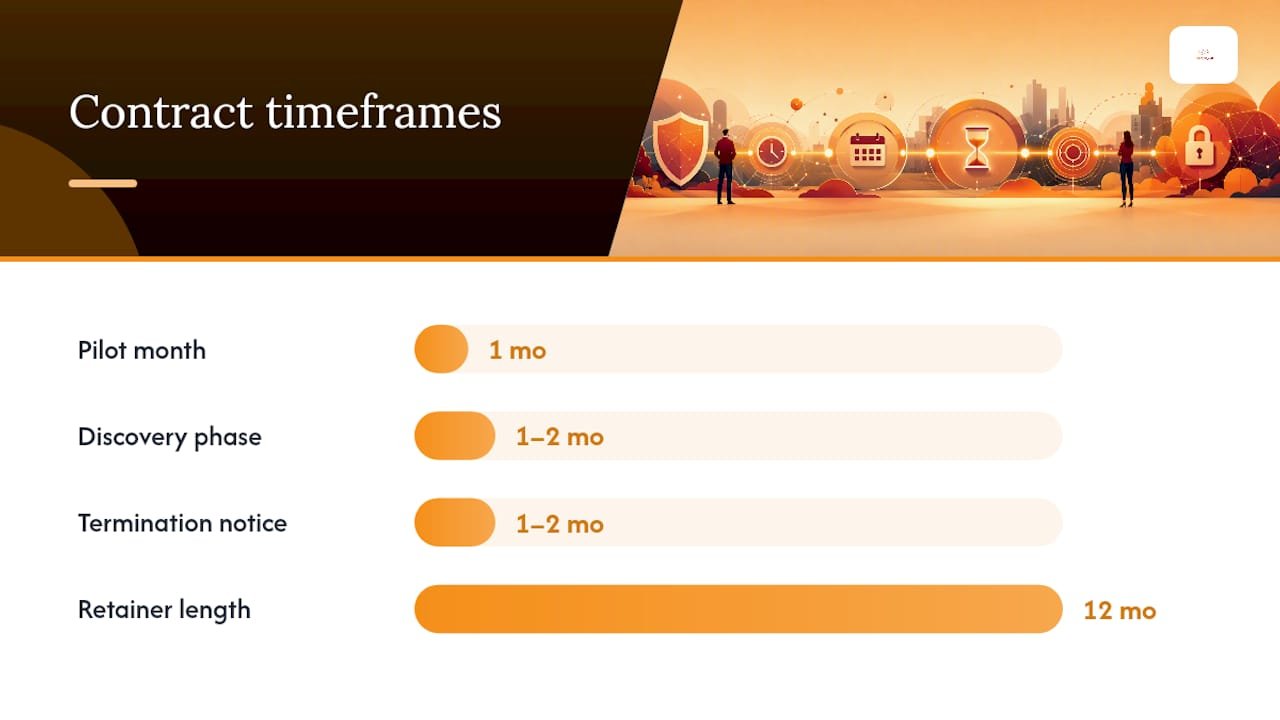
- Termination clause with a defined notice period (30–60 days is standard)
- Transition assistance clause requiring documentation handoff
- Clear statement of which party owns and pays for tooling subscriptions
- Confidentiality and liability terms, including data handling
Red flags that should give you pause:
- Deliverables described only as “ongoing security support” with no specifics
- No defined hours or accountability metrics in the retainer
- Mandatory tooling requirements with no pricing disclosed upfront
- No transition assistance clause
- Unlimited liability carve-outs that expose you to uncapped costs
- Resistance to providing references from similar clients
On negotiation: ask for a fixed-scope pilot month before committing to a 12-month retainer. A reputable provider will agree to a 30–60 day discovery phase with defined deliverables. If a vendor refuses a pilot and pushes immediately for a 12-month commitment, that is worth noting. Also negotiate a cap on overage hours so a busy month does not double your invoice. For a broader checklist on structuring vendor evaluations, the enterprise cybersecurity checklist for leaders is a useful reference.
How Total Cyber Solutions structures vCISO engagements
Total Cyber Solutions is a veteran-owned cybersecurity and managed IT services company. The team works with SMBs and mid-market organizations across compliance-heavy industries, offering vCISO leadership alongside managed cybersecurity, risk assessments, compliance consulting, and workforce training.
Engagements typically follow three shapes:
- Starter package. Designed for companies under 100 employees with no existing security program. Covers initial gap assessment, basic policy development, risk register setup, and quarterly advisory reporting. Typically 10–20 hours per month.
- Growth package. For SMBs with 100–300 employees that need ongoing program management, vendor risk oversight, security awareness training coordination, and monthly reporting. Covers 20–40 hours per month and includes compliance framework alignment (SOC 2, HIPAA, NIST CSF).
- Compliance package. For mid-market or regulated organizations that need full program ownership, board-level reporting, audit coordination, and multi-framework compliance support (HIPAA, CMMC, CJIS). Covers 40–80 hours per month and includes incident response planning.
Onboarding follows a consistent pattern: a discovery phase in weeks one through three, quick-win remediation in weeks four through eight, and a 90-day risk roadmap delivered to leadership by the end of the first quarter. Board-readiness deliverables are built into every engagement from day one, not added later.
Pro Tip: Ask your vCISO provider to deliver a written 90-day risk roadmap as a condition of the onboarding phase. If they cannot commit to that deliverable in writing before you sign, the engagement lacks the structure you need to measure progress.
For a full picture of Total Cyber’s managed cybersecurity services and how vCISO leadership fits into a broader security program, the services page covers the scope in detail. Ready to start the conversation? Submit your information here and a member of the team will follow up to discuss your situation.
A practitioner’s honest take on where buyers get this wrong
Most buyers under-scope two things: incident response and tooling. They budget for the retainer, sign the contract, and then discover six months in that their vCISO’s IR role is advisory only, not command, and that the GRC platform they need costs $1,200 per month on top of everything else. Those two line items alone can add $20,000–$30,000 to an annualized budget that was never planned for them.
The other common mistake is treating the first year as steady-state. It is not. The first six months are front-loaded with project work: gap assessments, policy builds, vendor risk reviews, and remediation planning. Buyers who budget only for the retainer and ignore project fees end up either underfunding the program or asking for scope reductions that undermine the whole engagement.
My recommended heuristic: budget a 6–9 month retainer plus a defined project budget equal to two to three months of retainer fees for first-year remediation work. That gives your vCISO the runway to build a real program, not just produce reports. Then reassess at month nine for steady-state planning.
The NIST Cybersecurity Framework is a useful anchor for scoping those first-year deliverables. If your vCISO cannot map their work to a recognized framework, that is a scope clarity problem worth solving before month one.
Total Cyber Solutions: a practical next step for vCISO buyers
Total Cyber Solutions offers vCISO leadership without the overhead of a full-time executive hire. For SMBs and mid-market companies that need a real security program, not just a compliance checkbox, the veteran-owned team brings managed cybersecurity, compliance consulting, and executive-level security leadership under one contract.

The engagement starts with a discovery call to understand your environment, your compliance obligations, and your current security posture. From there, Total Cyber builds a scoped proposal with defined deliverables, clear hours, and transparent pricing. No vague retainers. No surprise tooling fees. If you are ready to get a realistic number for your situation, start the conversation here.
Sources
Recommended
- Managed Security Services Benefits for SMBs: 2026 Guide | Total Cyber Solutions
- SMB IT Security ROI Measurement: A Practical Guide | Total Cyber Solutions
- IT Security Best Practices for Virginia SMBs: 2026 Guide | Total Cyber Solutions
- 2022 ISC2 Cybersecurity Workforce Report | Total Cyber Solutions