

A security posture assessment is a holistic, structured evaluation of your organization’s overall cybersecurity health, measuring how well your defenses, policies, and people work together to manage risk. Unlike a vulnerability scan or a compliance audit, this process examines your entire security program across technical controls, governance, processes, and personnel. The industry term you will encounter most often is “cybersecurity posture assessment,” and it maps directly to frameworks like NIST CSF 2.0 and CISA guidance. Totalcyber conducts these assessments for organizations that need a clear, honest picture of where they stand before threats find the gaps first.
What is a security posture assessment, and what does it cover?
A security posture assessment is defined as a holistic evaluation of cybersecurity readiness that goes well beyond running a scanner against your network. It covers technical controls, governance structures, written policies, operational processes, and the human behaviors that either protect or expose your organization. That scope is what separates it from a point-in-time vulnerability scan, which only captures exposed software flaws.
The definition of security posture also includes how well your organization can detect, respond to, and recover from an incident. A business can have strong perimeter defenses and still fail badly at incident response. The assessment surfaces both problems at once, giving you a complete picture rather than a partial one.

NIST CSF 2.0 provides the most widely used structure for organizing assessment findings. The framework covers six core functions, 22 categories, and 106 subcategories. That level of detail means nothing falls through the cracks when a qualified assessor works through your environment.
What components and frameworks are evaluated?
The six core functions of NIST CSF 2.0 are Govern, Identify, Protect, Detect, Respond, and Recover. Each function maps to a specific layer of your security program, and each serves as a fundamental category for organizing assessment findings. Assessors score your maturity within each function and produce a profile that shows where you are strong and where you are exposed.
Beyond NIST CSF 2.0, assessors commonly reference CIS Controls and ISO 27001 to fill gaps or satisfy specific regulatory requirements. CIS Controls are particularly useful for smaller organizations because they prioritize the most impactful defensive actions first. ISO 27001 applies when your contracts or regulators require a formal information security management system.
The assessment also evaluates controls for existence, configuration, and verified performance. A control that exists on paper but is misconfigured provides no real protection. Distinguishing between controls that exist and those operating effectively is critical for realistic posture scoring.
Pro Tip: Ask your assessor to produce an organizational profile scorecard mapped to NIST CSF 2.0. That document bridges technical findings with executive language, making budget conversations far easier.
| Framework | Primary use | Maturity output |
|---|---|---|
| NIST CSF 2.0 | Broad posture evaluation | Function-level maturity scores |
| CIS Controls | Prioritized defensive actions | Implementation group ratings |
| ISO 27001 | Formal management system | Conformance and gap analysis |
How is a security posture assessment performed?
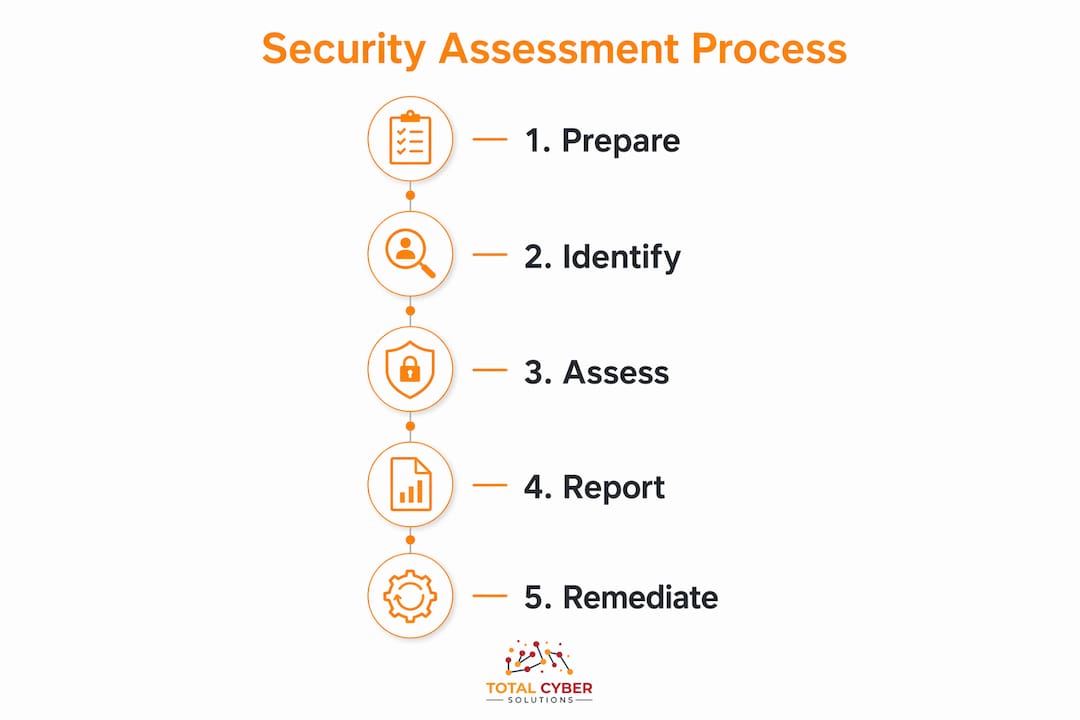
The security assessment process follows six sequential steps. Each step builds on the last, so skipping one produces an incomplete picture.
-
Scoping. Define which systems, locations, business units, and data types fall inside the assessment boundary. A scope that is too narrow misses real risk. A scope that is too broad produces a report no one can act on.
-
Asset inventory. Catalog every device, application, cloud service, and data store within scope. You cannot protect what you cannot see.
-
Threat modeling. Identify the threat actors most likely to target your industry, the attack paths they favor, and the assets they would pursue. This step keeps the assessment grounded in realistic risk rather than theoretical worst cases.
-
Control evaluation. Test each control for existence, correct configuration, and actual performance under realistic conditions. This is where assessors distinguish between a firewall rule that exists and one that blocks the right traffic.
-
Risk scoring. Risk scoring translates findings into ranked lists by combining the likelihood of exploitation with business impact. Inputs include asset criticality, known exploits, patch currency, regulatory scope, and exposure profile. That ranking tells you which gaps to close first.
-
Remediation roadmap. Sequence fixes by risk severity and resource availability. Remediation roadmaps prioritize quick wins before long-haul architectural changes to maintain momentum. Assign a named owner to every item on the list.
The assessment process is not the same as a penetration test. A penetration test simulates an attack to see how far an adversary can go. A posture assessment measures the overall health of your program. Both are valuable, but they answer different questions. You can learn more about vulnerability scanning’s role in risk management as a complementary practice.
Pro Tip: Build your remediation roadmap in three tiers: fixes you can complete in 30 days, fixes that require 90 days, and fixes that need a full budget cycle. That structure keeps leadership aligned and prevents the list from stalling.
Why is a security posture assessment critical for modern organizations?
Cyber threats are not slowing down. Ransomware incidents increased by 32% in 2025, and third-party breaches account for 30% of all security incidents. Those numbers mean the gap between your current defenses and what attackers can do is widening every quarter. A posture assessment finds that gap before an attacker does.
The importance of security posture evaluation becomes even clearer when you compare it to a compliance audit. Passing an audit confirms you met a checklist on a specific date. It does not confirm your controls work under real conditions.
“Organizations can pass compliance audits yet remain vulnerable to operational risks. A security posture assessment evaluates efficacy against realistic threats, not regulatory checklists. That distinction is the difference between documented compliance and actual security.”
Continuous posture management replaces the old model of annual point-in-time audits. Modern best practices embed automated monitoring to maintain dynamic security posture scores that update as your environment changes. That approach keeps your risk picture accurate between formal assessments.
CISOs, boards, and cyber insurers all benefit from posture assessment outputs. Scorecards mapped to NIST CSF 2.0 communicate maturity levels clearly, giving leadership the evidence they need to justify security investments and giving insurers the data they need to price your policy accurately. For organizations pursuing CMMC certification, posture assessments also feed directly into the CMMC readiness process.
Good data center hygiene is another dimension of posture that organizations often overlook. Data center security practices for compliance and protection directly affect your overall posture score, especially if you host critical systems on premises.
What are the common pitfalls in security posture assessments?
The biggest mistake organizations make is treating the assessment as a one-time project. A report that sits on a shelf does not reduce risk. The findings need owners, timelines, and follow-up reviews.
- No remediation ownership. Named remediation owners ensure vulnerabilities are addressed and tracked through improvement cycles. Without assigned owners, findings stall at the report stage.
- Audit mentality. Focusing on checking boxes rather than testing real-world effectiveness produces a false sense of security. The goal is to find structural gaps, not to confirm that policies exist on paper.
- Technical language that executives cannot use. A finding that says “TLS 1.0 is enabled on the legacy web server” means nothing to a CFO approving a remediation budget. Translate every finding into business impact language.
- Ignoring continuous monitoring. A posture assessment conducted in january is outdated by march if your environment changes. Treat the assessment as the starting point of an ongoing program, not the finish line.
Pro Tip: After your assessment, schedule a 90-day check-in with the same assessor. That review confirms remediation progress and catches new gaps introduced by system changes.
Key Takeaways
A security posture assessment is the most complete method available for understanding your organization’s real cybersecurity readiness, and it requires scoping, control evaluation, risk scoring, and continuous follow-through to produce lasting risk reduction.
| Point | Details |
|---|---|
| Broader than a vulnerability scan | Posture assessments cover governance, people, processes, and technical controls together. |
| NIST CSF 2.0 structures findings | Six functions, 22 categories, and 106 subcategories organize every gap into a clear scorecard. |
| Risk scoring drives prioritization | Combine likelihood and business impact to rank fixes before committing resources. |
| Compliance audits are not enough | Passing an audit does not confirm controls work under real threat conditions. |
| Continuous management beats annual reviews | Automated monitoring keeps your posture score accurate as your environment evolves. |
Posture assessments are a strategic tool, not a checkbox
I have worked with organizations that completed thorough assessments and then filed the report. Twelve months later, they faced the same gaps. The assessment was excellent. The follow-through was not.
The organizations that get real value from posture evaluations treat the findings as the opening of a conversation, not the end of one. They assign owners. They schedule quarterly reviews. They bring the scorecard to board meetings and use it to justify budget requests. That approach turns a technical document into a management tool.
The other shift I advocate for is executive engagement from day one. When the CISO and the CFO both understand what the assessment measures and why, remediation decisions happen faster. Security stops being a cost center and starts being a business risk function. That change in framing is worth more than any single technical fix.
My honest recommendation: build a continuous posture program rather than scheduling a one-off project. Start with a formal assessment to establish your baseline. Then embed monitoring, assign ownership, and review progress on a fixed cadence. The threat environment changes every quarter. Your posture program should keep pace.
— Alden
How Totalcyber supports your security posture program
Totalcyber’s managed cybersecurity services are built for organizations that need more than a one-time report. The team conducts structured posture assessments mapped to NIST CSF 2.0, assigns risk scores to every finding, and builds remediation roadmaps your team can actually execute. Continuous monitoring keeps your posture score current between formal reviews, so you are never operating on stale data.

Totalcyber is a veteran-owned firm with direct experience in compliance consulting, risk assessments, and workforce training. If your organization is ready to move from guesswork to a clear security baseline, reach out today and get your posture assessment started.
FAQ
What is the definition of security posture?
Security posture is defined as the overall strength of an organization’s cybersecurity defenses, policies, processes, and people working together to manage risk. It reflects how well an organization can prevent, detect, and recover from cyber threats.
How does a security posture assessment differ from a compliance audit?
A compliance audit confirms you met a regulatory checklist on a specific date. A posture assessment tests whether your controls actually work against realistic threats, which is a meaningfully higher bar.
How often should organizations conduct a security posture assessment?
A formal assessment should occur at least annually, with continuous automated monitoring running between reviews. Major changes to your environment, such as a cloud migration or a merger, should trigger an additional assessment.
What framework is most commonly used in a security posture assessment?
NIST CSF 2.0 is the most widely used framework, covering six core functions, 22 categories, and 106 subcategories. CIS Controls and ISO 27001 are also referenced depending on industry and regulatory requirements.
How do you prioritize findings from a security posture assessment?
Risk scoring combines the likelihood of exploitation with business impact to rank findings. Asset criticality, known exploits, patch currency, and regulatory scope all feed into the final priority list.
Recommended
- 2022 ISC2 Cybersecurity Workforce Report | Total Cyber Solutions
- Cybersecurity Maturity Model Certification (CMMC) | Total Cyber Solutions
- Cybersecurity Maturity Model Certification (CMMC): What You Need to Know | Total Cyber Solutions
- The Role of Vulnerability Scanning in Cyber Risk Management | Total Cyber Solutions