

Cybersecurity compliance is the deliberate practice of aligning your security measures with established frameworks and regulations to materially reduce cyber risk. For small and medium-sized business owners, understanding why compliance reduces cyber risk is the difference between a reactive scramble after a breach and a disciplined defense that stops most attacks before they start. Frameworks like NIST CSF, ISO 27001, and SOC 2 give you a proven blueprint. They prescribe specific controls, require documented policies, and demand ongoing testing. That structure is exactly what closes the gaps attackers exploit.
Why compliance reduces cyber risk through structured frameworks
Compliance frameworks do not just tell you what to do. They tell you how to prove you did it, and that accountability changes everything. When your team follows NIST CSF or ISO 27001, you are not guessing at security. You are applying controls that regulators, auditors, and insurers have validated across thousands of organizations.
Compliance frameworks like NIST, ISO, and SOC 2 share many control domains, which means one compliance effort can satisfy multiple requirements at once. Multi-factor authentication, data encryption, and incident response planning appear across nearly every major framework. Implementing them once covers a wide range of regulatory obligations simultaneously.

The controls these frameworks prescribe also reduce your attack surface in concrete ways. MFA blocks credential-stuffing attacks. Encryption renders stolen data useless. Access management limits the blast radius when one account gets compromised. These are not abstract policies. They are guardrails that stop real attacks from becoming real disasters.
Pro Tip: Map your existing controls to a single framework first, like NIST CSF. Once you see which controls overlap with ISO 27001 or SOC 2, you can satisfy multiple requirements without doubling your workload.
Consistency matters just as much as the controls themselves. Human error causes a significant share of breaches, and standardized controls reduce the decisions your team has to make under pressure. When the process is documented and repeatable, the right action becomes the default action.
Here are the foundational controls that appear across the most common compliance frameworks:
- Multi-factor authentication (MFA): Required by NIST, ISO 27001, SOC 2, and HIPAA. Blocks the majority of unauthorized login attempts.
- Data encryption: Protects data at rest and in transit. Appears in virtually every major framework.
- Access management: Limits who can reach sensitive systems. Reduces insider threat and lateral movement after a breach.
- Incident response planning: Requires a documented, tested plan for how your team responds when something goes wrong.
- Vulnerability management: Regular scanning and patching to close known security gaps before attackers find them.
Is compliance just a checkbox, or does it actually manage risk?
This is the question every business owner should ask. The honest answer is that compliance can be a checkbox if you treat it that way. And treating compliance as a checkbox risks paying twice: once for the audit and again when a breach exposes the gaps your paperwork covered up.
Real compliance and cyber risk management is a continuous lifecycle. The stages look like this:
- Assess: Identify your current risks, assets, and gaps against the applicable framework.
- Implement: Put controls in place to address the gaps you found.
- Test: Verify that controls work as intended through audits, penetration testing, and tabletop exercises.
- Remediate: Fix what the testing reveals. Document every step.
- Maintain: Monitor continuously. Update controls as your environment and threat landscape change.
Cyber compliance requires ongoing policies, testing, and documentation as a continuous lifecycle, not a one-time event. Regulators like those enforcing NIS2 and ISO 27001 expect evidence of this cycle, not just a signed policy document from last year.
The distinction between cybersecurity and cyber compliance is also worth understanding clearly. Cybersecurity protects your systems. Compliance proves and governs that protection. Cybersecurity and compliance functions must coordinate because an incident response plan that exists only on paper fails the moment a real incident happens. Compliant organizations test their plans. That testing is what makes the difference when the click happens and the door opens.
Pro Tip: Automation tools can collect evidence continuously throughout the year. When audit time arrives, your documentation is already complete. That removes the last-minute scramble that causes most compliance failures.
Continuous evidence collection through automation makes compliance a natural byproduct of daily operations rather than a separate, painful project. For a small team, that shift in approach saves significant time and reduces errors.
What are the measurable benefits of cybersecurity compliance for SMBs?
Compliance delivers benefits well beyond avoiding fines. The operational and financial case is strong on its own terms.
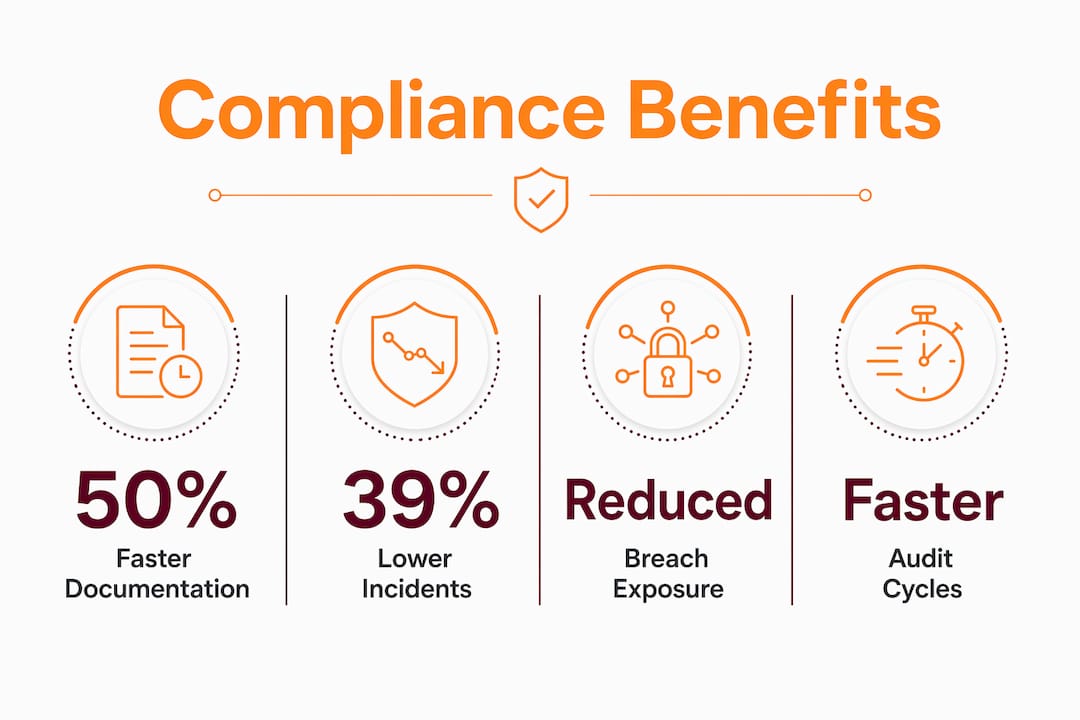
Organizations implementing Security by Design principles achieve 50% faster documentation cycles and 39% lower incident response costs. That means when something does go wrong, your team spends less time and money containing it. For an SMB without a large IT department, that efficiency gain is significant.
Mature compliance programs result in smaller, faster-contained security incidents than peers without mature programs. Breaches still happen to compliant organizations, but they tend to be less severe and resolved more quickly. That limits reputational damage, customer notification costs, and downtime.
The business case extends further:
- Reduced regulatory fines: Non-compliance with HIPAA, PCI DSS, or state privacy laws carries real financial penalties. A compliance program eliminates most of that exposure.
- Lower cyber insurance premiums: Insurers reward documented controls with better rates and fewer coverage disputes after a claim.
- Sales and contract enablement: Many enterprise buyers and government contracts now require vendors to demonstrate compliance. Your policy compliance program becomes a competitive differentiator.
- Internal clarity: Documented policies and clear ownership reduce confusion about who is responsible for what, which speeds up decision-making across your team.
Investing in structured compliance programs delivers measurable returns through reduced breach exposure and faster audit cycles. Compliance is not a cost center. It is an operational asset that pays for itself.
How can SMBs implement an effective cybersecurity compliance program?
Starting a compliance program feels large. Breaking it into steps makes it manageable.
-
Identify your applicable regulations. A healthcare practice faces HIPAA. A retailer faces PCI DSS. A defense contractor faces CMMC. Start by listing every regulation and framework that applies to your industry and customer base.
-
Conduct a gap assessment. Compare your current controls against the requirements of your applicable frameworks. A vulnerability assessment gives you a clear picture of where you stand and what needs attention first.
-
Implement foundational controls. MFA, encryption, and access management are the starting point for almost every framework. Get these in place before tackling more advanced requirements.
-
Build your documentation. Write policies for acceptable use, incident response, data handling, and access control. These documents are what auditors check first and what your team uses when something goes wrong.
-
Train your people. Cyber awareness training is a compliance requirement in most frameworks and one of the highest-return investments you can make. Phishing simulations and regular training sessions reduce the likelihood that a distracted employee opens the wrong attachment.
-
Monitor and update continuously. Assign ownership for each control. Schedule quarterly reviews. Update your program when regulations change or your business adds new systems or services.
Compliance is the floor of a security program. Effective cyber risk management layers advanced controls on this foundation to meaningfully reduce breach risk. Think of compliance as the structure and cybersecurity as everything you build on top of it.
Key Takeaways
Compliance reduces cyber risk by enforcing documented, tested security controls that close vulnerabilities, limit breach impact, and create the governance structure your business needs to respond effectively when threats arrive.
| Point | Details |
|---|---|
| Compliance is proactive risk management | Frameworks like NIST CSF and ISO 27001 prescribe controls that close attack surface gaps before breaches occur. |
| Continuous lifecycle beats annual audits | Assess, implement, test, remediate, and maintain. Treating compliance as ongoing cuts incident costs by 39%. |
| Automation sustains evidence collection | Tools that collect audit trails continuously remove last-minute scrambles and reduce compliance failures. |
| SMBs gain competitive and financial benefits | Compliance lowers insurance premiums, reduces fines, and opens doors to contracts that require vendor certification. |
| Cybersecurity and compliance must work together | Security protects systems; compliance proves and governs that protection. Both are required for real risk reduction. |
What I have learned about compliance after years of working with SMBs
Most business owners I talk to come in with the same mindset: compliance is something you do for the auditor, not for the business. I understand where that comes from. The audit process can feel like a performance. You gather documents, answer questions, and get a certificate. Then you put it in a drawer.
That mindset is the most expensive mistake I see SMBs make. The organizations that treat compliance as a living program, not a filing exercise, are the ones that contain breaches faster, spend less on incident response, and win contracts their competitors cannot touch. The audit becomes effortless because the work is already done.
The other thing I have noticed is that compliance and cybersecurity get siloed in a lot of small organizations. The IT person handles security. The office manager handles compliance paperwork. Neither talks to the other. That gap is where attackers find their footing. When you integrate the two functions, your incident response plan gets tested, your controls get documented, and your team knows what to do when something goes wrong.
My advice to any SMB owner reading this: stop waiting for a regulation to force your hand. The regulatory landscape is tightening, and the businesses that build compliance into their culture now will spend far less time and money catching up later. Compliance is not a tax. It is the foundation of a business that can survive a bad day.
— Alden
How Totalcyber helps SMBs build compliance programs that actually work
Running a business is demanding enough without adding a compliance program to your plate. Totalcyber works with small and medium-sized businesses to build, implement, and maintain cybersecurity compliance programs that fit your size, industry, and budget.

Our managed cybersecurity services cover everything from gap assessments and framework mapping to continuous monitoring and audit preparation. We handle the complexity so your team can stay focused on running the business. Whether you are working toward NIST alignment, SOC 2 readiness, or CMMC certification, Totalcyber brings the expertise and the systems to get you there without the guesswork. Reach out to learn what a compliance program built for your business actually looks like.
FAQ
What does cybersecurity compliance actually mean?
Cybersecurity compliance means aligning your security controls, policies, and documentation with an established framework or regulation such as NIST CSF, ISO 27001, SOC 2, HIPAA, or PCI DSS. It proves that your security program meets a recognized standard.
How does compliance reduce the risk of a cyberattack?
Compliance frameworks require controls like MFA, encryption, and access management that directly reduce attack surface. Organizations with mature compliance programs experience smaller, faster-contained breaches than those without structured programs.
Is compliance the same as cybersecurity?
No. Cybersecurity protects your systems from threats. Compliance proves and governs that protection through documented policies, tested incident response plans, and audit trails. Both functions must work together for real risk reduction.
How often does a compliance program need to be updated?
Compliance is a continuous lifecycle, not an annual event. Regulations like NIS2 and ISO 27001 require ongoing risk assessments, control testing, and documented remediation. Quarterly reviews are the minimum for most SMBs.
Can a small business realistically manage compliance on its own?
Most small businesses lack the internal resources to manage compliance continuously without support. Managed cybersecurity services provide the expertise, automation, and monitoring that make compliance sustainable for teams without a dedicated security staff.