

What do cyber insurers actually require from your business?
Cyber insurers are not just selling policies. They are auditing your security posture before they write a single dollar of coverage. A significant portion of applications get denied on first submission—41% of cyber insurance applications are denied initially, mostly because the applicant could not demonstrate the mandatory security controls required by insurers. The role of cybersecurity insurance requirements has shifted from a checkbox exercise into a genuine security standard, and the bar keeps rising.
Here are the controls that virtually every major carrier demands:
- Enforced MFA on remote access, email, admin accounts, and cloud applications is required by 96% of insurance carriers in 2026
- Endpoint Detection and Response (EDR) deployed on every endpoint, not just servers
- Immutable, air-gapped backups with documented, tested restoration procedures
- Written and tested incident response plan with defined roles and communication protocols
- Security awareness training with regular phishing simulations is required by most carriers
- Patch management policy requiring critical updates within 30 days of vendor release
- Email authentication via SPF, DKIM, and DMARC records
- Third-party vendor risk assessments for all vendors with system access
- Documented cybersecurity risk assessment updated at least annually
75% of insurance carriers now run external attack surface scans during underwriting to verify that what you report matches what they can actually see. If there is a gap, expect a denial or a flag.

MFA and access management: the controls insurers check first
96% of carriers require enforced MFA in 2026. Not “available.” Not “recommended to staff.” Enforced, meaning users cannot bypass it. That distinction trips up a lot of businesses during the application process.
Insurers look at MFA across four specific areas:
- Remote access (VPN, RDP, remote desktop tools)
- Email platforms (Microsoft 365, Google Workspace)
- Admin and privileged accounts at every level
- Cloud applications that store or process sensitive data
Authenticator apps and hardware tokens are the preferred methods. SMS-based codes are increasingly viewed as insufficient because of SIM-swapping attacks, and some carriers now explicitly exclude SMS from their definition of “enforced MFA.”
Beyond MFA, insurers also look at your broader identity and access management practices. Privileged Access Management (PAM) controls, least-privilege principles, and regular access reviews all factor into underwriting decisions. If a former employee still has active credentials six months after leaving, that is the kind of gap an external scan will surface.

Pro Tip: Document your MFA enforcement policy in writing, including which systems are covered and which method is required. Insurers want evidence, not assurances. A one-page policy with screenshots of your configuration settings can make the difference between approval and a follow-up questionnaire.
Why your incident response plan is a coverage requirement, not a formality
A written and tested incident response plan reduces both claim disputes and the time it takes to contain a breach. Insurers know this, which is why most applications now ask for it directly. “We have a plan” is not enough. They want to see it documented, dated, and tested.
A qualifying incident response plan typically includes:
- Defined roles and responsibilities for each phase of a breach response
- Communication protocols covering internal teams, legal counsel, and the insurer’s notification line
- Containment and eradication procedures specific to your environment
- Vendor contacts for forensics, legal, and public relations support
- Documented tabletop exercise results showing the plan has been tested within the past 12 months
Disaster recovery documentation belongs here too. Insurers want to see that you have thought through how to restore operations, not just how to stop an attack. Recovery Time Objectives (RTO) and Recovery Point Objectives (RPO) should be defined and realistic for your business size and industry.
Reviewing and updating the plan annually is the minimum. After any significant infrastructure change or actual incident, update it immediately. Stale plans with outdated contacts or obsolete system references are a red flag during underwriting.
Backup strategies that actually satisfy insurer requirements
Undocumented backups do not meet underwriting standards—insurers require immutable, air-gapped backups along with documented, tested restoration procedures to satisfy coverage requirements. That is the practical reality. Insurers require proof that your backups are immutable, air-gapped, and regularly tested, not just that they exist somewhere on a server.
What qualifies as insurer-compliant backup practice:
- Immutable backups that cannot be altered or deleted, even by an administrator
- Air-gapped copies stored offline or in a separate network segment, out of reach of ransomware
- Defined RTO and RPO documented and aligned with your business continuity plan
- Tested restoration procedures with written results showing successful recovery
- Backup frequency matched to your data change rate, typically daily at minimum
The reason insurers care so deeply about backup testing is straightforward. Ransomware claims are among the most expensive they pay. If your backups fail during a recovery attempt, the claim cost skyrockets. Carriers have learned to verify backup quality before a loss occurs, not after.
Pro Tip: Run a full restoration test at least quarterly and keep a written log of each test, including what was restored, how long it took, and whether the data was intact. That log is exactly what an underwriter wants to see.
EDR and email security: what insurers verify externally
EDR is mandatory for coverage approval by insurers in 2026. Traditional antivirus software, the kind that scans for known signatures, does not satisfy this requirement. EDR tools monitor endpoint behavior in real time, detect anomalies, and can isolate a compromised device automatically. That behavioral detection capability is what insurers are paying for when they require it.
Insurer expectations for EDR and email security include:
- Full endpoint coverage across laptops, desktops, and servers, with no gaps
- Real-time threat detection and automated response capabilities enabled, not just installed
- SPF, DKIM, and DMARC records properly configured and published for your domain
- Anti-phishing filters and link-scanning tools active on all inbound email
- Regular review of email security logs to catch misconfiguration or bypass attempts
Email authentication protocols have become a top underwriting requirement specifically because business email compromise (BEC) is one of the most common and costly claim types. A DMARC policy set to “reject” tells an insurer you have closed one of the most exploited attack paths in existence.
Carriers run external scans that check whether your DMARC record is published and whether your EDR agent is visible on your endpoints. Discrepancies between what you report and what they find typically result in immediate denial.
Employee training and patch management: the human and operational layer
Security awareness training with phishing simulations is now a requirement enforced by most insurance carriers, not an optional add-on. The logic is simple. Most breaches start with a person clicking something they should not have. Training reduces that risk, and insurers price policies accordingly.
What a qualifying training and patch management program looks like:
- Annual security awareness training for all staff, with documented completion records
- Phishing simulation campaigns run at least quarterly, with results tracked over time
- Critical patch deployment within 30 days of vendor release, as required by most carriers
- Vulnerability scanning to identify unpatched systems before an insurer’s external scan does
- Documented patch management policy specifying timelines, responsibilities, and exceptions
A prompt patching window is required to reduce exposure to vulnerabilities. It reflects the average time attackers take to weaponize a newly disclosed vulnerability. Insurers who mandate this timeline are essentially requiring you to close the window before threat actors can climb through it.
Tracking training completion and phishing simulation results in a spreadsheet or learning management system gives you the documentation an underwriter will ask for. Verbal assurances do not hold up during a claims investigation.
How cyber insurance has become a cybersecurity maturity audit
Cyber insurance is no longer a safety net you buy and forget. Insurers now treat the application process as a structured audit of your security maturity, and the consequences of misrepresentation are severe.
Material misrepresentation, meaning claiming controls you do not actually have, is a leading cause of claim denial after a breach. You can pay premiums for years, suffer a ransomware attack, and walk away with nothing if the carrier discovers your MFA was not actually enforced or your backups had not been tested. That is a real outcome, not a hypothetical.
The impact of insurance on cybersecurity practices has been significant across the industry. Businesses that implement insurer-mandated controls as a genuine security baseline, rather than a paper exercise, tend to experience fewer incidents and recover faster when something does go wrong. Stronger controls correlate with 10–20% premium reductions and better renewal terms, which means the investment pays back in more than one direction.
Pro Tip: Treat your cyber insurance application as a security gap analysis. Every question the insurer asks points to a control they consider critical. If you cannot answer “yes” and prove it, that is your remediation priority list.
Access and identity management beyond MFA
Access and identity management covers more ground than MFA alone. Insurers look at how your organization controls who can access what, and whether those permissions are reviewed and updated regularly.
Privileged Access Management (PAM) is the practice of limiting and monitoring accounts with elevated permissions, such as domain administrators or database owners. These accounts are prime targets in any attack, and insurers know it. A PAM solution that records privileged sessions and requires just-in-time access approval is a strong signal of security maturity.
Least-privilege principles mean every user and system account gets only the access needed for their specific role, nothing more. Regular access reviews, typically quarterly, catch accounts that have accumulated permissions over time or belong to staff who have changed roles. Automated provisioning and deprovisioning tied to your HR system reduces the risk of orphaned accounts, which are a common finding in breach investigations.
Cybersecurity compliance practices that include identity governance align directly with what insurers want to see. The goal is a documented, repeatable process, not a one-time cleanup.
What minimum coverage limits and policy terms actually mean for your business
Understanding cyber insurance policies means reading past the premium and looking at what the policy actually covers, and what it excludes. Coverage limits, sublimits, and exclusions vary widely across carriers, and the gaps can be expensive.
First-party coverage pays for costs your business incurs directly: incident response fees, forensic investigation, business interruption losses, and data restoration. Third-party coverage handles claims from customers, partners, or regulators arising from a breach at your organization. Both types of coverage are typically included in a standalone cyber policy, but the limits for each may differ.
Watch for sublimits on specific claim types. Some policies cap ransomware payments or social engineering losses at a fraction of the overall policy limit. A $2 million policy with a $250,000 ransomware sublimit is not a $2 million ransomware policy. Read the definitions section carefully, because how the policy defines “computer fraud” or “data breach” determines whether your specific incident qualifies.
Retention amounts (the cyber insurance equivalent of a deductible) have increased alongside premiums over the past few years. Matching your retention to your actual cash reserves is a practical step most businesses overlook until they are filing a claim.
Compliance with regulatory standards and how it affects your coverage
HIPAA, GDPR, and state-level regulations like the California Consumer Privacy Act (CCPA) create cybersecurity liability requirements that overlap directly with insurer mandates. Carriers ask about your regulatory obligations during underwriting because non-compliance creates a claims exposure they price into your premium.
HIPAA’s Security Rule requires covered entities and business associates to implement administrative, physical, and technical safeguards for protected health information. Many of those safeguards, including access controls, audit logs, and encryption, are the same controls insurers require. Meeting HIPAA is not a substitute for meeting insurer requirements, but the overlap is substantial.
GDPR applies to any US business that processes personal data of EU residents. A breach involving EU data can trigger regulatory fines, and your cyber policy’s third-party liability coverage may be what stands between you and a significant financial penalty. Carriers want to know whether you have a data processing inventory and a breach notification process in place before they agree to cover that exposure.
Documenting your compliance posture, including which frameworks you follow and how you verify adherence, strengthens your application and reduces the likelihood of a coverage dispute after an incident.
Third-party vendor risk management requirements
Your vendors can be the door that attackers walk through. Insurers understand this, and third-party vendor risk management has become a standard underwriting requirement, particularly for businesses that share data or system access with outside parties.
A qualifying vendor risk program includes written vendor agreements with security requirements, periodic security assessments for high-risk vendors, and a process for reviewing vendor access when a contract ends. Insurers want to see that you know which vendors have access to your systems, what data they can reach, and what controls they have in place.
Cyber hygiene practices at the vendor level matter as much as your own internal controls. A vendor with weak security who has direct access to your network is effectively a gap in your perimeter. Requiring vendors to complete a security questionnaire annually and provide evidence of their own cyber insurance coverage is a reasonable baseline that most carriers will view favorably.
Cybersecurity risk assessments and documentation insurers expect
A documented risk assessment is the foundation that ties all other controls together. Insurers ask for it because it shows you understand your own environment, know where your risks are, and have a plan to address them. Without it, every other control you claim looks less credible.
A qualifying risk assessment identifies your critical assets, maps the threats and vulnerabilities that could affect them, and documents the controls you have in place to reduce exposure. NIST guidance provides a widely recognized framework for this process that insurers are familiar with. Updating the assessment annually, or after any major infrastructure change, keeps it current and defensible.
Vulnerability scanning is a practical component of ongoing risk assessment. Regular scans identify unpatched systems, misconfigured services, and exposed ports before an attacker or an insurer’s external scan finds them first. Keeping scan results and remediation records gives you the documentation trail that underwriters and claims adjusters will ask for.
Reporting obligations and notification timelines you cannot miss
Most cyber insurance policies require you to notify the carrier within a specific window after discovering a potential incident, often 24–72 hours. Missing that window can jeopardize your claim, even if the incident itself is fully covered. Know your policy’s notification requirement before an incident happens, not during one.
Beyond the insurer, a breach may trigger regulatory notification obligations. HIPAA requires covered entities to notify affected individuals within 60 days of discovering a breach. Many states have their own breach notification laws with shorter timelines. Your incident response plan should map out all applicable notification requirements so your team is not scrambling to figure out who to call while also trying to contain the attack.
Keeping a breach notification checklist as part of your incident response documentation is a practical step. It should list the insurer’s claims hotline, your legal counsel’s contact, and the relevant regulatory bodies for your industry and state.
Claims process and the most common reasons claims get denied
Filing a cyber insurance claim is not automatic. The process typically starts with notifying your carrier, then working with their appointed forensic and legal vendors to investigate and document the incident. Carriers control the vendor selection in most policies, which means you may not be able to use your preferred forensics firm.
The most common causes of claim denial are:
- Material misrepresentation on the application, claiming controls that were not actually in place
- Late notification, missing the policy’s reporting window after discovering an incident
- Excluded incident types, such as social engineering losses not covered under the base policy
- Failure to maintain controls that were in place at the time of application but lapsed before the incident
- Insufficient documentation to support the claimed loss amount
The misrepresentation issue deserves particular attention. If you told your insurer you had enforced MFA and the forensic investigation reveals the attacker accessed your network through an account without it, the carrier has grounds to deny the claim entirely. That is not a technicality. It is the direct consequence of reporting controls you do not actually have.
Working with a managed security provider to maintain and document your controls year-round, not just at renewal time, is the most reliable way to avoid this outcome.
Key Takeaways
Qualifying for cyber insurance in 2026 requires demonstrable, documented security controls, not just a completed application form.
| Point | Details |
|---|---|
| MFA enforcement is mandatory | 96% of carriers require enforced MFA; SMS codes no longer satisfy most underwriters. |
| Backups must be tested and documented | Immutable, air-gapped backups with written restoration test results are required to qualify for ransomware coverage. |
| Misrepresentation voids claims | Claiming controls you do not have is the leading cause of post-breach claim denial, regardless of premium history. |
| Patch critical vulnerabilities within 30 days | Most carriers mandate patching critical vulnerabilities within 30 days as a condition of coverage. |
| Strong controls reduce premiums | Businesses with verified security controls can achieve 10–20% premium reductions and stronger renewal terms. |
Totalcyber helps you meet and maintain every insurer requirement

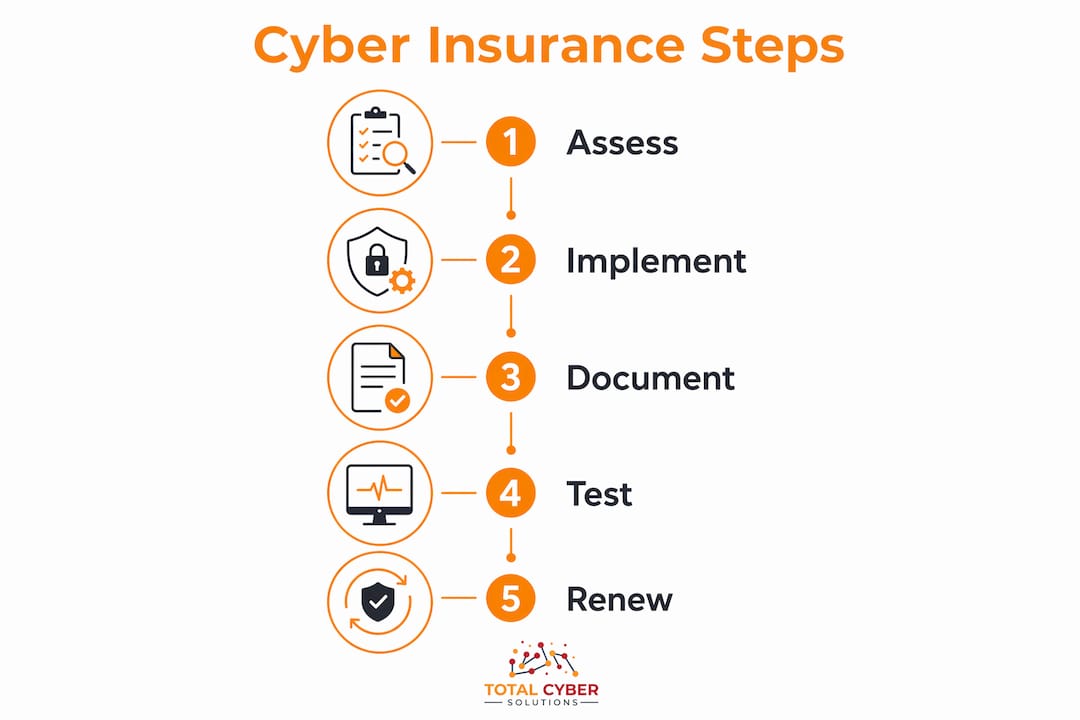
Meeting cyber insurance requirements is not a one-time project. Insurers re-evaluate your controls at every renewal, and the standards keep getting stricter. Totalcyber’s managed cybersecurity services are built specifically to help businesses implement, document, and maintain the controls that carriers require, from enforced MFA and EDR deployment to tested backups and cyber awareness training for your team.
Totalcyber is a veteran-owned cybersecurity and IT services company serving businesses across the United States. Whether you are applying for coverage for the first time or preparing for renewal, the team at Totalcyber can assess your current posture, close the gaps, and give you the documentation that underwriters actually want to see.
Talk to Totalcyber today and find out exactly where your security stands before your insurer does.