

Cyber threat intelligence is evidence-based, analyzed knowledge about attackers and their methods that answers one question: does this threat actually matter to your organization? It’s not a raw list of suspicious IP addresses or a spreadsheet of malware hashes. It’s the finished product of collecting, verifying, and interpreting threat data so a security team can act on it instead of just staring at it.
Done right, CTI shortens the time an attacker sits undetected inside your network and tells you which vulnerabilities to patch first, instead of leaving your team to fix everything at once. Standards bodies like ISO and NIST’s Computer Security Resource Center both define it as information that has been transformed and enriched enough to support real decisions. Frameworks like MITRE ATT&CK give that intelligence a common vocabulary. Here’s what CTI actually gives a business:
- A faster answer to “are we exposed to this specific threat?”
- A ranked list of which vulnerabilities need patching this week, not this quarter
- Context that turns a generic security alert into a business risk conversation
- A feedback loop that gets sharper the longer you run it
Key Takeaways
Cyber threat intelligence turns raw threat data into business-relevant decisions by adding context, confidence scoring, and a direct line to executive risk conversations.
| Point | Details |
|---|---|
| CTI is a process and a product | It follows a repeatable lifecycle and produces reports, alerts, and detection rules consumers can act on. |
| Three levels serve different audiences | Strategic intelligence informs the board, operational informs IR teams, and tactical feeds detection tools directly. |
| The lifecycle has six stages | Planning, collection, processing, analysis, dissemination, and feedback keep CTI relevant over time. |
| Translation drives adoption | Reframing findings in business terms measurably increases executive engagement with security reporting. |
| Total Cyber offers a managed path | Managed cybersecurity services deliver vetted intelligence and vCISO guidance without building an in-house team. |
Table of Contents
- What Is Cyber Threat Intelligence, and How Is It Different From Data?
- What Are the Three Types of Threat Intelligence?
- How Does the Cyber Threat Intelligence Lifecycle Work?
- Where Does Threat Intelligence Data Actually Come From?
- How Do Analysts Turn Raw Data Into Usable Intelligence?
- What Business Problems Does Cyber Threat Intelligence Actually Solve?
- How Do You Build or Scale a CTI Program?
- What Do Threat Intelligence Platforms Actually Do?
- Why Does Threat Intelligence Fail to Reach the Boardroom?
- A Business-First Take on Threat Intelligence
- Turn Threat Intelligence Into a Managed Security Advantage
- Frequently Asked Questions
- Sources
What Is Cyber Threat Intelligence, and How Is It Different From Data?
Raw threat data is a fire hose. Cyber threat intelligence is what comes out the other end after someone has filtered, verified, and made sense of it. The distinction matters because a lot of vendors sell “threat intelligence” that is really just a live feed of indicators with no context attached.
CTI works as both a process and a product. As a process, it’s the ISO’s structured intelligence lifecycle that takes a question and turns it into an answer. As a product, it’s the report, the alert, or the detection rule that lands in an analyst’s queue.
Consider a single indicator of compromise (IoC): an IP address tied to command-and-control traffic. On its own, that’s data. Add who’s behind it, which sector they target, and which tactics, techniques, and procedures (TTPs) they favor, and it becomes intelligence you can act on.

| Raw Data | Contextualized CTI |
|---|---|
| IP address flagged as malicious | IP linked to a known ransomware affiliate targeting healthcare providers |
| File hash in a blocklist | Hash tied to a loader used in a documented phishing campaign against your industry |
| Alert: unusual login | Alert correlated with a known credential-stuffing campaign and mapped to a MITRE ATT&CK technique |
Understanding this gap is the first real test of whether a security program is running on intelligence or just running on noise.
What Are the Three Types of Threat Intelligence?
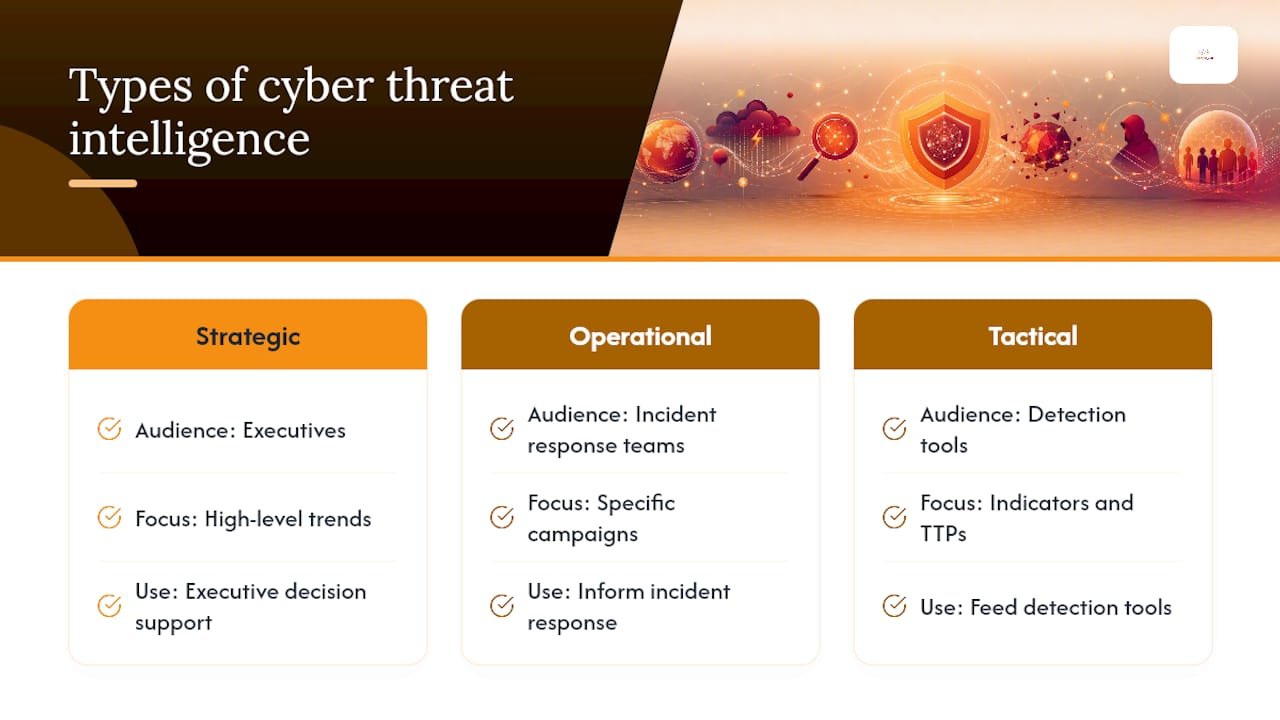
Not every stakeholder needs the same intelligence, and treating a boardroom the same as a security operations center is a common way CTI programs fail. The three recognized levels, per ISO’s guidance, map cleanly to who consumes them and what they decide.
Strategic intelligence answers big-picture questions: which threat actors target our industry, and what should we budget for next year? It’s built for executives and board members who need trends, not packet captures.
Operational intelligence sits in the middle. It covers specific campaigns, actor motivations, and infrastructure. Incident response teams and security managers use it to understand what a particular attack group is likely to do next.
Tactical and technical intelligence is the ground-level detail: IoCs, malware signatures, and TTPs that plug directly into detection tools.
| Level | Primary Audience | Example Output | Typical Use |
|---|---|---|---|
| Strategic | C-suite, board | Annual threat landscape brief | Budget and risk-appetite decisions |
| Operational | Security managers, IR leads | Campaign analysis report | Deciding how to respond to an active threat |
| Tactical/Technical | SOC analysts, engineers | IoC lists, detection rules | Feeding SIEM and EDR tools |
A mature program produces all three from the same underlying research, just repackaged for the audience reading it.
How Does the Cyber Threat Intelligence Lifecycle Work?
CTI doesn’t materialize from a subscription fee. It runs on a repeatable process, commonly broken into six stages that convert a business question into a usable answer.
- Planning and direction. Leadership and security teams agree on what questions matter: are we a target for a specific ransomware group? This stage sets priority intelligence requirements (PIRs).
- Collection. Analysts pull raw data from internal telemetry, commercial feeds, and open sources.
- Processing. Data gets normalized, deduplicated, and structured so it can actually be analyzed.
- Analysis. This is where data becomes intelligence: correlating events, mapping TTPs, and scoring confidence levels.
- Dissemination. Findings go out in the format each audience needs, whether that’s a detection rule or an executive slide.
- Feedback. Consumers tell the intelligence team what worked and what missed the mark, which reshapes the next cycle’s PIRs.
Ownership matters here. Security leadership typically drives planning, SOC analysts handle collection and processing, senior analysts own the analysis stage, and it’s usually a CISO or vCISO who ensures dissemination actually reaches the right desk.
Pro Tip: Skip vague requirements like “tell us about ransomware.” A PIR should read like “identify which ransomware groups have targeted our industry peers in the past 12 months and what initial access methods they used.” Specific questions produce intelligence you can act on instead of another generic report nobody reads.
Where Does Threat Intelligence Data Actually Come From?
Good CTI blends multiple source types, because no single feed sees the whole picture. The main categories include:
- Internal telemetry from SIEM and EDR logs, which shows what’s actually happening on your network
- Commercial threat feeds that aggregate indicators across many organizations
- Open source intelligence (OSINT), including security research blogs, forums, and public vulnerability disclosures
- Information sharing groups, like sector-specific ISACs, where peer organizations trade what they’re seeing
- Dark web monitoring for chatter about your organization or industry
- Vendor and research reports that document specific campaigns in depth
Before trusting any source, run it through a quick vetting checklist: where did this data originate, how fast does it update, how accurate has it historically been, how many false positives does it generate, and does it actually overlap with threats relevant to your environment? FIRST’s TIQ-Test methodology formalizes this into coverage, fitness, and impact testing, which is worth borrowing even if you never run the full framework.
Open-source enrichment platforms like MISP and OpenCTI help here too, adding context to raw indicators before they ever reach an analyst’s desk.
Pro Tip: A feed that generates thousands of alerts a day but rarely matches your actual telemetry isn’t intelligence. It’s noise with a subscription fee attached.
How Do Analysts Turn Raw Data Into Usable Intelligence?
Analysis is the stage where CTI earns its name. Analysts correlate disparate events, map observed behavior against frameworks like MITRE ATT&CK to identify TTPs, and assign confidence scores so consumers know how much weight to put on a given finding.
The outputs that come out of this stage tend to fall into a few consistent buckets:
- Detection rules that feed directly into a SIEM
- Incident response playbooks tied to specific attacker behaviors
- Executive threat landscape briefs summarizing trends over a quarter
- Watchlists tracking specific actors, domains, or infrastructure relevant to your sector
Pro Tip: Always attach a confidence level to intelligence, and say what it’s good for. “High confidence, applicable to email security controls” tells an IT director something. “Threat detected” tells them nothing.
What Business Problems Does Cyber Threat Intelligence Actually Solve?
CTI earns its keep across several functions, not just the security operations center. Common use cases include:
- Sharpening SOC detection so analysts chase real threats instead of chasing everything
- Speeding up incident response by giving responders context on attacker behavior before they act
- Prioritizing vulnerability patching based on what’s being actively exploited, not just CVSS scores
- Assessing supply-chain and vendor risk before a contract gets signed
- Giving executives a risk picture they can actually use in board reporting
- Informing cybersecurity due diligence during mergers and acquisitions
Metrics worth tracking include dwell time, mean time to detect and contain, and the percentage of patched vulnerabilities that were actively being exploited rather than just theoretically risky.
Here’s a scenario that plays out constantly among small and midsize businesses: a company facing hundreds of open vulnerabilities uses CISA’s Known Exploited Vulnerabilities catalog to identify the small handful actually being exploited in the wild, and patches those first. That single move can cut real exposure faster than trying to close every gap on the list. A structured translation framework applied in one pilot lifted executive engagement with CTI reporting by 70% and improved investment alignment with top business risks by 40% over six months, which tells you the payoff isn’t just technical. It’s a boardroom asset once it’s framed correctly.
How Do You Build or Scale a CTI Program?
Most organizations don’t start with a fully staffed intelligence team, and they don’t need to. What they need is a clear-eyed view of where they stand and a plan to grow.
Step one: define roles and ownership. Even a lean program needs someone accountable for setting PIRs, someone processing and analyzing data, and a decision-maker (often a vCISO) who translates findings into action.
Step two: pick your data sources. Combine internal telemetry with at least one vetted external feed and a sector information-sharing relationship where one exists.
Step three: integrate with existing tools. Intelligence that doesn’t flow into your SIEM or SOAR platform sits in a report nobody reads. Automation here is what separates a program that scales from one that drowns in manual work.
Step four: formalize sharing agreements. ISAC membership and peer relationships multiply what a single team can see on its own.
Step five: set a feedback cadence. Revisit your PIRs quarterly based on what the previous cycle actually delivered.
If you’re evaluating outside help, ask providers pointed questions: What sources feed their intelligence? What’s their false-positive rate? What SLAs govern how fast they notify you of a critical finding? Can they show proof of performance against your actual environment, not just a sales deck?
A few markers separate entry-level CTI from a mature program:
- Entry-level: a single commercial feed feeding a SIEM, reviewed manually, with no formal PIRs
- Intermediate: multiple sources, documented PIRs, some automation, and regular executive reporting
- Mature: integrated TIP, ISAC participation, automated enrichment, and metrics tied directly to business risk decisions
Budget scales with ambition. A business without a dedicated analyst on staff is usually better served by a managed security services relationship than by trying to hire and retain scarce intelligence talent, especially given how tight the cybersecurity talent market has remained.
What Do Threat Intelligence Platforms Actually Do?
A threat intelligence platform (TIP) is the engine that turns scattered feeds into something an analyst can use in minutes instead of hours. Core capabilities include ingesting data from multiple sources, normalizing formats, enriching indicators with context, correlating findings against your environment, and offering case management so analysts can track investigations end to end.
When evaluating a TIP, or a managed service built on one, weigh these factors:
- How broad is the source coverage, and does it match your industry’s threat profile?
- How much genuine context comes with each indicator, versus just a raw hash or IP?
- How easily does it plug into your existing SIEM, SOAR, and EDR tools?
- Can it scale as your data volume grows without falling apart?
- Has the feed been tested with a structured method, such as TIQ-Test’s coverage and fitness checks, rather than just vendor claims?
Two deployment patterns dominate the market: an in-house TIP paired with one or more commercial feeds, or a managed CTI service that handles ingestion and analysis and pipes finished intelligence straight into your existing security stack.
Why Does Threat Intelligence Fail to Reach the Boardroom?
The most common failure in CTI isn’t bad data. It’s bad translation. Analysts produce technical findings that never get reframed into terms an executive can act on, and research on CTI adoption confirms the field remains heavily technical even where the underlying literature shows genuine decision-making value.
Other recurring problems include noisy feeds that bury real signals, intelligence that never gets operationalized into a detection rule or a policy change, and attribution limits that make it tempting to claim more certainty about “who did this” than the evidence supports.
A practical fix is a structured translation process, sometimes called TI2BI (Threat Intelligence to Business Insight):
- Contextualize. Tie each finding to a specific business asset or process, not an abstract system.
- Estimate business impact. Translate technical risk into financial exposure or operational downtime.
- Model decision scenarios. Show leadership what happens if you invest now versus if you wait.
- Produce Strategic Business Insight reports. Package findings in language a CFO or board member reads without a glossary.
Pro Tip: If your quarterly threat brief gets forwarded without comment, it probably reads like an incident log. If it triggers budget questions, you’ve built something executives can actually use.
A Business-First Take on Threat Intelligence
Most organizations treat cyber threat intelligence as a technical feed to bolt onto a SIEM, and that’s exactly why so many programs stall out after the first year. The data was never the problem. The failure to connect it to a dollar figure, a board decision, or a risk appetite conversation is what kills momentum.
What changes when CTI gets reframed for executives isn’t the underlying data. It’s the question being asked. Instead of “what threats exist,” the question becomes “what threat, if realized, costs us the most, and are we currently exposed to it?” That shift alone is what separates a security team that gets budget approved from one that gets asked to justify its existence every renewal cycle.
The organizations that get this right treat threat intelligence as a decision-support function, on par with financial forecasting, rather than a technical utility buried in the SOC.
Turn Threat Intelligence Into a Managed Security Advantage
Building CTI capability in-house takes time, specialized analysts, and tooling most small and midsize businesses can’t justify on their own. Total Cyber closes that gap through managed cybersecurity services that bring vetted threat intelligence, prioritized vulnerability remediation, and vCISO-level guidance into a single relationship, without the overhead of building a dedicated intelligence team from scratch.
Total Cyber’s approach pairs the intelligence lifecycle with hands-on execution: monitoring, incident response, and compliance support that maps to frameworks like HIPAA, NIST, CJIS, and CMMC. Pair that with cyber awareness training so the threats your team identifies also get translated into practical staff habits, not just technical alerts.
If you’re weighing whether to build, buy, or outsource your threat intelligence capability, the next step is a conversation, not another vendor deck. Reach out through the Total Cyber contact form to discuss a security audit, a pilot engagement, or a fully managed program built around your risk profile.
- Start with a risk and vulnerability audit to see where CTI would have the biggest impact
- Pilot a managed monitoring engagement before committing to a full program
- Layer in vCISO guidance to translate findings for leadership and the board
Frequently Asked Questions
What is cyber threat intelligence in simple terms?
Cyber threat intelligence is analyzed, verified knowledge about cyber threats that tells you whether a specific attacker, campaign, or vulnerability is relevant to your organization, so you can act on it instead of just monitoring it.
How is threat intelligence different from a threat feed?
A threat feed is a raw stream of indicators like IP addresses or file hashes. Cyber threat intelligence adds context, such as who’s behind an attack and what industries they target, so the data becomes something an analyst or executive can actually use.
What are the three types of cyber threat intelligence?
Strategic intelligence serves executives with high-level trends, operational intelligence informs incident response teams about specific campaigns, and tactical or technical intelligence feeds detection tools with indicators and TTPs.
Do small businesses need cyber threat intelligence?
Yes, though the scale looks different. Even a lightweight approach, like prioritizing patches based on CISA’s Known Exploited Vulnerabilities catalog, gives small and midsize businesses a way to focus limited resources on the threats most likely to hit them.
What tools support a cyber threat intelligence program?
Threat intelligence platforms handle ingestion, enrichment, and correlation of data from multiple sources, and typically integrate with SIEM and SOAR systems already in place. Open-source options like MISP and OpenCTI add enrichment without a commercial license.
How do you measure whether a CTI program is working?
Track metrics like reduced dwell time, faster mean time to detect and contain incidents, and the percentage of patched vulnerabilities that were being actively exploited. Executive engagement with CTI reporting is also a strong indicator that the program has moved beyond a purely technical function.
Sources
For readers who want to dig further into the standards and methods behind this article, a few sources stand out.
- ISO – Threat intelligence and why it matters for cybersecurity
- threat intelligence – Glossary | CSRC
- What is the Cyber Threat Intelligence Lifecycle?
- FIRST — TIQ-Test and feed evaluation methods
- Threat Intelligence to Business Insight (TI2BI) Framework — Ben Phillip (2026)