A small business security operations center (SOC) is a dedicated function, either in-house or outsourced, that monitors your systems around the clock, detects threats before they cause damage, and coordinates your response when something goes wrong. It is not just a tool or a dashboard. It is a continuous process backed by trained analysts who watch your endpoints, network, and cloud environment every hour of every day.
Small businesses are not too small to be targeted. Attackers actively seek out organizations with limited security resources because the path of least resistance pays off. Regulatory pressure adds another layer. If you handle customer data, process payments, or work with government clients, frameworks like HIPAA, PCI DSS, and CMMC increasingly require documented security monitoring and incident response capabilities.
Without SOC support, most small businesses rely on reactive measures: antivirus software, occasional IT check-ins, and hoping nothing slips through. That approach worked a decade ago. It does not work now.
Key benefits a SOC delivers for small businesses:
- 24/7 monitoring of endpoints, network traffic, email, and cloud services
- Early detection of threats like phishing, ransomware, and insider activity
- Faster incident response that limits damage and downtime
- Documented audit trails that support compliance and cyber insurance requirements
- Ongoing visibility into your security posture and coverage gaps
The challenge is that building this capability internally is expensive and time-consuming. Most small businesses do not have the staff, tools, or budget to run a full in-house SOC. That is exactly why managed SOC services exist.
What does a small business SOC actually do every day?

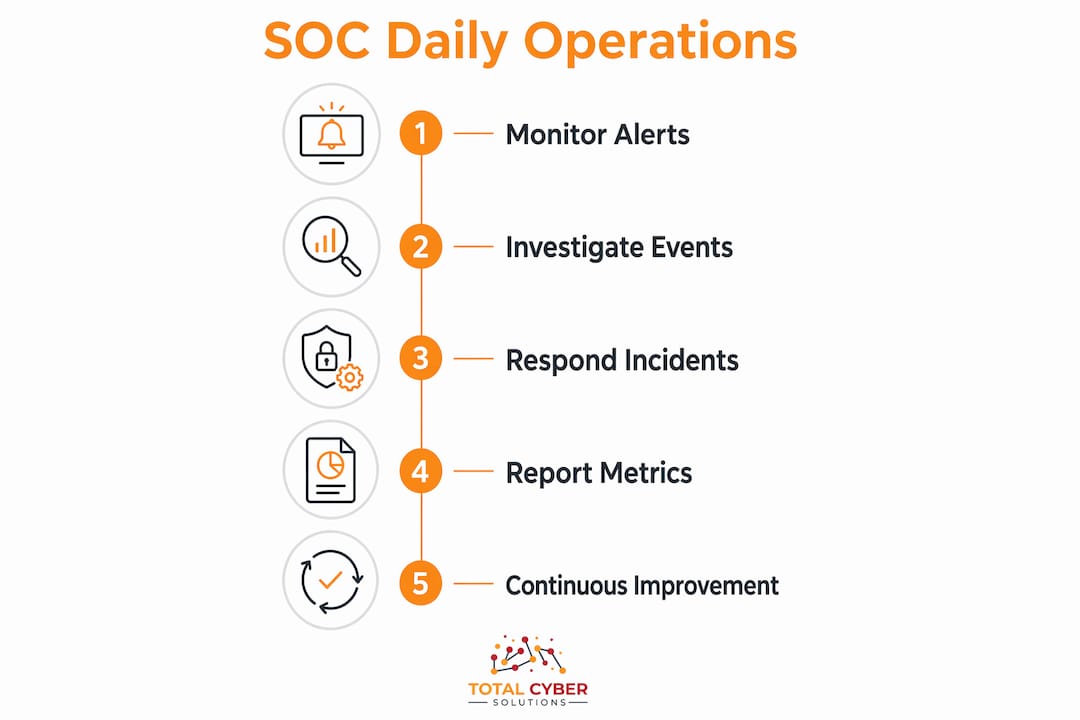
The daily work of a SOC is less dramatic than it sounds, but that consistency is the point. Analysts review alerts, investigate anomalies, and separate real threats from false positives before anything reaches your inbox.
Here is what that looks like in practice:
- Alert triage: Analysts review incoming alerts from endpoint detection tools, firewalls, and email security systems, filtering out noise and escalating confirmed threats.
- Event correlation: A security information and event management (SIEM) platform aggregates logs from across your environment so analysts can spot patterns that individual tools would miss.
- Incident investigation: When something looks suspicious, analysts dig into the timeline, affected systems, and potential impact before deciding on a response.
- Threat intelligence: SOC teams track known attack methods and indicators of compromise, applying that knowledge to your specific environment.
- Reporting: You receive regular summaries covering what was detected, how it was handled, and what needs attention.
The technology stack supporting these activities typically includes endpoint detection and response (EDR) tools, a SIEM platform like Exabeam for log aggregation and correlation, and network monitoring tools. What separates a quality SOC from a basic alert-forwarding service is human analyst review running continuously, not just during business hours.
What threats can a small business SOC detect?
The threats targeting small businesses are not hypothetical. They are the same ones hitting enterprises, just with fewer guardrails in the way.
A well-run SOC monitors for and detects:
- Phishing attacks: Malicious emails designed to steal credentials or deliver malware. SOC analysts watch for suspicious login attempts that follow a phishing click.
- Ransomware: Malware that encrypts your files and demands payment. Early behavioral detection can catch ransomware before it spreads across your network.
- Business email compromise (BEC): Attackers impersonate executives or vendors to authorize fraudulent wire transfers. SOC tools flag unusual email patterns and account behavior.
- Insider threats: Employees accessing data they should not, whether intentionally or accidentally. User behavior analytics surfaces these anomalies.
- Malware infections: Malicious software that installs itself through a compromised website, USB device, or email attachment. EDR tools detect and contain these in real time.
These threats cause real operational disruption and data loss when left unmonitored. A ransomware event that takes your systems offline for three days does not just cost you the ransom. It costs you productivity, customer trust, and potentially regulatory fines.
How a SOC supports business continuity and your security posture

Early detection is the difference between a contained incident and a full-blown crisis. A SOC catches threats at the earliest stage possible, which limits how far an attacker can move through your systems and how much damage they can do.
A well-functioning SOC supports business continuity and your overall security posture in several concrete ways:
- Minimizing downtime: Containing an incident quickly means your systems stay operational or recover faster.
- Compliance and audit readiness: SOC outputs, including logs, incident reports, and response timelines, satisfy documentation requirements under HIPAA, PCI DSS, and similar frameworks.
- Security improvement over time: SOC insights reveal recurring vulnerabilities, misconfigured systems, and coverage gaps that your team can address proactively.
- Employee awareness: When analysts identify phishing attempts or risky behavior, that intelligence feeds directly into security awareness training for your staff.
- Cyber insurance support: Insurers increasingly require evidence of active monitoring and incident response. SOC documentation provides exactly that.
Think of a SOC as the guardrails on your operations. You still drive the business. The SOC keeps you from going off the road when something unexpected happens.
How to build or leverage a SOC for your small business
Most small businesses do not need to build a SOC from scratch. What you need is a clear picture of your risk profile, your coverage gaps, and the service model that fits your budget and operations.
Step 1: Assess your environment. Document your users, devices, cloud applications, and any compliance obligations. This baseline tells you what needs to be monitored and what your risk exposure looks like.
Step 2: Choose a service model. Three options exist for small businesses:
- In-house SOC: You hire analysts, purchase tools, and run the function internally. This gives you full control but requires significant investment in staff and technology.
- Managed SOC (SOC as a Service): A third-party provider handles 24/7 monitoring and incident response. Most small businesses find this the most practical path.
- Hybrid model: Your internal IT team handles day-to-day security tasks while a managed provider covers after-hours monitoring and advanced threat response.
Step 3: Budget realistically. Pricing for managed SOC services varies. Basic endpoint protection and monitoring are typically priced per endpoint monthly. Managed detection and response (MDR) with full SOC monitoring usually costs a few thousand dollars monthly for small businesses covering a modest number of endpoints. Full managed security programs, including compliance support and advisory services, tend to be more expensive.
Step 4: Confirm technology requirements. A quality SOC uses EDR on endpoints, a SIEM platform for log aggregation, and network detection tools. Providers relying on consumer-grade antivirus are not delivering enterprise-grade protection regardless of what their marketing says.
Step 5: Integrate with existing infrastructure. Your SOC should connect to your existing email security, identity management, cloud platforms, and any compliance tools already in place. Coverage gaps at integration points are where attackers find their way in.
Pro Tip: Before signing any contract, ask the provider to walk you through a realistic first-year cost scenario for your specific environment, including onboarding fees, optional modules, and the cost of one moderate incident. Low headline pricing often hides expensive exceptions.
Questions to ask when evaluating SOC providers
Not all SOC services deliver the same thing. Two providers can sound identical on a sales call and produce very different outcomes once the contract is signed. These questions cut through the marketing language.
- What is covered? Ask for a plain-language list of monitored systems: endpoints, email, cloud platforms, network devices, and SaaS applications. Watch for gaps in cloud identity or email coverage.
- What is your response model? Clarify whether the service is monitor-only, monitor and advise, or full managed detection and response where the provider can take action on your behalf.
- What are your MTTD and MTTR targets? Mean Time to Detect and Mean Time to Respond are the metrics that tell you how fast threats are caught and contained. Any provider unwilling to share these numbers is a red flag.
- Is monitoring truly 24/7? True around-the-clock human review differs significantly from business-hours-only coverage or automated alert forwarding. Ask specifically about weekend and holiday coverage.
- Who do I call when something happens? Named contacts and clear escalation paths matter. A pooled support desk with no dedicated contact is not the same as a responsive partner.
- What does reporting look like? Ask for sample monthly and quarterly reports. Good reporting explains what happened, what was investigated, and what needs attention, in plain language a non-specialist can act on.
- What are the full contract terms? Separate fixed monthly costs from variable fees. Ask about onboarding charges, incident response fees outside the base plan, and costs for adding new users or cloud platforms.
Expert insights from Totalcyber on getting the most from your SOC
Totalcyber works with small businesses every day on exactly this challenge: how do you get real security coverage without overpaying for tools you do not need or underbuying a service that leaves you exposed?
A few things stand out from that experience:
- Staffing quality beats price every time. CISA guidance and industry experts consistently recommend prioritizing provider staffing quality and technology infrastructure over cost when selecting a SOC service. The cheapest option is rarely the right one for a business with real security requirements.
- Demand transparent KPIs from day one. MTTD and MTTR are not just metrics for enterprise security teams. They are the clearest signal of whether your provider is actually performing. If a provider cannot tell you these numbers, you have no way to measure what you are buying.
- Integrate SOC insights into your broader risk management. SOC data should inform your security decisions, not just sit in a report. Use monthly summaries to prioritize patching, update access controls, and identify training needs.
- Review your provider on a schedule. Quarterly reviews are the most practical cadence for small businesses. Ask what incidents were detected, whether response times were met, and whether any new coverage gaps emerged.
- Match the service model to your actual environment. A business with 12 users and one office has different needs than one with 45 users, contractors, and multiple cloud platforms. Your SOC coverage should reflect your real attack surface.
Pro Tip: Pair your SOC provider review with a quick internal audit of access controls, cloud configuration, and incident response workflows. If those have changed since your last review, your SOC coverage probably needs to change too.
If you are ready to assess your current security posture and explore what managed cybersecurity coverage looks like for your business, Totalcyber’s managed cybersecurity services are built specifically for organizations like yours.
What does a realistic SOC setup timeline look like?
Setting up SOC coverage is not a one-day project, but it does not have to take months either. A phased approach keeps the process manageable.
Phase 1: Discovery and scoping (weeks 1–2). Document your environment, identify compliance requirements, and define what needs to be monitored. This is also when you evaluate providers or assess internal capacity.
Phase 2: Tool deployment and integration (weeks 3–6). EDR agents go on endpoints, SIEM connections are configured, and cloud and email integrations are established. This phase often surfaces gaps you did not know existed.
Phase 3: Baseline and tuning (weeks 6–10). Analysts establish what normal looks like in your environment. Alert thresholds get tuned to reduce false positives without missing real threats. This step is where many rushed implementations fail.
Phase 4: Ongoing operations and review. Once live, the SOC runs continuously. Monthly reporting keeps you informed. Quarterly reviews assess performance, coverage, and whether the service still fits your business as it grows.
Skipping the tuning phase is the most common mistake small businesses make. A SOC generating hundreds of false positive alerts every week creates alert fatigue, and alert fatigue is how real threats get missed.
Outsourced SOC vs. in-house SOC: which makes sense for you?
The honest answer for most small businesses is that an in-house SOC is not realistic. Here is why, and when the calculus might shift.
Outsourced SOC advantages:
- Access to a full team of analysts without hiring costs
- Enterprise-grade tools at a fraction of the build-it-yourself price
- 24/7 coverage without managing shift schedules
- Faster deployment since the provider’s infrastructure already exists
Outsourced SOC challenges:
- Less direct control over day-to-day operations
- Dependency on the provider’s staffing and escalation quality
- Contract terms that may limit flexibility as your business changes
In-house SOC advantages:
- Full visibility and control over your security operations
- Analysts who know your business deeply over time
- No vendor dependency for critical response decisions
In-house SOC challenges:
- High cost for staffing, tools, and training
- Difficult to maintain true 24/7 coverage with a small team
- Recruiting and retaining qualified security analysts is genuinely hard
For most small businesses, a managed SOC or a hybrid model, where an internal IT contact works alongside an outsourced monitoring team, delivers the best balance of coverage and cost. The continuous monitoring role that a managed provider fills is simply not something most small teams can replicate on their own.
How to measure whether your SOC is actually working
A SOC you cannot measure is a SOC you cannot manage. These are the metrics that tell you whether you are getting real value.
Mean Time to Detect (MTTD): How long does it take from when a threat enters your environment to when the SOC identifies it? Shorter is better. A provider that cannot give you this number is not tracking it.
Mean Time to Respond (MTTR): How long from detection to containment or resolution? This metric reveals whether your provider is actually acting on alerts or just logging them.
Alert volume and false positive rate: A high false positive rate means analysts are spending time on noise instead of real threats. Tracking this over time shows whether tuning is improving.
Incidents confirmed vs. investigated: If your SOC investigates hundreds of alerts but confirms very few as real incidents, that is worth understanding. It could mean good tuning or it could mean threats are being dismissed too quickly.
Coverage gaps identified: A good SOC surfaces gaps in your monitoring, such as unmonitored cloud apps or devices added without onboarding. Tracking how quickly those gaps get addressed tells you whether the service is improving your posture or just maintaining it.
Compliance documentation completeness: If you are subject to HIPAA, PCI DSS, or another framework, your SOC should be producing the audit evidence you need. Missing documentation is a gap worth flagging in every quarterly review.
Measuring security ROI does not require a spreadsheet full of formulas. It starts with asking your provider these questions and holding them to consistent answers over time.
Key Takeaways
A managed SOC is the most practical path for small businesses that need 24/7 security coverage without the cost of building an in-house team.
| Point | Details |
|---|---|
| SOC core function | Continuous monitoring, detection, and response across endpoints, email, network, and cloud. |
| Critical evaluation metrics | Ask every provider for MTTD and MTTR targets before signing any contract. |
| Setup timeline | Plan for a phased rollout over several weeks; skipping the tuning phase leads to alert fatigue and missed threats. |
| Review cadence | Regular provider reviews keep coverage aligned with your business as it grows and changes. |
Ready to stop guessing about your security coverage? Get a professional assessment from Totalcyber and find out exactly where your gaps are and what it takes to close them.