

Continuous security monitoring is defined as the ongoing, automated process of evaluating an organization’s security controls, configurations, and environment to detect vulnerabilities, threats, and anomalies in real time. Formally codified in NIST SP 800-137 and reinforced by NIST SP 800-53 Control CA-7, this practice goes far beyond the annual audit. For IT managers and business owners at small to medium-sized companies, the role of continuous security monitoring is not optional. It is the baseline that keeps your organization aware of what is happening across every endpoint, cloud service, and user account, every single day. Totalcyber works with SMEs to make this level of visibility practical and affordable.
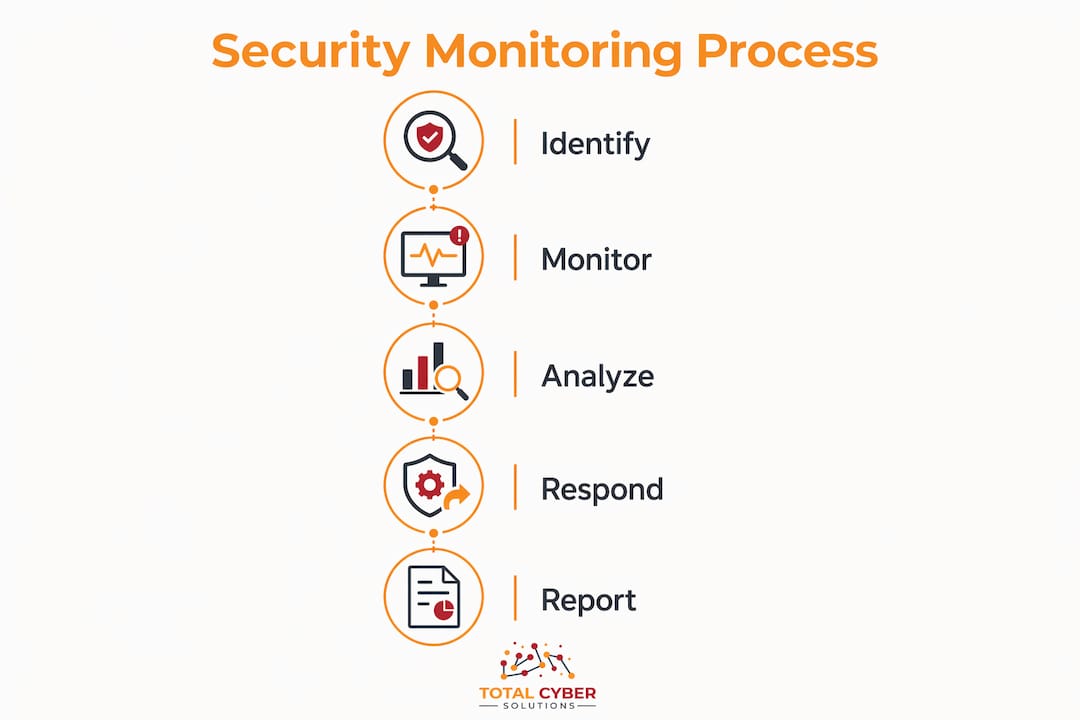
What does continuous security monitoring actually require?
The formal term for this discipline is Information Security Continuous Monitoring, or ISCM. NIST SP 800-137 defines it across three tiers: organizational governance, business process management, and information system operations. Each tier feeds data upward, so leadership gets a real picture of risk, not just a compliance checkbox.

NIST 800-53 Control CA-7 goes further. It does not just recommend monitoring. It requires a documented program with defined metrics, monitoring cadence, assigned responsibilities, and packaged evidence. Buying a tool does not satisfy CA-7. Running the tool, reviewing its output, remediating findings, and proving you did all of that does.
Regulated environments now mandate automated scanning no less frequently than monthly. Manual assessments do not meet this bar. That distinction matters because many SMEs still rely on quarterly vulnerability scans and annual penetration tests as their primary security checks.
Pro Tip: If your security program cannot produce on-demand evidence of control validation, your NIST compliance claim will not survive a real audit. Build the evidence trail into your monitoring workflow from day one.
Here is a quick comparison of what periodic audits deliver versus what continuous monitoring requires:
| Dimension | Periodic audits | Continuous monitoring |
|---|---|---|
| Frequency | Quarterly or annual | Daily to monthly, automated |
| Coverage | Point-in-time snapshot | Ongoing, real-time visibility |
| Evidence output | Report at a moment in time | Continuous log and alert records |
| Compliance fit | Insufficient for CA-7 | Satisfies NIST 800-53 CA-7 |
| Staffing model | External assessor | Internal ownership or MDR provider |
How does continuous security monitoring work for SMEs?
Most SMEs face three real barriers: limited staff, tight budgets, and fragmented attention. Your IT team is already juggling help desk tickets, software updates, and vendor calls. Adding 24/7 threat monitoring on top of that is not realistic without the right structure.
The most practical path for SMEs is outsourcing to a Managed Detection and Response provider. MDR services unify endpoint detection with expert triage and response, filling visibility gaps that internal teams simply cannot cover around the clock. The cost model is predictable. The coverage is continuous. And your team stays focused on running the business.
Automation handles the routine work. Dependency scanning, configuration drift detection, endpoint health checks, and log aggregation all run without human intervention. What automation cannot do is make final judgment calls on high-risk alerts. Humans must retain final control over decisions that carry real business consequences, like isolating a production server or blocking a user account.
Clear ownership is the piece most SMEs miss. Monitoring tools generate alerts. Someone has to own the triage process, set remediation deadlines, and confirm that fixes actually happened. Without that ownership, alerts pile up and nothing gets resolved. Fold security checks into your standard IT operations the same way you handle patch Tuesday or backup verification.
- Assign a named owner for alert triage, even if that person is your MDR provider
- Set written SLAs for remediation based on severity (critical findings within 24 hours, for example)
- Integrate monitoring dashboards into your existing IT ticketing workflow
- Automate low-risk responses like blocking known malicious IPs
- Review automated security tools quarterly to confirm they are still covering your full environment
Pro Tip: Treat your monitoring program like a CI/CD pipeline for security. Every change to your environment should trigger an automated check, not wait for the next scheduled scan.
What are the real benefits of continuous security monitoring?
Faster detection is the most direct benefit. When a threat actor gains access through a phishing link or a misconfigured cloud storage bucket, continuous monitoring catches the anomaly within minutes or hours, not weeks. That speed is the difference between a contained incident and a full ransomware deployment.
“Cybersecurity experts now treat continuous monitoring as the baseline with audits as occasional checks. The analogy is automated testing in a software pipeline. You do not ship code without running tests. You should not run a business without running security checks.”
Accurate security posture is the second benefit. Your environment changes constantly. Employees add new SaaS apps. Developers spin up cloud instances. Vendors get new access credentials. Each change is a potential gap. Continuous monitoring tracks configuration drift and anomalies across all three NIST tiers, so your security picture reflects reality, not last quarter’s audit report.
Compliance readiness is the third benefit, and it is underrated. When an auditor asks for evidence of control effectiveness, a continuous monitoring program produces it automatically. You are not scrambling to reconstruct six months of activity from memory and spreadsheets.
The financial case is straightforward too. MDR reduces alert noise by 80–90%, which means your team spends less time chasing false positives and more time on work that moves the business forward. Ransomware recovery costs, regulatory fines, and reputational damage all dwarf the cost of a monthly monitoring program.
Security monitoring best practices and pitfalls to avoid
Most SMEs that struggle with continuous monitoring share one problem: they bought tools but skipped the program. A tool without a process is just noise. Here is how to build a program that actually works.
- Define your monitoring scope first. List every asset that needs coverage: endpoints, servers, cloud workloads, identity systems, and business applications. If it is not in scope, it will not be monitored.
- Set a monitoring cadence and stick to it. Automated scans should run at minimum weekly for endpoints and configurations. Vulnerability scanning should run at least monthly for regulated environments.
- Write remediation SLAs before you need them. Critical findings get 24 hours. High findings get 72 hours. Medium findings get 30 days. Document this policy and enforce it.
- Collect telemetry from every layer. AI-enhanced detection depends on normalized logging from identity, endpoint, cloud, and business apps. Gaps in telemetry create blind spots that attackers exploit.
- Integrate monitoring with patch management. A vulnerability finding that does not trigger a patch ticket is a finding that never gets fixed. Connect your monitoring output directly to your patch workflow.
The most common pitfall is treating the monitoring tool as the program. Clear ownership and workflow integration matter more than which tool you choose. The second most common pitfall is ignoring log health. If your logging pipeline is broken, your monitoring is blind and you will not know it.
| Common pitfall | What it costs you | How to fix it |
|---|---|---|
| No named owner for alerts | Findings pile up, nothing gets remediated | Assign triage ownership in writing |
| Incomplete telemetry | Blind spots attackers exploit | Audit log sources quarterly |
| No remediation SLAs | Critical findings linger for months | Write and enforce severity-based deadlines |
| Tool without a process | False sense of security | Build a documented monitoring program |
| Treating audits as the endpoint | Gaps between assessments go undetected | Run continuous automated checks between audits |
Key Takeaways
Continuous security monitoring is the operational foundation that turns compliance frameworks into real protection, and SMEs that skip it are not just non-compliant, they are exposed.
| Point | Details |
|---|---|
| NIST frameworks require it | NIST SP 800-137 and CA-7 mandate documented, automated monitoring programs, not just tools. |
| MDR fills the staffing gap | Outsourcing to an MDR provider gives SMEs 24/7 coverage without building an in-house SOC. |
| Ownership drives results | Assigning clear triage responsibility matters more than which monitoring tool you choose. |
| Telemetry completeness is critical | Gaps in log coverage from endpoints, identity, and cloud create blind spots attackers exploit. |
| Audits alone are not enough | Periodic assessments provide snapshots; continuous monitoring provides the real-time awareness compliance requires. |
Why I think most SMEs are solving this problem backwards
After working with dozens of small and medium-sized businesses on their security programs, the pattern is consistent. The company buys a monitoring tool, points it at the network, and considers the job done. Six months later, the alert queue has 400 unreviewed items and nobody owns the inbox.
The uncomfortable truth is that the technology is the easy part. The hard part is building the habit. Continuous monitoring only works when it is woven into how your team operates every day, not treated as a separate security project that runs in the background.
I have also seen the opposite mistake: IT managers who wait for the annual audit to find out what is broken. By the time the auditor’s report lands, the environment has changed three times. The findings are already stale. Audits are useful. They are not a substitute for ongoing awareness.
The SMEs that get this right share one trait. They treat security monitoring the same way they treat financial reporting. You do not check your bank account once a year. You check it regularly, you set alerts for unusual activity, and you act on what you see. Your security posture deserves the same discipline.
If you are an IT manager reading this, the first step is not buying a new tool. It is assigning ownership and writing down what happens when an alert fires. Start there. The technology will follow. And if your team does not have the bandwidth to run this program internally, that is exactly what managed services exist to solve.
— Alden
How Totalcyber supports your security monitoring program
Totalcyber provides managed cybersecurity services built specifically for small and medium-sized businesses that need 24/7 coverage without the overhead of an in-house security team.

Totalcyber’s approach combines continuous threat monitoring, expert triage, and compliance reporting aligned to NIST frameworks. Your team gets a predictable monthly cost, clear remediation guidance, and the documentation you need when auditors come calling. Whether you need a full managed detection and response program or support building out your existing monitoring policies, Totalcyber has the experience to get it done. Reach out today and find out what a properly structured monitoring program looks like for your business.
FAQ
What is the role of continuous security monitoring?
Continuous security monitoring is the ongoing, automated process of tracking an organization’s security posture across endpoints, cloud systems, and identity controls to detect threats and vulnerabilities in real time. It is formally required by NIST SP 800-137 and NIST 800-53 Control CA-7.
How is continuous monitoring different from a periodic audit?
Periodic audits provide a point-in-time snapshot and do not satisfy modern compliance standards on their own. Continuous monitoring runs automated checks daily to monthly and produces the ongoing evidence trail that frameworks like NIST CA-7 actually require.
Why is continuous security monitoring important for SMEs?
SMEs face the same threats as large enterprises but with fewer resources to detect and respond. Continuous monitoring closes the gap by automating detection, reducing alert noise, and enabling faster containment before a breach escalates into a costly incident.
Can a small business afford continuous security monitoring?
Yes. Outsourcing to a Managed Detection and Response provider gives SMEs SOC-grade monitoring at a predictable monthly cost, without hiring a full security team. MDR services reduce alert noise significantly, making the investment efficient for lean IT teams.
What does NIST CA-7 actually require for compliance?
NIST 800-53 CA-7 requires a documented monitoring program with defined metrics, a consistent cadence, assigned responsibilities, and packaged evidence of control validation. Buying a tool alone does not satisfy the control. Running the program and proving it does.