

Cloud security posture is defined as the continuous process of assessing, managing, and improving the security configuration of your organization’s cloud environment to reduce risk and maintain compliance. The industry term for the technology that manages this process is Cloud Security Posture Management, or CSPM. If you run IT for a small or medium-sized business, understanding cloud security posture is no longer optional. 56% of organizations consider their daily posture highly proactive, yet only 39% have a documented mature cloud security strategy. That gap is where breaches happen.
What is cloud security posture management?
Cloud Security Posture Management, or CSPM, is the practice of continuously monitoring your cloud configurations, detecting weaknesses, and fixing them before attackers find them first. Think of it as a constant health check for every setting, permission, and resource in your cloud environment. It covers public cloud platforms, hybrid setups, and multi-cloud deployments equally.
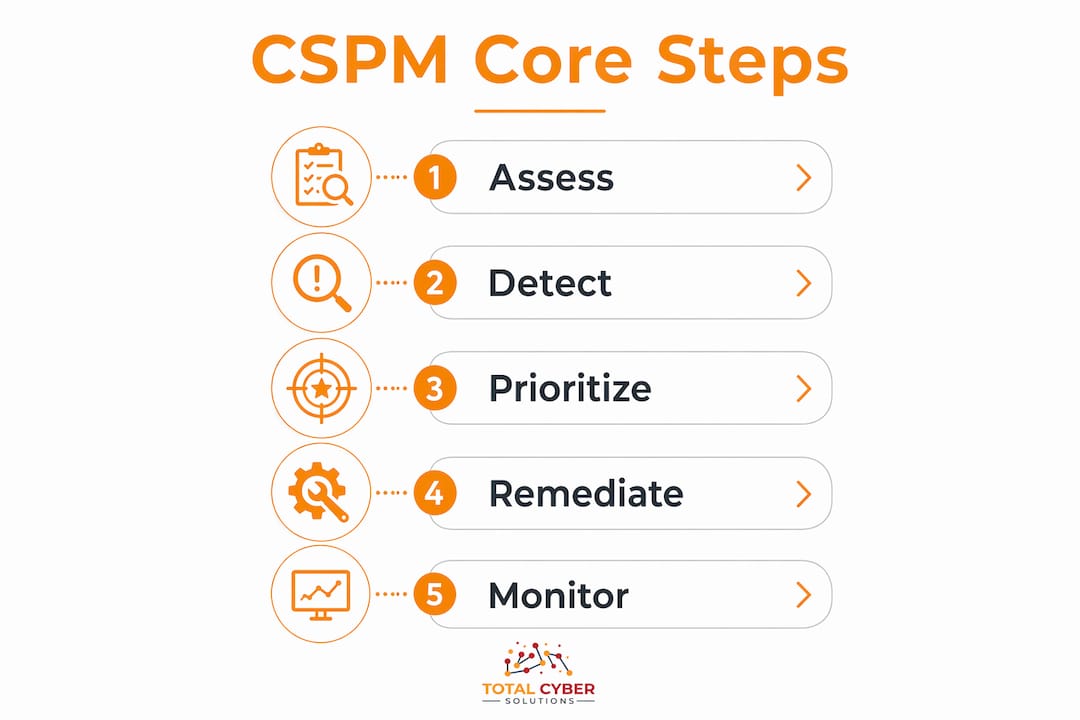
CSPM tools collect data from your cloud environment, evaluate it against established best practices, identify weaknesses, and offer remediation guidance. Frameworks like NIST and CIS Benchmarks serve as the measuring stick. Your posture score reflects how closely your environment matches those standards.

The role of cloud security goes beyond just finding problems. A mature CSPM practice connects your technical configurations to your business risk. A misconfigured storage bucket is not just a technical error. It is an open door to a data breach, a compliance violation, and a potential financial loss.
Core components of CSPM
- Continuous monitoring: Your cloud environment changes constantly. CSPM tools watch every configuration change in real time, not just during scheduled scans.
- Misconfiguration detection: Permissive firewall rules, overly broad storage permissions, and unencrypted data stores are flagged automatically.
- Risk scoring and prioritization: Not every finding carries equal weight. CSPM tools score risks based on severity and reachability, so your team fixes the most dangerous issues first. You can learn more about how risk scoring works for SMBs specifically.
- Remediation guidance: Tools provide step-by-step fix instructions, and some offer automated remediation for low-risk changes.
- Identity and access management (IAM) integration: CSPM connects with your IAM policies to flag excessive permissions and delegated trust relationships.
- Compliance reporting: Dashboards map your configurations against frameworks like SOC 2, HIPAA, and PCI DSS, making audit prep far less painful.
Pro Tip: Start your CSPM practice by running a security posture assessment before you buy any tool. You need a baseline to measure progress.
What challenges do SMBs face with cloud security posture?
SMBs face a specific set of obstacles that enterprise organizations rarely encounter at the same intensity. The biggest one is resource scarcity. Your IT team is likely managing cloud infrastructure, end-user support, and compliance requirements simultaneously. That leaves little time for deep security analysis.
Here are the most common challenges SMB IT managers report:
- Skills shortage: Cloud security requires specialized knowledge of IAM policies, network configurations, and compliance frameworks. Most SMB IT teams are generalists, not cloud security specialists.
- Visibility gaps: When employees spin up cloud resources without IT approval, you lose visibility instantly. Shadow IT is a direct threat to your posture because you cannot protect what you cannot see.
- Alert fatigue: Security teams are overwhelmed by the volume of alerts that cloud environments generate. When every alert looks urgent, nothing gets treated as urgent.
- Tool sprawl: 64% of security experts would prefer a single-vendor platform uniting network, cloud, and application security. Most SMBs instead accumulate disconnected point tools that create more gaps than they close.
- Identity and permission risks: Most cloud incidents stem from misgoverned identities and access relationships, not isolated software vulnerabilities. Excessive permissions are the most common entry point.
- Ransomware targeting: 82% of ransomware attacks target SMBs. That number should change how you think about cloud risk management.
The combination of limited staff, complex environments, and active targeting makes cloud security posture a critical priority, not a nice-to-have.
How can SMBs implement effective cloud posture management?
The good news is that you do not need an enterprise security budget to build a strong cloud security posture. You need the right practices applied consistently.
Start with identity. Misgoverned identities are the leading cause of cloud breaches. Apply the principle of least privilege everywhere. Every user, service account, and application should have only the permissions it needs to do its job, nothing more. Review permissions quarterly and remove anything stale.
Adopt continuous monitoring. Scheduled scans are not enough. Cloud environments change too fast. A misconfiguration introduced at 9:00 AM can be exploited by noon. Continuous monitoring catches changes as they happen.
Use automation carefully. Automated remediation requires human-in-the-loop validation to prevent inadvertent outages. Start by automating detection and alerting. Graduate to automated fixes only after your team has validated the logic and tested it in a non-production environment.
Align with a framework. CIS Benchmarks and NIST CSF give you a structured way to measure and improve your posture. Compliance alignment also reduces your overall cyber risk, not just your audit score.
Build guardrails, not just policies. A written policy that nobody enforces does nothing. Use your CSPM tool to enforce policies automatically. If a developer tries to open a storage bucket to the public internet, the guardrail blocks it before it goes live.
Train your team. 44.5% of initial cloud access comes through software vulnerabilities, and 27.2% comes through weak or absent credentials. Phishing-resistant MFA and context-aware access controls are your top defenses. Training your team to recognize threats reduces the human error that attackers count on.
Pro Tip: Establish cybersecurity policies before deploying CSPM tools. Tools enforce policies. Without policies, tools just generate noise.
| Practice | Why it matters |
|---|---|
| Least privilege IAM | Reduces the blast radius if credentials are compromised |
| Continuous monitoring | Catches misconfigurations before attackers do |
| Framework alignment (NIST, CIS) | Provides measurable benchmarks for posture improvement |
| Human-validated automation | Speeds up remediation without risking outages |
| Regular training | Cuts credential-based attacks and shadow IT incidents |
What should you look for in cloud security posture management tools?
CSPM tools vary widely in capability, and the right choice depends on your environment and team size. Understanding the feature categories helps you evaluate options without getting lost in vendor marketing.
The table below maps core CSPM capabilities to what they actually do for your team.
| Feature category | What it does for you |
|---|---|
| Configuration monitoring | Continuously scans cloud resources for policy violations |
| Risk scoring | Ranks findings by severity so your team prioritizes correctly |
| IAM governance | Flags excessive permissions and unused accounts |
| Automated remediation | Fixes low-risk issues automatically with human oversight |
| Multi-cloud support | Covers AWS, Azure, and Google Cloud from one dashboard |
| Compliance reporting | Maps your posture to SOC 2, HIPAA, PCI DSS, and other frameworks |
Entry-level tools work well for single-cloud SMB environments with a small number of resources. Enterprise platforms add features like attack path analysis, runtime threat detection, and cross-cloud correlation. Most SMBs start with an entry-level or mid-tier tool and scale up as their cloud footprint grows.
The most important evaluation criterion is not feature count. It is integration. Your CSPM tool needs to connect with your existing IAM system, ticketing workflow, and compliance program. A tool that generates findings nobody acts on is not a security improvement. It is just more noise.
Key Takeaways
Cloud security posture management is the most direct way SMBs can reduce cloud risk without adding headcount, but only when it is integrated with identity governance, compliance frameworks, and human oversight.
| Point | Details |
|---|---|
| Posture maturity gap is real | Only 39% of organizations have a documented mature cloud security strategy despite most feeling proactive. |
| Identity is the top risk | Most cloud breaches start with misgoverned permissions, not software exploits. |
| Automation needs human oversight | Automated remediation prevents outages only when validated by your team first. |
| Framework alignment matters | CIS Benchmarks and NIST CSF give you measurable targets for posture improvement. |
| SMBs are primary targets | 82% of ransomware attacks hit SMBs, making continuous cloud visibility a business-critical need. |
Why CSPM is not a silver bullet, and what to do about it
CSPM is one of the most valuable tools in a modern SMB security program. I have seen it catch misconfigurations that would have been invisible to a manual review. But I have also seen organizations treat it as a checkbox and walk away feeling protected when they are not.
The honest truth is that CSPM is a foundational piece of your cloud security ecosystem, not the whole ecosystem. It tells you what is wrong. It does not fix your culture, your access review process, or your incident response plan. Those require human decisions.
What I find most encouraging about where cloud security is heading is the shift from manual alert review to automated policy guardrails. Security teams are finally accepting that humans cannot review every alert at machine speed. The teams winning at cloud security are the ones defining clear policies and letting automation enforce them, while keeping humans in the loop for anything that could cause an outage.
For SMBs specifically, my advice is this: do not wait until you have a perfect tool stack. Start with a baseline assessment, fix your IAM permissions, align with one framework, and build from there. Maturity is a direction, not a destination.
— Alden
Totalcyber can help you manage your cloud security posture
Keeping your cloud environment secure takes more than a single tool. It takes continuous monitoring, trained staff, and policies that actually get enforced.
Totalcyber provides managed cybersecurity services built specifically for SMBs, including continuous cloud monitoring, risk assessments, and compliance support. Our cloud services team helps you identify misconfigurations, close identity gaps, and align your environment with frameworks like NIST and CIS Benchmarks. We also offer cyber awareness training to reduce the human errors that attackers rely on. You get expert support without the cost of building an in-house security team. Ready to strengthen your posture? Talk to our team today.
FAQ
What is cloud security posture in simple terms?
Cloud security posture is the overall security health of your cloud environment, measured by how well your configurations, permissions, and policies match established best practices and compliance requirements.
What does CSPM stand for?
CSPM stands for Cloud Security Posture Management. It refers to the tools and practices used to continuously monitor and improve the security configuration of cloud environments.
Why is cloud security posture important for SMBs?
82% of ransomware attacks target SMBs, and most cloud breaches start with misconfigured settings or excessive permissions. A strong posture reduces the attack surface before incidents occur.
How do you assess cloud security posture?
A posture assessment compares your current cloud configurations against frameworks like NIST CSF or CIS Benchmarks, identifies gaps, scores risks by severity, and produces a prioritized remediation plan.
What is the difference between CSPM and traditional security tools?
Traditional security tools focus on perimeter defense and endpoint protection. CSPM focuses specifically on the configuration and compliance state of cloud resources, catching risks that firewalls and antivirus tools were never designed to detect.
Recommended
- What Is a Security Posture Assessment? 2026 Guide | Total Cyber Solutions
- The Role of Cybersecurity Policies for SMB Owners | Total Cyber Solutions
- IT Security Best Practices for Virginia SMBs: 2026 Guide | Total Cyber Solutions
- The Role of Cybersecurity Risk Scoring for SMBs | Total Cyber Solutions