

A cybersecurity maturity model translates your security practices into a measurable roadmap that leaders can prioritize, fund, and defend in front of a board. That single function makes it one of the most practical governance tools available to IT managers and security leaders today. Frameworks like NIST CSF, CMMC 2.0, and C2M2 each give you a structured way to see where you stand, where you need to go, and what it will cost to get there.
Three things happen when you put a maturity model to work:
- Board-ready reporting: A maturity score converts technical controls into a language executives understand, making investment requests far easier to justify.
- Risk-based prioritization: Low-maturity domains point directly to your highest-exposure gaps, so remediation dollars go where they matter most.
- Continuous improvement cycle: The model creates a repeatable assessment cadence, so security never stalls at “good enough.”
Adopting a model helps you identify gaps, set benchmarks, prioritize investments, and align to compliance requirements at the same time.
Table of Contents
- What a cybersecurity maturity model actually measures
- Which leading frameworks should you consider?
- How to choose the right model for your organization
- Step-by-step: how to run a maturity assessment and build a roadmap
- How maturity models connect to risk and vulnerability management
- How to present maturity findings to executives and the board
- Common pitfalls that derail maturity programs
- CMMC 2.0 as a worked example for DoD contractors
- Key Takeaways
- Why maturity models matter more than most leaders realize
- Totalcyber helps you move from assessment to real security improvement
- Authoritative sources and official references
What a cybersecurity maturity model actually measures
A cybersecurity maturity model is a structured framework that scores how consistently and completely an organization implements security practices across defined domains. The levels or scales exist because security capability is not binary. You are not simply “secure” or “not secure.” You are somewhere on a spectrum, and the model makes that spectrum visible and actionable.
Core components you will assess:
- Domains or functions: Governance, identity and access management, asset management, threat detection, incident response, and recovery.
- Maturity levels: Typically a 1–5 scale (ad hoc to optimized) or, in models like C2M2, Maturity Indicator Levels (MIL 0–3) applied independently per domain.
- Scoring approach: Consensus-based ratings from subject matter experts, supported by documented evidence.
- Evidence types: Policies, configuration baselines, audit logs, penetration test results, training records, and incident response playbooks.
A baseline assessment is the critical first step because it identifies gaps, sets priorities, and produces the evidence package you need for stakeholder conversations. Without it, you are guessing at your own risk profile.

Which leading frameworks should you consider?
Three models dominate the conversation for U.S. organizations: NIST CSF, CMMC 2.0, and C2M2. Each was built for a different primary purpose, and picking the wrong starting point wastes time and money.
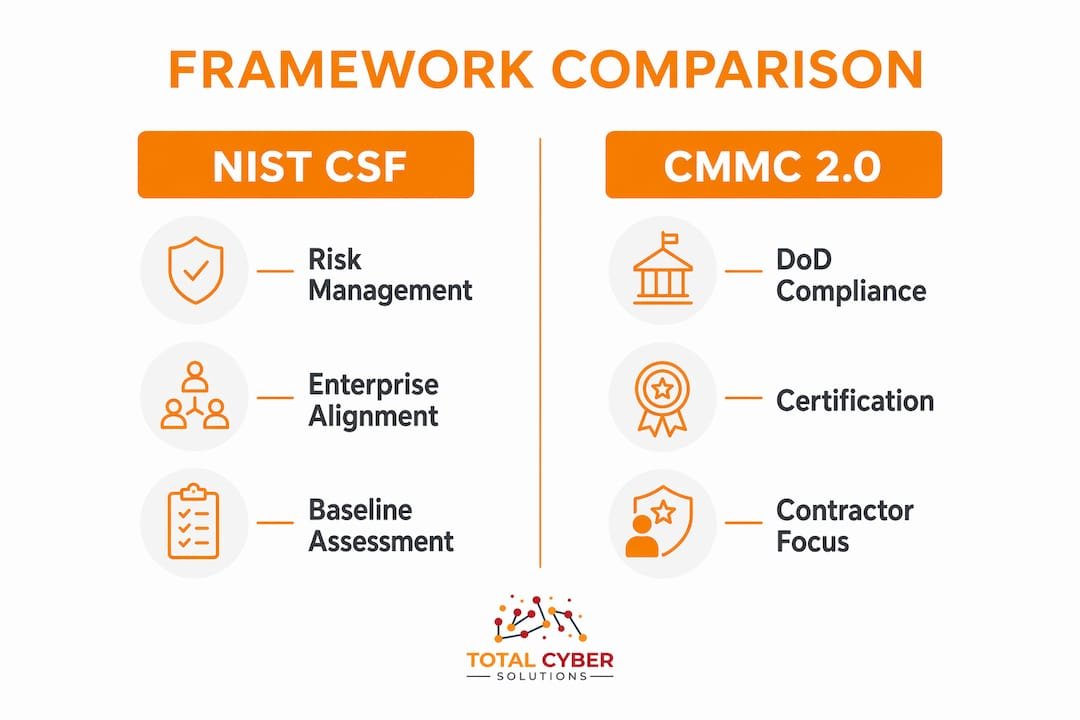
| Dimension | NIST CSF | CMMC 2.0 | C2M2 |
|---|---|---|---|
| Primary purpose | Risk management and enterprise alignment | DoD supply chain compliance | Critical infrastructure and OT improvement |
| Sector fit | General enterprise, any industry | Defense Industrial Base (DoD contractors) | Energy, utilities, critical infrastructure |
| Maturity scale | Implementation Tiers (1–4) plus Profiles | Three levels (1, 2, 3) mapped to NIST SP 800-171/172 | MIL 0–3 across 10 domains |
| Implementation effort | Low to medium; flexible and self-directed | Medium to high; Level 2+ requires third-party audit | Medium; self-evaluation with facilitated workshops |
| Auditability | Self-assessed or third-party; no mandatory certification | Level 2+ requires C3PAO certification | Self-evaluation; no mandatory certification |
| Cost/resource shape | Low entry cost; scales with depth | Higher cost at Level 2+ due to C3PAO fees | Moderate; free tools available from DOE |
NIST CSF provides a Core, Implementation Tiers, and Profiles to benchmark current and desired states, making it the most common starting point for organizations without a regulatory mandate. C2M2 uses MIL 0–3 ratings across 10 domains and includes self-evaluation tools, making it particularly strong for organizations with operational technology environments.
Best-fit use cases at a glance:
- NIST CSF: Any enterprise seeking a flexible risk alignment framework without a specific regulatory driver. Also the best foundation before layering on other models.
- CMMC 2.0: Any organization in the Defense Industrial Base that handles Federal Contract Information or Controlled Unclassified Information. Non-negotiable for DoD contracts.
- C2M2: Energy, utilities, and critical infrastructure operators, or any organization with significant OT/ICS exposure.
For organizations that need tactical, prioritized control improvements without the overhead of a full framework, CIS Controls offer prescriptive implementation groups scaled by organization size. They work well as a complement to NIST CSF rather than a replacement.
Pro Tip: If you are a general enterprise with no DoD exposure, start with NIST CSF to build your baseline. Once your core functions are documented and scored, mapping to C2M2 or CMMC becomes significantly faster because the evidence you collected already covers a large portion of the required controls.
How to choose the right model for your organization
The right model depends on four factors: your regulatory exposure, your sector, your available resources, and what your leadership needs from the output. Run through this checklist before committing.
Decision checklist:
- Do you hold or process Controlled Unclassified Information for the DoD? If yes, CMMC 2.0 is required, not optional.
- Do you operate industrial control systems, SCADA, or OT networks? C2M2 was built for this environment.
- Are you a general enterprise with no specific regulatory mandate? NIST CSF gives you the most flexibility and the lowest entry cost.
- Does your leadership want a risk-quantified output (financial impact of gaps)? Pair any model with cyber risk quantification techniques.
- Do you have limited internal staff? Choose a model with free self-evaluation tools (C2M2 or NIST CSF) and consider external support for evidence collection.
- Do you need to demonstrate compliance to a customer or auditor? CMMC Level 2 certification via a C3PAO is the only path that satisfies DoD contractual requirements.
When to combine models:
- Start with NIST CSF to establish your baseline across all five core functions.
- Map your NIST CSF gaps to CMMC practice domains if DoD work is on the horizon.
- Use C2M2 domain ratings independently per domain rather than seeking a single organization-wide score. Different domains will be at different MIL levels, and that is expected.
- Revisit the model selection annually as your regulatory environment changes.
One practical note: C2M2 and CMMC overlap significantly in their practice areas, but they are not interchangeable. C2M2 results cannot substitute for a CMMC self-assessment or certification. Think of C2M2 as preparation work, not a shortcut.
Step-by-step: how to run a maturity assessment and build a roadmap
A maturity assessment is not a one-afternoon exercise. Plan for a structured process with defined phases, clear owners, and a realistic timeline.
-
Project kickoff and scope definition (Week 1–2). Define which systems, locations, and business units are in scope. Assign an internal sponsor (typically the CISO or IT Director) and identify subject matter experts for each domain. Decide which model you are using.
-
Inventory and evidence collection (Weeks 2–5). Gather policies, configuration baselines, audit logs, training records, and incident response documentation. This phase is where most timelines slip. Budget more time here than you think you need.
-
Scored assessment (Weeks 4–6). Facilitate workshops with domain SMEs to rate each practice area. Use consensus scoring, not a single person’s opinion. Document the rationale for every rating.
-
Gap analysis (Week 6–7). Map your current scores against your target state. Identify which gaps carry the highest business risk, not just the lowest scores.
-
Risk prioritization (Week 7–8). Rank gaps by likelihood of exploitation and potential business impact. This is where maturity scoring connects directly to your risk register.
-
Roadmap with milestones (Week 8–10). Build a 12–18 month improvement plan with defined sprints, owners, and measurable outcomes. Tie each initiative to a specific maturity domain and target level.
-
Implementation sprints (Months 3–12+). Execute remediation in 60–90 day sprints. Assign clear accountability for each control improvement.
-
Re-assessment cadence. Reassess at least annually, or after a significant change (new system, acquisition, regulatory update). Security is never finished.
Roles and responsibilities:
- CISO or IT Director: Sponsors the program, approves the roadmap, owns executive reporting.
- Domain SMEs: Provide evidence and consensus ratings for their areas.
- Compliance or GRC team: Maps model controls to regulatory requirements.
- External assessor (optional but recommended): Provides independent validation and reduces score inflation risk.
Effort buckets:
- Low effort: Small organization, NIST CSF self-assessment, no OT, internal staff only. Expect a timeframe of several weeks and relatively low external costs.
- Medium effort: Mid-size enterprise, NIST CSF or C2M2, some external support for evidence collection. Expect a timeline of a few months.
- High effort: CMMC Level 2 certification, OT inclusion, regulatory audit prep, or CRQ integration. Expect a timeline extending over several months and potentially significant external resource investment.
For smaller organizations, scaled implementations that focus on high-impact controls first are a practical way to build maturity without overextending your team. A security posture assessment can serve as the formal output of this process.

How maturity models connect to risk and vulnerability management
Your maturity scores are most useful when they feed directly into your operational risk programs. A low score in the “Detect” domain, for example, tells you that your detection coverage is inconsistent. That should immediately raise the priority of your next vulnerability scan cycle and your investment in SIEM tuning.
How domain scores map to operational programs:
- Identify domain (low maturity): Asset inventory is incomplete. Prioritize discovery scans before any other remediation.
- Protect domain (low maturity): Configuration baselines are missing or unenforced. Patch management and endpoint hardening move to the top of the sprint backlog.
- Detect domain (low maturity): Log coverage is partial. Detection engineering and SIEM coverage expansion become the immediate focus.
- Respond/Recover (low maturity): Incident response plans exist on paper but have not been tested. Tabletop exercises and playbook validation take priority.
KPIs that tie maturity levels to operations:
| Domain | Maturity KPI | Operational Metric |
|---|---|---|
| Asset Management | % of assets in CMDB | Mean time to discover new assets |
| Vulnerability Management | % of systems in baseline config | Mean time to remediate critical CVEs |
| Detection | Detection coverage rate | Mean time to detect (MTTD) |
| Incident Response | Playbook test frequency | Mean time to respond (MTTR) |
Maturity scoring also informs cybersecurity insurance underwriting. Insurers increasingly ask for evidence of maturity program results, and a documented improvement trajectory can directly affect your premium and coverage terms. Pairing your model results with vulnerability scanning gives you the operational data to back up your maturity claims.
How to present maturity findings to executives and the board
Most boards prefer a concise presentation rather than a lengthy technical deep-dive. They want three things: where you are, where you need to be, and what it costs to close the gap.
Executive summary template:
- Current state: “Our overall maturity across the five NIST CSF functions averages [score]. Our weakest domains are [X] and [Y], which represent our highest-probability risk exposure.”
- Target state: “To reach a defensible baseline for our industry, we need to reach [target level] in [specific domains] within 18 months.”
- Investment ask: “The roadmap requires [resource estimate]. Based on cyber risk quantification, closing these gaps reduces our estimated probable loss exposure by [range].”
Pairing maturity deltas with CRQ converts control improvements into specific financial impact estimates, which is the most effective way to justify a security budget increase. The security benchmarks you establish during assessment also give you peer comparison data, which boards find compelling.
Pro Tip: Package your board presentation as a one-page scorecard showing current vs. target maturity by domain, three prioritized initiatives with estimated cost and expected risk reduction, and a 12-month milestone timeline. One page forces clarity and gets read.
Metric mappings for board conversations:
- Maturity delta in “Protect” domain → reduction in mean time to patch critical vulnerabilities.
- Maturity delta in “Detect” domain → improvement in detection coverage rate and MTTD.
- Maturity delta in “Respond” domain → reduction in MTTR and estimated breach cost.
- Overall maturity improvement → input to IT security ROI calculations for finance leadership.
Common pitfalls that derail maturity programs
The most common mistake is treating a maturity assessment as a one-time project. You complete it, file the report, and move on. Twelve months later, your environment has changed but your score has not.
Pitfalls to watch for:
- One-and-done assessments. Security leaders consistently advise that completing one assessment phase must lead directly to planning the next. Build the re-assessment cadence into the program from day one.
- Treating the model as a checklist. Checking boxes without understanding the business risk behind each control produces inflated scores and false confidence.
- Failure to map to business risk. A low score in a domain that does not touch your critical business processes matters less than a medium score in a domain that does. Always weight gaps by business impact.
- Poor evidence quality. Verbal claims during a workshop are not evidence. Policies that exist but are not enforced are not evidence. Require documented, verifiable artifacts for every rating.
- Weak executive sponsorship. Without a named sponsor who controls budget and can remove obstacles, improvement roadmaps stall after the first sprint.
A practical fix for score inflation: bring in an independent assessor for at least one cycle. Internal teams naturally rate themselves higher than an outside reviewer would. The gap between self-assessed and independently validated scores is often the most useful data point you will get from the entire exercise.
CMMC 2.0 as a worked example for DoD contractors
CMMC 2.0 is the DoD’s program for strengthening cyber resilience across the Defense Industrial Base. If your organization holds Federal Contract Information or Controlled Unclassified Information under a DoD contract, CMMC is not optional. Level 2 maps directly to NIST SP 800-171, and Level 3 adds requirements from NIST SP 800-172 for the most sensitive programs.
Immediate steps for DoD contractors:
- Scope your CUI environment. Identify every system, network segment, and third-party connection that touches Controlled Unclassified Information.
- Run a baseline assessment against NIST SP 800-171. All 110 practices in NIST SP 800-171 are required at Level 2. Know your current score before engaging a C3PAO.
- Build your System Security Plan (SSP). The SSP is your primary evidence artifact. It documents how each practice is implemented across your environment.
- Address your Plan of Action and Milestones (POA&M). Gaps identified in the baseline go into the POA&M with remediation timelines.
- Engage a C3PAO early. Third-party assessment organizations have limited capacity. If your contract requires certification, start the engagement process well before your deadline.
For organizations already using C2M2, the C2M2-CMMC supplemental guidance maps overlapping practices and identifies where additional work is needed. C2M2 experience accelerates CMMC readiness, but C2M2 results cannot replace a CMMC assessment. You can also explore Totalcyber’s CMMC readiness resources for a step-by-step overview of the certification path.
Key Takeaways
A cybersecurity maturity model gives IT and security leaders a repeatable, evidence-based method to measure gaps, prioritize investments, and communicate risk in terms the board can act on.
| Point | Details |
|---|---|
| Start with a baseline assessment | A scored baseline identifies your highest-risk gaps and produces the evidence needed for stakeholder conversations. |
| Match the model to your situation | NIST CSF fits general enterprise risk alignment; CMMC 2.0 is required for DoD contractors; C2M2 suits critical infrastructure and OT environments. |
| Tie maturity scores to business metrics | Map domain improvements to KPIs like mean time to remediate and detection coverage rate to justify investment to finance and the board. |
| Treat it as a continuous cycle | One assessment is a starting point, not a finish line. Build a re-assessment cadence into the program from day one. |
| Totalcyber accelerates the process | Totalcyber provides assessments, roadmap development, and managed cybersecurity services to move organizations from baseline to defensible maturity faster. |
Why maturity models matter more than most leaders realize
Most organizations adopt a maturity model because a regulation or a customer audit forces them to. That is the wrong reason, and it usually produces the wrong result: a score that looks good on paper but does not reflect actual security capability.
The organizations that get the most value from a maturity framework treat it as a governance tool first. They use it to answer a question that every board should be asking: “Are we spending our security budget on the right things?” A maturity score without a business risk mapping attached to it is just a number. A maturity score that tells you “our detect-and-respond capability is two levels below where it needs to be given our threat profile” is a funding argument.
There is also a workforce dimension that rarely gets discussed. The cybersecurity skills gap is real, and maturity assessments surface it quickly. When you score your “Protect” domain and find that configuration management is ad hoc, the root cause is often not a missing tool. It is a missing process owner, or a team that has never been trained on the standard. Maturity models force that conversation into the open.
The continuous improvement cycle is where the real value compounds and aligns with the zero trust approach to cybersecurity maturity, as explained in the zero trust strategia cyberbezpieczenstwa article. Organizations that reassess annually and track their maturity trajectory over three to five years build a defensible record of due diligence. That record matters in a breach investigation, in an insurance claim, and in a board conversation about whether the security program is working.
Totalcyber helps you move from assessment to real security improvement
Knowing your maturity score is step one. Closing the gaps is where most organizations need a partner. Totalcyber is a veteran-owned cybersecurity and IT services company that takes organizations from baseline assessment through remediation and into a sustained improvement program, without the overhead of building that capability entirely in-house.

What Totalcyber brings to your maturity program:
- Baseline and gap assessments aligned to NIST CSF, CMMC 2.0, and C2M2.
- Roadmap development that maps gaps to business risk and prioritizes by impact.
- Remediation sprints covering policy development, configuration hardening, and vulnerability analysis.
- Executive reporting packages that translate maturity scores into board-ready metrics.
- Managed cybersecurity services for organizations that need sustained monitoring and continuous improvement support.
- Compliance consulting and cyber awareness training to close the human and process gaps your assessment uncovers.
The next step is straightforward. Request a readiness assessment and Totalcyber will help you establish your baseline, build your roadmap, and start closing the gaps that matter most.
Authoritative sources and official references
These are the primary and official documents to use when preparing evidence, building your SSP, or citing model specifications in audit artifacts.
Official model specifications:
- Cybersecurity Capability Maturity Model (C2M2) Version 2.1 — The official DOE model document. Download this for the full practice list, MIL definitions, and self-evaluation tools.
- C2M2 Program Page, U.S. Department of Energy — Official DOE landing page with version history and sector guidance.
- CMMC Program Overview, DoD CIO — The authoritative source for CMMC requirements, levels, and certification pathways.
- C2M2-CMMC Supplemental Guidance — Maps C2M2 practices to CMMC requirements; essential for organizations using both models.
- NIST Cybersecurity Framework Update (NIST.gov) — Official NIST page covering CSF updates and the current framework structure.
- C2M2 to NIST CSF Mapping, NIST NCCoE — Official mapping between C2M2 domains and NIST CSF functions; useful when combining models.
Explanatory resources (not official model specifications):
- GSA CMMC Overview — Plain-language introduction to CMMC 2.0 for contractors new to the requirement.
- CISO’s Guide to Implementing a Cybersecurity Maturity Model, TechTarget — Practitioner-focused implementation guidance with pitfall warnings.
- Cybersecurity Maturity Models Overview, Flexential — Accessible overview of leading models and when to use each.
When preparing evidence or audit artifacts, always cite the official model specification, not a blog post. Explanatory resources are useful for planning and training, but an auditor or C3PAO will reference the official document.
Recommended
- Cybersecurity Maturity Model Certification (CMMC) | Total Cyber Solutions
- Cybersecurity Maturity Model Certification (CMMC): What You Need to Know | Total Cyber Solutions
- The Role of Security Benchmarks in Business Cybersecurity | Total Cyber Solutions
- The Role of Cybersecurity Policies for SMB Owners | Total Cyber Solutions