

What is a security audit, and what does it cover?
A security audit is an independent, systematic review of an organization’s information systems, controls, policies, and procedures. Its purpose is to assess compliance, identify vulnerabilities, and recommend improvements. According to NIST, it evaluates technical infrastructure, physical safeguards, and administrative practices against defined security criteria.
Think of it as a health checkup for your IT environment. You are not waiting for something to break; you are proactively checking whether your defenses are actually working.
A security audit covers several core elements:
- Policy review: Verifying that written security policies exist, are current, and are enforced
- Technical assessment: Examining network configurations, access controls, encryption, and system settings
- Physical controls: Checking server room access, hardware security, and physical entry logs
- Compliance verification: Measuring controls against regulatory requirements or industry standards
- Risk identification: Flagging gaps that could expose the organization to a breach or penalty
It is worth knowing how a security audit differs from related activities. A vulnerability assessment identifies weaknesses in systems but does not verify whether your policies and controls meet a defined standard. A penetration test goes further by simulating an actual attack. An audit, by contrast, verifies compliance and control adequacy across the full organization. All three serve different purposes, and combining them produces a stronger security posture than relying on any one alone.

Why security audits matter for your organization
Security audits are one of the most direct ways to find out where your organization is exposed before an attacker does. They surface gaps in access controls, outdated configurations, and policy failures that routine IT management tends to miss.
Regulatory pressure makes audits increasingly unavoidable. Organizations handling health data must meet HIPAA requirements, payment processors must comply with PCI DSS v4.0, and federal agencies and contractors operate under FISMA. Failing an audit in any of these environments carries real consequences: fines, contract loss, and reputational damage.
The stakes are high. Cybersecurity incidents continue to grow in frequency and cost across US industries. A security audit gives you documented evidence of where your controls stand, which is exactly what regulators, insurers, and business partners want to see.
The practical benefits of conducting regular audits include:
- Risk reduction: Catching misconfigurations and access control failures before they become breaches
- Regulatory compliance: Meeting the requirements of HIPAA, PCI DSS v4.0, FISMA, ISO 27001, and the NIST Cybersecurity Framework 2.0
- Operational clarity: Understanding which systems, data, and processes carry the most risk
- Third-party confidence: Providing partners, clients, and insurers with documented proof of security maturity
- Continuous improvement: Creating a baseline that makes each subsequent audit more targeted and efficient
Audits also reinforce internal accountability. When employees and managers know that controls are reviewed regularly, adherence to security policies tends to improve across the board.
What are the main types of security audits in 2026?
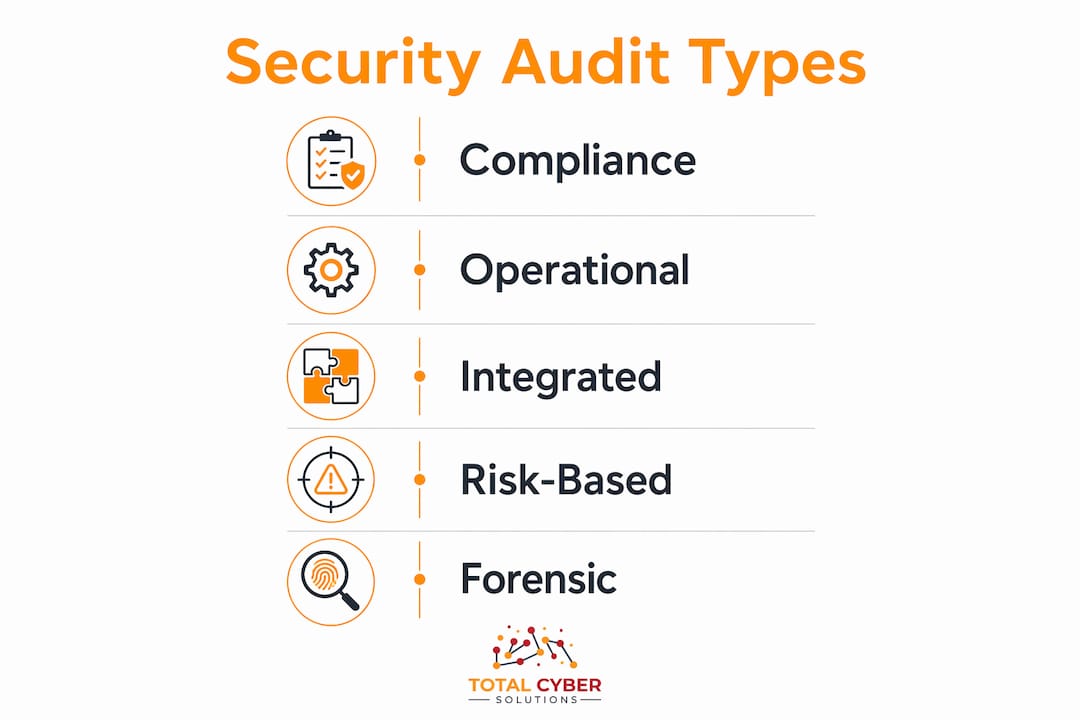
Not every audit looks the same. The type you need depends on your industry, regulatory obligations, and the specific risks your organization faces. Here are the most common types US organizations encounter.
- Compliance audits measure your controls against a fixed regulatory standard. HIPAA audits focus on protected health information. PCI DSS v4.0 audits apply to any organization that stores, processes, or transmits payment card data. FISMA audits apply to federal agencies and their contractors. The result is typically pass or fail against a defined checklist.
- Risk-based audits use the NIST Cybersecurity Framework 2.0 to evaluate controls relative to your specific threat environment. Instead of a pass/fail outcome, you receive risk ratings that help you prioritize where to invest.
- SOC 2 audits are conducted against the AICPA Trust Services Criteria, covering security, availability, processing integrity, confidentiality, and privacy. A SOC 2 Type I audit verifies that controls are suitably designed at a single point in time. A SOC 2 Type II audit validates that those controls operated effectively over a period of six to twelve months. Type II evidence carries significantly more weight with partners and investors.
- Vulnerability assessments identify technical weaknesses in systems and networks. They are related to audits but narrower in scope.
- Penetration tests simulate real attacks to test whether identified weaknesses can actually be exploited.
| Audit Type | Primary Standard | Outcome | Best For |
|---|---|---|---|
| Compliance audit | HIPAA, PCI DSS v4.0, FISMA | Pass / Fail | Regulated industries |
| Risk-based audit | NIST CSF 2.0 | Risk ratings | All organizations |
| SOC 2 Type I | AICPA Trust Services Criteria | Point-in-time attestation | SaaS, cloud providers |
| SOC 2 Type II | AICPA Trust Services Criteria | Operational effectiveness over several months | Mature service organizations |
| Vulnerability assessment | Varies | Weakness inventory | Technical teams |
| Penetration test | Varies | Exploitability findings | High-risk environments |
Choosing the right type starts with understanding your regulatory obligations and your most significant threats. Many organizations begin with a risk assessment to narrow the field before committing to a full audit program.
How to conduct a security audit: process steps and best practices
A well-run security audit follows a clear sequence. Skipping steps or rushing the process tends to produce findings that are too vague to act on.
- Define scope and objectives. Decide which systems, locations, and data types the audit will cover. Narrow scope produces sharper findings. Broad, undefined scope produces noise.
- Gather information. Collect network diagrams, system inventories, existing policies, access control lists, and previous audit reports. This is where auditors, security officers, and compliance managers align on what they are reviewing.
- Assess risk. Map identified assets to known threats and existing controls. This step determines where testing effort should concentrate.
- Test controls. Use a combination of automated scanning tools and manual review. Automated vulnerability scanners and configuration checkers cover volume. Manual review catches logic flaws, policy gaps, and physical control failures that automated tools miss.
- Document findings. Produce a report that categorizes each finding by severity and maps it to a specific control failure or gap. Vague findings like “improve password policy” are not useful. Specific ones like “17 accounts with no MFA enabled on VPN access” are.
- Prioritize and remediate. Categorize vulnerabilities by risk impact and likelihood, then align your remediation plan with your organization’s risk tolerance and compliance deadlines. High-severity findings tied to regulatory requirements go first.
- Follow up. Verify that remediation actions were completed. An audit that ends at the report stage delivers only partial value.
Internal auditors bring organizational context. External auditors bring independence and often satisfy regulatory requirements that demand third-party validation. Many organizations use both.
Pro Tip: Treat your audit findings as a living document, not a one-time deliverable. Schedule a 90-day follow-up review to verify remediation progress and update your risk register before the next audit cycle begins.

How often should you conduct a security audit?
Annual audits are the baseline standard for most US organizations, and several compliance frameworks explicitly require them. NIST guidance reinforces that audits should be cyclical, not treated as one-time events. A single audit tells you where you stood on one day. A recurring program tells you whether your security posture is improving.
That said, certain events should trigger an audit outside your regular schedule:
- A major IT change, such as a cloud migration, new software deployment, or infrastructure overhaul
- A merger, acquisition, or significant change in business operations
- A security incident or confirmed breach
- New regulatory requirements that apply to your industry or data types
- A new vendor or partner relationship that involves access to your systems or sensitive data
The shift toward continuous auditing reflects how quickly the threat environment changes. Waiting twelve months to review controls that were put in place after a major platform migration is a real risk. Building shorter review cycles into your security program, even lightweight quarterly reviews between full annual audits, keeps your defenses aligned with your actual environment.
The goal is not to audit for the sake of auditing. It is to maintain a clear, current picture of where your organization stands so you can make informed decisions about where to invest next.
Key Takeaways
A security audit is the most direct way to verify that your organization’s controls actually work, not just that they exist on paper.
| Point | Details |
|---|---|
| Core definition | A security audit is an independent review of systems, controls, and policies measured against defined standards. |
| Compliance coverage | Audits address HIPAA, PCI DSS v4.0, FISMA, SOC 2, ISO 27001, and the NIST Cybersecurity Framework 2.0. |
| SOC 2 Type II value | Type II audits validate operational effectiveness over an extended period, carrying more weight than a point-in-time Type I. |
| Audit frequency | Annual audits are the baseline; major IT changes, incidents, and new regulations trigger additional reviews. |
| Remediation priority | Categorize findings by risk impact and likelihood, then align fixes with compliance deadlines and risk tolerance. |
Ready to strengthen your security posture?

Knowing what a security audit covers is the first step. Acting on that knowledge is what actually protects your organization. Totalcyber’s team of veteran cybersecurity professionals helps US businesses plan, execute, and follow through on security audits, from scoping through remediation. Whether you need managed cybersecurity services or a targeted compliance review, we work with you at every stage.
Get in touch with Totalcyber today and find out exactly where your organization stands.