

A small business typically pays between $1,000 and $4,000 a month for managed security monitoring, while mid-sized companies often land in the $5,000 to $30,000 range. Larger or heavily regulated organizations can push past $30,000. The gap comes down to three things: how many endpoints you’re covering, how deep the service goes (alerting versus active response), and how strict your retention and SLA terms are. Before you sign anything, run a 60 to 90 day pilot and get the SLA language in writing.
TL;DR:
- Security monitoring costs increase significantly with higher log retention requirements and more complex integrations, especially for regulated organizations.
- Vendor quotes often break down into endpoint licensing, data storage, professional services, and hardware, with transparent itemization helping prevent surprises.
- Larger organizations and those needing active response services pay well over $30,000 monthly, while SMBs usually spend between $1,000 and $4,000.
- Negotiating a 60 to 90 day pilot allows validation of detection accuracy, false-positive rates, and response SLAs before committing to a full contract.
- Outsourcing SMBs to managed providers is typically far more cost-effective than building an in-house SOC that can cost millions annually.
Table of Contents
- How vendors usually itemize security monitoring fees
- What drives security monitoring prices up or down
- Contract and scope checkpoints that change price
- How to budget and prove ROI to leadership
- Our view on pricing transparency and pilots
- Ready to see what monitoring actually costs for your business?
- FAQ
- Sources
How vendors usually itemize security monitoring fees
Vendor quotes can look like a foreign language. Once you know what’s being billed, the numbers start to make sense.
Most providers price one of two ways: per endpoint or per user, or a flat tier based on company size. Per-endpoint pricing suits businesses with predictable device counts. Flat tiers work better when you have a mix of servers, cloud workloads, and remote laptops that shift month to month.
Then there’s the data itself. Log ingestion and storage drive a surprising share of your bill, especially if you’re feeding a SIEM platform. The more data you generate, and the longer you keep it, the more you pay. CISA recommends retaining key logs for at least six months, and that retention window shows up directly in storage costs.
Licensing is another layer. EDR and XDR tools, plus cloud connectors for Microsoft 365 or AWS, often get passed through from the vendor to you, sometimes itemized, sometimes buried in the base fee.
Watch for these common line items on a quote:
- Per-endpoint or per-user licensing fees, billed monthly or annually
- Log ingestion and data retention charges tied to storage volume
- EDR, XDR, and cloud connector licensing pass-throughs
- One-time onboarding, integration, and professional services fees
- Hardware or sensor costs for on-premises network monitoring
Ask your vendor to separate recurring fees from one-time setup costs. A quote that bundles everything into one number makes it hard to know what you’re actually paying for month to month.
What drives security monitoring prices up or down
Your final price depends on a handful of variables, and understanding them lets you negotiate instead of just accepting the first number you see.
- Scale. More endpoints, more cloud workloads, and higher log volume all push cost up, often in a way that isn’t linear. Doubling your endpoint count can increase your bill by more than double once you cross certain ingestion thresholds.
- Service depth. Basic alerting costs far less than full managed detection and response with live containment, threat hunting, and incident response built in. Our overview of managed detection and response breaks down what active response actually includes.
- Compliance and retention. Requirements like PCI or HIPAA often mandate longer log retention and stricter audit trails, both of which add to storage and reporting costs.
- Integration complexity. Connecting a modern SaaS stack is simpler than wiring in legacy on-premises systems or operational technology, and custom playbook work adds professional services hours.
- Coverage and staffing ratios. True 24×7 coverage with defined escalation paths costs more than business-hours monitoring, largely because it requires a higher analyst-to-customer ratio around the clock.
Pro Tip: Ask every vendor for their analyst-to-customer ratio during off-hours. A thin overnight team means slower response when it matters most.
Contract and scope checkpoints that change price
The contract is where price and protection either line up or quietly diverge. A few specific clauses deserve your full attention before you sign.
Start with the difference between alerting and active remediation. CISA’s advisory on MSP risk is blunt about this: confirm in writing whether your provider will act on a threat or just notify you about it. That single distinction changes both your risk exposure and your price.
Push for explicit response SLAs, including hours-to-contain targets for nights, weekends, and holidays. A provider that promises fast response during business hours but goes quiet at 2 a.m. on a Saturday isn’t offering real 24×7 protection.
Before you sign, confirm these scope items:
- Who owns your logs, how long they’re retained, and whether you have export and audit rights
- Exact onboarding and offboarding timelines, including data handback procedures
- Any exit fees tied to ending the contract early
- Insurance and liability limits, plus who monitors your supply-chain exposure
- Pilot or proof-of-value terms that let you validate detection quality before committing
CISA’s Vendor SCRM template for SMBs outlines exactly this kind of performance indicator and offboarding control, and it’s worth working through before you negotiate final terms. The NDISAC MSP shopping questionnaire adds specific questions about SOC and SIEM capabilities and dashboard access that are worth asking directly.
How to budget and prove ROI to leadership
Justifying the spend to a CFO means comparing apples to apples. A managed monitoring contract isn’t just a fee, it’s an alternative to building the capability yourself.
An in-house analyst costs roughly $90,000 a year in salary alone, before tooling, training, and platform hosting. Running a full 24×7 in-house SOC commonly costs between $2 million and $7 million per year once you account for staffing, licensing, and overhead. For context, a small organization with around 100 endpoints might pay roughly $50,000 a year for basic MDR through a managed provider, a fraction of the in-house cost.
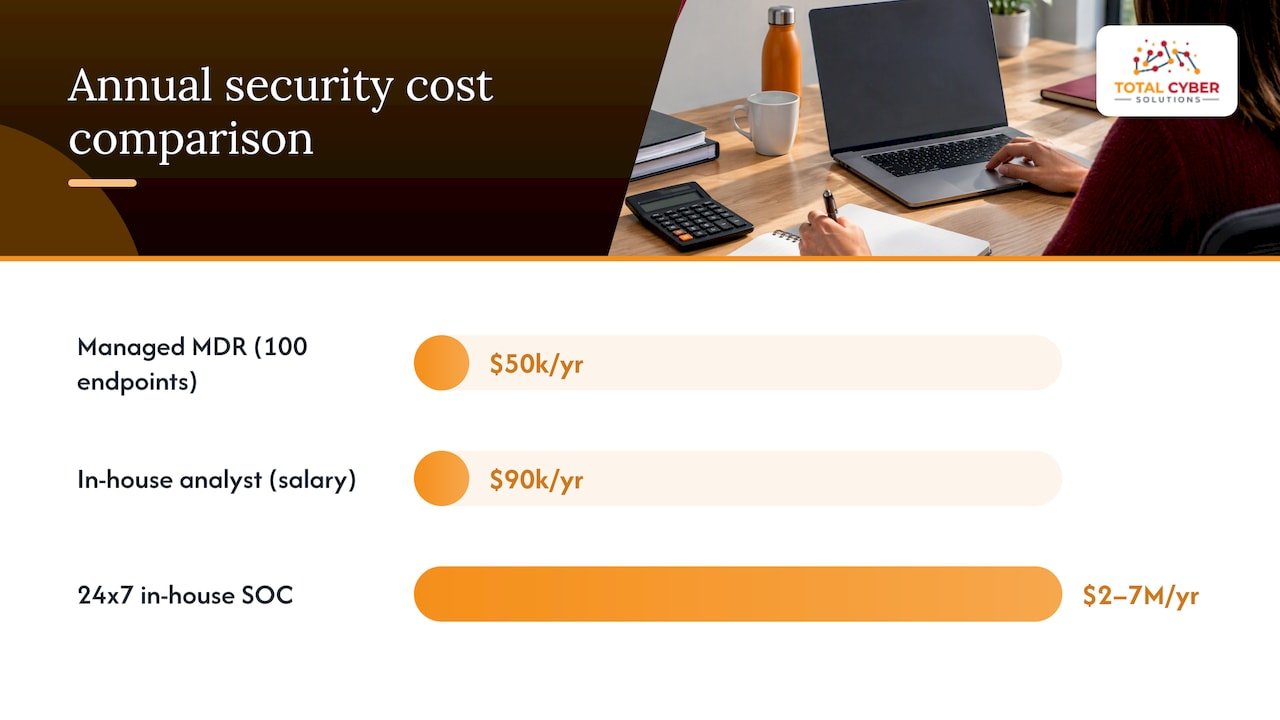
A 100-endpoint SMB comparing options will typically find managed monitoring costs a small percentage of what a staffed, round-the-clock internal SOC would require, which is why most SMBs outsource this function rather than build it. Our small business SOC guide walks through this trade-off in more detail.
Before committing to a contract, negotiate a 90-day pilot and track:
- Mean time to detect and mean time to contain threats
- False-positive rate during the trial period
- Number of incidents caught versus incidents that required escalation
- Compliance readiness improvements you can report to leadership
Our view on pricing transparency and pilots
Too many SMBs sign a monitoring contract based on a glossy pitch deck, then discover the real scope once an incident hits and the provider only alerts instead of acting. Price and protection aren’t the same thing, and a cheap quote that only watches your network isn’t a deal.
We emphasize transparency in pricing. Every pricing conversation typically starts with a pilot period so you can evaluate detection quality and false-positive rates before committing. Quotes are structured to be all-inclusive, aiming to avoid surprise ingestion fees appearing after signing.
— Alden
Ready to see what monitoring actually costs for your business?
The clearest way to know your real number is to test it. We run a 60 to 90 day pilot that validates detection accuracy, false-positive rates, and response SLAs against your actual environment, not a sales demo.
- A defined pilot window with measurable detection and response benchmarks
- Transparent, all-inclusive pricing with no hidden ingestion or integration fees
- A direct path to our managed cybersecurity services if the pilot proves out
Request your pilot or a costed estimate through our MSP discovery form, and if you want to pair it with a focused look at phishing exposure, SmishAlert’s social engineering assessment is a useful complement during that same evaluation window.
FAQ
How much does security monitoring cost per month?
Small businesses commonly pay $1,000 to $4,000 a month, while mid-sized companies often spend $5,000 to $30,000 depending on endpoint count and service depth. Larger or compliance-heavy organizations frequently exceed $30,000 a month once active response and extended retention are included.
Is MDR more expensive than basic monitoring?
Yes, because MDR includes live containment, threat hunting, and incident response rather than just alerts. Basic MDR for a small organization with around 100 endpoints runs near $50,000 a year, while very large environments can incur significantly higher costs.
Is it cheaper to build an in-house SOC or outsource monitoring?
Outsourcing is almost always cheaper for SMBs. A staffed, round-the-clock in-house SOC can cost between $2 million and $7 million a year, far beyond what most mid-sized businesses spend on a managed contract.
What hidden fees should I watch for in a monitoring quote?
Look for log ingestion and storage charges, onboarding or integration fees, and licensing pass-throughs for EDR or cloud connectors. Ask your vendor to itemize recurring versus one-time costs so nothing surprises you after signing.
Should I negotiate a pilot before signing a monitoring contract?
Yes, a 60 to 90 day pilot lets you measure detection accuracy, false-positive rates, and response times before committing to a full contract. It also gives you leverage to negotiate SLA terms based on real performance rather than vendor promises.
Sources
- Protecting Against Cyber Threats to Managed Service Providers and their Customers | CISA
- Managed Detection and Response (MDR) Statistics and Trends in 2025
- NDISAC SMB WG MSP Shopping Questionnaire (v7.1, 2025)